 Colonial Voyage The website dedicated to the Colonial History
Written by Marco Ramerini. English text revision by Dietrich Köster.
The Florentine Amerigo Vespucci, on 1 January 1502, came to a gulf at 13° latitude south, to which he gave the name Bahia de Todos Santos, on the shores of which the city of Bahia now stands. Salvador was founded in 1549 by Tomé de Souza, the first governor-general of Colonial Brazil, and remained the capital of Portuguese Brazil until 1763.
During colonial times the city was invaded by the Dutch, who occupied Salvador for about a year in 1624/1625. Later they made several other attempts to take the city in 1638 and 1647. The growth of the capital city of Salvador came with the sugar plantations at the end of the 16th century and continued throughout the 17th century. Bahia became the most prosperous and important slave trade center not only in Brazil but in all of the Americas.

Cloister of the Convento (Convent) de São Francisco, Igreja de São Francisco, Salvador (Bahia), Brazil. Author and Copyright Marco Ramerini
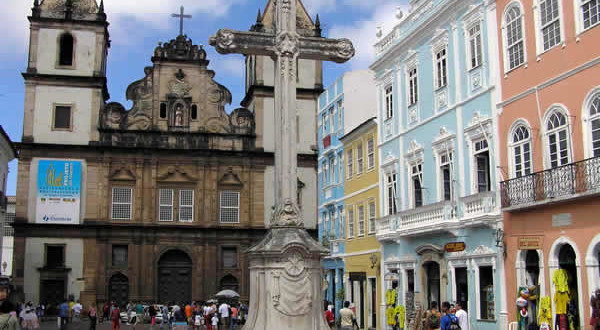
Today Salvador preserves in his historic centre, the “pelourinho”, his historical colonial architectural monuments, magnificent mansions, baroque churches and forts. Restoration projects have recuperated the glory of many of the oldest buildings. Among the finest worth to be be mentioned are the Convent and Igreja de São Francisco, a baroque church with a beautiful azulejos cloister. Forced to build their masters’ church and yet prohibited from practising their own religion (Candomblé), the African slave artisans responded through their work: the faces of the cherubs are distorted, some angels are endowed with huge sex organs, some appear to be pregnant. Another beautiful church is the Igreja da Ordem Terceira de São Francisco, Salvador (Bahia). This church is adjacent to Igreja de São Francisco and it was constructed in 1702. It has a gorgeous sandstone facade, which is unique in Brazil. The facade remained hidden until it was accidentally discovered in the 1930s.

Igreja da Ordem Terceira de São Francisco, Salvador (Bahia). Author and Copyright Marco Ramerini
The Basílica do Senhor Bom Jesus do Bomfim, Salvador (Bahia) is a 18th-century church that houses a curious room called Sala dos Milagres (Room of Miracles), where people leave votive offerings in thanks for cures. The votives forming a rather bizarre collection of hanging plastic replicas of multitudinous problematic body parts. The Mercado Modelo is the major craftsmanship pole in Salvador, built in 1861 to be a Customs House, nowadays it has 259 stalls, which offer every kind of popular production in leather, straw, tissue, wood, laces, semiprecious stones and silver, besides candies, fruits in syrup and craft drinks.
This is the text design of the inscription of the Historic Centre of Salvador da Bahia in the UNESCO list of the World Heritage Monuments: “As the first capital of Brazil, from 1549 to 1763, Salvador da Bahia witnessed the blending of European, African and Amerindian cultures. It was also, from 1558, the first slave market in the New World, with slaves arriving to work on the sugar plantations. The city has managed to preserve many outstanding Renaissance buildings. A special feature of the old town are the brightly coloured houses, often decorated with fine stucco-work.”
-
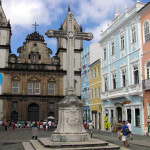
- Convent and Igreja de São Francisco, Salvador de Bahía, Bahía, Brazil. Author and Copyright Marco Ramerini.
-
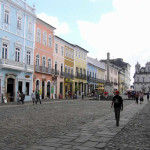
- Pelourinho, Salvador de Bahía, Bahía, Brazil. Author and Copyright Marco Ramerini….
-
- A beach, Salvador de Bahía, Bahía, Brazil. Author and Copyright Marco Ramerini..
-
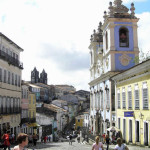
- Pelourinho, Salvador de Bahía, Bahía, Brazil. Author and Copyright Marco Ramerini
-
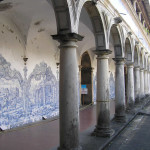
- Cloister of the Convento (Convent) de São Francisco, Igreja de São Francisco, Salvador (Bahia), Brazil. Author and Copyright Marco Ramerini
-
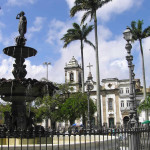
- Igreja da Ordem Terceira de São Domingos (1731-1737), Terreiro de Jesus and Praça da Sé, Salvador (Bahia), Brazil. Author and Copyright Marco Ramerini
-
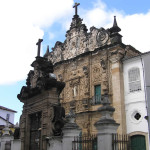
- Igreja da Ordem Terceira de São Francisco, Salvador (Bahia). Author and Copyright Marco Ramerini
-
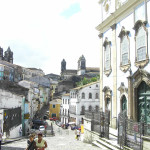
- Pelourinho, Salvador (Bahia), Brazil. Author and Copyright Marco Ramerini
-
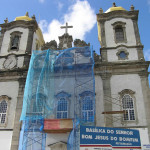
- Basílica do Senhor Bom Jesus do Bomfim, Salvador (Bahia), Brazil. Author and Copyright Marco Ramerini
-
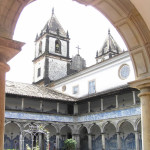
- Cloister of the Convento (Convent) de São Francisco, Igreja de São Francisco, Salvador (Bahia), Brazil. Author and Copyright Marco Ramerini.