Categories
Indonesia Portuguese Colonialism Portuguese language

Portuguese influence in Sikka District, Flores Island, Indonesia
Written by : Francisco Soarez Pati, S.H

Email: fransisco78@gmail.com

Photos by Fransisco Soarez Pati, S.H

The Portuguese was the first Europeans country to conquer a number of areas in the Nusantara. The territory that was conquered by the Portuguese was then captured by the Dutch by war, negotiation, deceit, fighting and buying and selling under the guise of exchanging colonial territories. The territories that were contested by the Portuguese and the Dutch later became part of the largest archipelagic country in the world, called the Unitary State of the Republic of Indonesia.

The presence of the Portuguese in the XV to XVII centuries in a number of Nusantara areas, including Aceh, Java, Ternate, Tidore, Makasar, Manado, Solor, Adonara, Alor and it’s surroundings, the islands of Timor and Flores in general, especially in Sikka district, East Nusa Tenggara province, Indonesia does not apart from the mission of the Portuguese colonial nation at that time, namely Feitaria, fortaleza, a Igreja which means trade, military domination and evangelization. In the English version of Feitaria, Fortaleza, a Igreja later interpreted as Gold, Glory, Gospel.

In Sikka district in the island of Flores Island, East Nusa Tenggara Province beside from the villages of Sikka and Paga which are widely known as former Portuguese colonial territories which regulated in an agreement called Tratado Demarcação E Troca De Algumas Possessoes Portuguese E Neerlandezas No Archipelago De Solor E Timor which means Agreement on Demarcation and Exchange of Some Portuguese and Dutch Ownerships in the Solor and Timor Islands which was signed by Dom Pedro V and Mauricio Helderwier on 20 April 1859, it turns out that there are still a number of other places which at least had Portuguese influence, such as Bola sub-district and Kewapate sub-district and a source of fresh water on the northern coast of the island of Flores named Wair Noke Rua which means spring of saint. Located 12 km from the city of Maumere to the north of the island of Flores, the place is believed to be the place where Saint Francis Xavier stopped on his voyage from Ternate to Malacca at that time to fill up supplies.

Although currently there is no colonization around the world, the traces and Portuguese influences in Sikka Regency can be found to this day, namely an Old Church in Sikka village, a number of heirlooms were brought by King Dom Alexius Ximenes da Silva from Malacca such as a helmet, two necklaces, a scepter all of which were made of gold. The heirloom was given by the Portuguese when he crowned Dom Alexius Ximenes da Silva as king. As a form of gratitude, the Portuguese were then given a number of these items along with partial hegemony rights in and around Sikka. Beside that there is a vacant lot which local people in Paga believed as a place that the Church was founded by the Portuguese which the local people call the Manu Church, a grave stone. the place believed to be the burial place of 2 Portuguese people, the Bobu dance and Portuguese cannon in Paga sub-district.

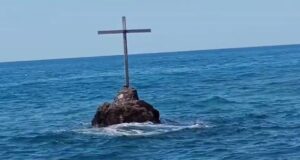
In Sikka district there is also a rock on the southern coast of the Sawu Sea in Bola sub-district. In the sixteenth century the Portuguese planted a cross on the rock which the local people called Watu Cruz (Stone of the Cross), and also the name of the sub-district of Queva–Pantai (Kewapante) and Portuguese clans such as Da Gama, Da Silva, Da Gomez, Da Cunha, Da Lopez, Da Costa, Da Rato, Parera, Fernandez, Carwayu (Carvalho), Rodriquez Kondi (Conde) as well as a number of nicknames such as Samador (Semeador), Don, Ximenes, Menina, Soares, Alvares, Tavares, Pedro, Jasinta, Jose, Maria, Edmundus (Edmundo), et cetera.

Grave stone, is believed to be the burial place of 2 Portuguese people who were beheaded by Anthony Da Costa or Mamo Ndona. Photo Fransisco Soarez Pati, S.H,

One of the Portuguese heritage that has integrated into the culture of the people of Sikka Regency up to now is the use of a number of vocabularies in daily communication in the Sikka regional language (Krowe) which have been spoken from generation to generation since the fifteenth century.

A number of Portuguese vocabularies that have been integrated into the culture of the Sikka Regency communities, including Misa means the celebration of the Eucharist in the Catholic liturgy, Gereja from the word of Igreja which means Church, Cruz from the word of Cruz meaning Cross, Sumana from the word of Semana meaning Week, Semana Santa from the word of Semana Santa meaning Holy Week, Segunda from the word of Segunda meaning Monday, Terça-feira from the word of Terça feira meaning Tuesday, Quarta from the word of Quarta meaning Wednesday, Quinta from the word of Quinta meaning Thursday, Sesta from the word of Sexta Feira meaning Friday, Sabut from the word of Sábado meaning Saturday, Duminggu from the word of Domingo meaning Sunday, Seu from the word of Ceu meaning Heaven, Anjo from the word of Anjo which means Angel, Anjo Da Guarda from the word of Anjo Da Guarda which means Guardian Angel, Plender from the word of Aprender which means learning, Jentiu from the word of Gentios (non-Jewish). In the Sikka language “jentiu” is identified with a lazy people going to Church, and then Santa from the word of Santa means saint (for female), Santo from the word of Santo means saint (for male), Bola from the word of Bola means ball, Siruwisu from the word of Serviço means serving in the sense of livelihood or work, Kadera from the word of Cadeira meaning chair, lemari from the word of Almario meaning cupboard, Armada from the word of Armada meaning fleet, bendera from the word of Bandeira meaning flag, Violin from the word of violin meaning violin, boneka from the word of Boneca meaning doll, Dadu from the word of Dados meaning dice, Dansa from the word of Dança meaning dance, Kama from the word of Cama meaning bed, Ganco from the word of Gancho meaning ganco, Jendela from the word of Janela meaning window, kemeja from the word of Camisa meaning shirt, kertas from the word of Carta meaning letter, lentera from the word of lenterna meaning lantern, meja from the word of Mesa meaning table, mentega from the word of Manteiga means butter, Nona from the word of dona means miss, permisi from the word of Permissão which means permission, pesta from the word of festa means party, sabang from the word Sabão means soap, serdadu from the word Soldado means soldier, terigu from the word of Trigo means wheat, tinta from the word of Tinta means ink, Lesu from the word of Lenço means handkerchief, Bako from the word of tabaco means cigarette, Tapioca from the word of Tapioca means a starch extracted from cassava root, sepatu from the word of Sapato means Shoes, Salto from the word of salto means somersault, Rosario from the word Rosario of means rosary, pesir from the word of Passear which means traveling, Peniti from the word of Alfinete which means pin, markisa from the word Maracujá means Passion fruit, mandor from the word of Mandador meaning foreman, Martir from the word of Mártir meaning Martyr, Kapitan from the word of capitão meaning lieutenant, Gudang from the word of gudão meaning warehouse, Botir from the word of botelha meaning bottle, Aula from the word of Aula meaning hall, Akta from the word of Acta means certificate, Politik from the word of Politico means politics, Maitua from the word of Mãe means mother (dedicated to young women), Paitua from the word of Pai means father (dedicated to youth), Tripleks from the word of Triplex means triplex, Ara from the word of Arroz means rice, garpu from the word of Garfo means fork, Pasku from the word Pascoa meaning Easter, Natal from the word Natal meaning Christmas, cantar from the word Canta meaning sing, and the last is Mate from the word of Morto means death.

Vacant land is a former Portuguese Church,The Paganess believe in this place the Catholic Church was built in the 17th century. Now the Church building is no longer.  Photo Fransisco Soarez Pati, S.H,
Vacant land is a former Portuguese Church,The Paganess believe in this place the Catholic Church was built in the 17th century. Now the Church building is no longer. Photo Fransisco Soarez Pati, S.H,

In addition, one of the Portuguese colonial heritages that is deeply rooted in the life of the people of Sikka district and the people of the island of Flores island, Indonesia is Catholicism. The journey of Catholicism on the islands of Flores, Solor, Adonara, Lembata and it’s surroundings has a long history. At the time of negotiations to follow up the agreement on the sale of Portuguese colonial territories throughout the islands of Flores, West Timor, Solor, Adoara, Alor and Pantar which became known as Tratado Demarcação E Troca De Algumas Possessoes Portuguese E Neerlandezas No Archipelago De Solor E Timor, which means Agreement Demarcation and Exchange of Some Portuguese and Dutch Ownerships in the Solor and Timor Islands that has signed by Dom Pedro V and Mauricio Helderwier on 20 April 1859, the Dutch Parliament objected because in the agreement the Portuguese did not give freedom to the Dutch to carry Protestant missions (Zendeling) on ​​the island of Flores and it’s surroundings. On the other hand, the Portuguese remained in their stance that the Catholic religion which had been introduced to the people in Flores island and it’s surroundings should remain the religion of the people.

Instead, the Dutch were given the freedom to carry out Protestant missions in the western part of the island of Timor and the surrounding islands. The spread of Protestantism can be seen from the identity of the people in the province of East Nusa Tenggara in the western part of the island of Timor, namely parts of the districts of North Central Timor, South Central Timor, Kupang, Sabu, Rote, Sumba and the Alor archipelago, where the majority of modern society is currently Protestant. Meanwhile, the people of Flores, Solor, Adonara, Lembata and the surrounding islands are Catholic.

Karel Steenbrink in his book entitled Catholics in Indonesia, Volume I, the publisher of Ledalero, Maumere, stated that the principle of the Portuguese colonial nation at that time was “the flag may be changed, but religion should not be changed. Roman Catholicism must be preserved as before” (O catolicismo Romano deve ser preservado como antes). Catholicism then took root in the community of Sikka district in particular and the people of the island of Flores and it’s surroundings in general and remains the religion of the majority of the community. Without the Portuguese, the people of the islands of Flores, Solor, Adonara, and Lembata in Indonesia probably would not have known Catholicism today (Sem os Portugueses, o povo das ilhas das Flores, Solor, Adonara e Lembata talvez não saber do catolicismo hoje).

BIBLIOGRAPHY :

  • (1861), Tratado Demarcação E Troca De Algumas Possessoes Portuguese E Neerlandezas No Archipelago De Solor E Timor, Entre Sua Magistrade El-Rei De Portugal E Sua Magistade El Rei De Paizes Baixos, Assignado Em Lisboa Pelos 20 Abril, 1859
  • António d’Oliveira Pinto da França, Pengaruh Portugis Di Indonesia, Cetakan Pertama, PT. Penebar Swadaya, , 2000, translated by Katoppo from the original title “Portuguese Influenced in Indonesia”, Calouste Gulbenkian Foundation, Lisabon, 1985
  • Joaquim Magalhães de Castro, Lautan Rempah Peninggalan Portugis di Nusantara, PT. Elexmedia Computindo, 2019
  • Karel Steenbrink, Orang-Orang Katolik Di Indonesia, 1808-1942, Sebuah Profil Sejarah, Jilid I, Penerbit Ledalero, Cetakan I, April, 2006.
Categories
East Timor India Macau Portuguese Colonialism Portuguese language

The Role of the Portuguese Language in Lusophone Asia

Written by Dietrich Köster

Portuguese India/Estado da Índia Portuguesa – Goa, Daman/Damão and Diu

Until the invasion of Nehru’s troops in December 1961 Portuguese was the official language, while after the annexation English received this status. The local languages Konkani in Goa and Gujarati in Damão and Diu only play a minor role in public life. Even during the Portuguese time there were more secondary schools with English as teaching medium in Goa than those with Portuguese as language of instruction. Since the annexation the Portuguese language is only offered as a second or third language subject in some schools.

The last Portuguese-language newspaper completely switched to English at the beginning of 1984. Thus “O Heraldo” changed its title to “Herald”. The newspaper “A Vida” ceased to appear altogether. Today there are only papers in English and in Indian languages. The sole reading material in Portuguese I could acquire in a bookshop was a series of five volumes of textbooks for learning Portuguese “UM PASSO NOVO”. Additionally the opportunity to study Portuguese is offered at the University of Goa. The lecturer appointed by the Instituto Camões Dr Lume told me that he is in charge of more than 60 students.

The official Portuguese presence in Goa is nowadays limited to a Consulate-General and a newly opened branch of the Portuguese cultural institution Fundação do Oriente. Today the knowledge of the Portuguese language is mainly limited to the Christian part of the local elder generation.

Macau

The Chinese are by 97% the overwhelming part of the population, followed by 2% Portuguese. The latter are often sent from Portugal for a fixed period to serve in the public administration or in educational institutions. Until 1991 Portuguese was the only official language. Since this year Chinese has the same status. In everyday life you can make yourself understood everywhere in Chinese, whereas the chance to make use of Portuguese is possible only to a limited extent, the English language being as business language a strong competitor to the official language of European origin, simply due to the proximity of Hongkong. In the past the Portuguese administration of Macau practised a deplorable neglect in Portuguese language matters. Only in the few Portuguese or Luso-Chinese schools Portuguese is the teaching medium or a compulsary subject respectively. In the numerous Chinese schools Portuguese is just offered as an optional subject. Nevertheless all public notices and signposting – also regarding the shops – are always designed in both official languages.

Portuguese Timor – East Timor

Even the young generation, who has not witnessed the Indonesian invasion in 1975, is engaged in selfdetermination and independence of East Timor, although most young people have little or no knowledge of Portuguese. The Indonesian school system does not provide instruction in this language. Instead all pupils and students have to learn the language Bahasa Indonesia, which is based on the Malay language. The sole group of people, who wholeheartedly welcomed the integration of East Timor into the Indonesian state, are the migrants, who were sent by the Jacarta government to East Timor in the framework of the resettlement scheme “Transmigrasi”. In contrast to the Timorese of the elder and middle generation this group of people do not know a single word of Portuguese. Thus they are easy to spot as people from another country, having replaced the Chinese business community to a great extent, who had fled to Australia in 1975.

All inscriptions in the public sphere and every publication are exclusively carried out in Bahasa Indonesia. There are no publications in Portuguese accessible to the general public. Just the names of the streets were kept from the Portuguese time, while placing instead of “rua” or “avenida” the Indonesian word “jalan” in front. As only other lasting memory there are several monuments with Portuguese inscription. One of them is commemorating the fifth centenary of the death of Henry the Navigator in 1960.

As an outstanding personality I met Father Eduardo Brito of the Catholic parish of Balide in Díli. He had come from Margão/Goa to Portuguese Timor in a group of 40 priests in 1947. Only three priests are still alive and remain active in their adopted country. For his many years of great merits Father Brito was honoured by governor Abílio José Osório Soares in 1995 by installing a monument with his bust already during his lifetime. His final resting this priest will find in a crypt in front of this monument.

Situation as of mid-1997

Categories
Portuguese Bibliographies Portuguese language

Portuguese Language in Asia, Africa, America. Bibliography of Portuguese Colonial History 16th-18th century

Written by Marco Ramerini. English text revision by Dietrich Köster.

PORTUGUESE LANGUAGE IN ASIA:

– Various Authors, “Actas do Congresso sobre a situação da língua portuguesa no Mundo” ? Imprensa National, 1983, Lisboa, Portugal.

– Various Authors “Resquícios de Português na ilha de Flores (Indonésia)”, in: “Boletim de Estudos Crioulos, suplemento de Papia” n°1, 1994 Brasília

– Abdurachman, Paramita Rahayu “Some Portuguese loanwords in the vocabulary of speakers of Ambonese Malay in Christian villages of the Central Moluccas”, 17 pp., LIPI, 1972, Jakarta, Indonesia.

– Asiff, Hussein “Language and lore of the Creole people”, in: “Sunday Observer”, 17 September 2000

– Bartens, Angela “Die iberoromanisch-basierten Kreolsprachen” 345 pp., (Hispano-Americana 8), Peter Lang, 1995, Frankfurt am Main/New York. The following languages are examined: 1. Kabuverdianu, 2. Kriôl, 3. Sãotomense/Forro, 4. Angolar, 5. Principense, 6. Annobonense/Fa d’Ambu, 7. Afrikaans, 8. Indo-Portuguese, 9. Sri Lanka creole Portuguese, 10. Malayo Portuguese (Papia Kristang and the regional Portuguese of East Timor), 11. Chabacano, 12. Macaísta, 13. Brazilian Portuguese, 14. Fronteirizo, 15. Saramakka, 16. Papiamentu, 17. Palenquero, 18. Caribbean Spanish (insular and extra-insular).

– Baxter, Alan “Notes on the Creole Portuguese of Bidau, East Timor” pp. 1 – 38 JPCL (Journal of Pidgin and Creole Languages) N° 5/1 (April 1990), John Benjamins Publishing Company This paper discusses a variety of Southeast Asian Creole Portuguese formerly spoken in Bidau, Dili, East Timor. It is found that the language of Bidau is closely related to the creoles of Malacca and Macao.

– Bravo da Costa Rodrigues, Maria de Lourdes “La chronique universitaire. The status of the Portuguese language and some other cultural aspects in Goa” in: “Lusotopie 2000” pp. 597-610

– Burnell, A. C. and Yule, H. “Introduction. Hobson-Jobson: a glossary of colloquial Anglo-Indian words and phrases, and of kindred terms, etymological, historical, geographical and discursive”, Murray, 1903, London.

– Cahen, M – Couto, D. – Desouza, P. R. – Marrou, L. – Siqueira, A. “Issues of Asian Portuguese-speaking spaces and Lusotopias” in: “Lusotopie 2000” pp. 137-158

– Clancy, Clements “The genesis of a language: the formation and development of Korlai Portuguese” XII, 281 pp. maps, Creole language library vol.16, Benjamins, 1996, Amsterdam and Philadelphia.

– Clancy, Clements “Efeitos dos processos de adoção de uma nova língua e de empréstimo lingüístico na fonologia do português de Korlai” in: “PAPIA Revista de Crioulos de Base Ibérica”, Universidade de Brasília, Volume 3, nº 1, 1994

– Dalgado, S. R. “Estudos sobre os Crioulos Indo-Portugueses” 187 pp. Comissão Nacional para as Comemorações dos Descobrimentos Portugueses 1998 Lisbon, Portugal. Dialecto Indo-Português de Goa; Dialecto Indo-Português de Damão; Dialecto Indo-Português do Norte; Dialecto Indo-Português de Negapatão; Berço duma cantiga em Indo-Português. The latest edition of the interesting study of Sebastião Rodolfo Delgado on the Creole languages of Goa, Damão, Negapatão and the Northern Province of India.

– Dalgado, Sebastião Rodolfo, “Dialecto Indo-Português de Ceilão”, 301p. (Cadernos Ásia) CNCDP, 1998, Lisboa, Portugal.

– Daus, Ronald “Portuguese Eurasian communities in Southeast Asia” 83 pp. Institute of Southeast Asian Studies, 1989, Singapore. The Portuguese Eurasian communities in Malacca, Tugu, Larantuka and Singapore.

– Goonatilleka, M.H. “A Portuguese Creole in Sri Lanka: A Brief Socio-Linguistic Survey”, in: Sousa, Teotónio R. de (ed.) “Indo-Portuguese History. Old Issues, New Questions (3 th ISIPH )” pp. 147-180 Concept, 1985, New Delhi, India.

– Hettiarachchi, A. S. “Influence of Portuguese on the Singhalese Language”, JCBRAS Vol. IX, 1965, pp. 229-238

– Hull, Geoffrey “Tetum and other languages of East Timor” In: “A course in Tetum-Praça (The Lingua Franca of East Timor)

– Hull, Geoffrey “The Languages of East Timor. Some Basic Facts” Internet article: Academy of East Timor Studies, University of Western Sydney Macarthur, 1999, Australia.

– Hull, Geoffrey “Current language issues in East Timor” Public lecture given at the University of Adelaide, 2000, Australia.

– Jackson, Kenneth David “Sing without a shame: oral traditions in Indo-Portuguese creole verse: with transcription and analysis of a nineteenth-century manuscript of Ceylon Portuguese Creole”, XXVII, 257 pp., Creole Language Library, Benjamins, 1990, Amsterdam and Philadelphia.

– Jackson, Kenneth David “O folclore do Crioulo Português da Índia e do Sri Lanka”, in: “Actas do Congresso sobre a situação da língua portuguesa no Mundo” vol. 1 pp. 339-346, Imprensa Nacional, 1983, Lisbon, Portugal.

– Jackson, Kenneth David “Canta sen vergonya: Portuguese Creole verse in Sri Lanka”, pp. 31 – 48 JPCL (Journal of Pidgin and Creole Languages) N° 2/1 (1987), John Benjamins Publishing Company This study analyzes the oral traditions of Sri Lanka Creole Portuguese. The Creole of the Burghers of Batticaloa and Trincomalee and the Kaffirs of Puttalam. This study also presents for the first time a unique source from the H. Nevill collection at the British Library, which is an extensive manuscript of Sri Lankan Creole texts from the 1870s or 1880s written in Dutch orthography and including material subsequently published by Schuchardt, Dalgado and others.

– Köster, Dietrich (Deutsche Gesellschaft für die afrikanischen Staaten portugiesischer Sprache), “Política linguística de Timor-Leste: a reintrodução do português como língua oficial e de ensino”, Estudos de Línguas e Culturas de Timor-Leste/Studies in Languages and Cultures of East Timor, no. 6, 2004, pp. 1-7, Instituto Nacional de Linguística da Universidade Nacional Timor Lorosa’e, Dili, East Timor.

– Lopes, David “A Expansão da Língua Portuguesa no Oriente durante os Séculos XVI, XVII e XVIII”, 265 pp., Portucalense Editora, 1969, Porto, Portugal.

– Lutz, Nancy Melissa “Colonization, decolonization and integration: language policies in East Timor, Indonesia”, Paper presented at the annual meeting of the American Anthropological Associacion Chicago, November 20, 1991. 1995 version

– Matos, Luís de, “O português, língua franca no Oriente” In: “Colóquios sobre as províncias do Oriente” Vol. 2, Junta de Investigações do Ultramar, 1968, Lisboa. – pp. 11-23, (Estudos de Ciências Políticas e Sociais; 81)

– Pinharanda Nunes, Mário, “Concepção de tempo e espaço no kristang e no malaio”, in: “PAPIA Revista de Crioulos de Base Ibérica” Universidade de Brasilia, Volume 3, nº 2, 1994

– Rouillé Correia, Ana Cristina “O ensino do Português em Macau”, in: 6º Congresso da Associação Internacional de Lusitanistas, Universidade Federal do Rio de Janeiro – Universidade Federal Fluminense, Rio de Janeiro, 8 a 13 de agosto de 1999

– Santa Maria, L. “I prestiti portoghesi nel malese-indonesiano” 130 pp. (Pubblicazione del Seminario di Indianistica I), 1967.

– Silva Jayasuriya, Shihan de, “Indo-Portuguese of Ceylon: a contact language”, 188 pp., Athena Publications, 2001, London, United Kingdom.

– Silva Jayasuriya, Shinhan de, “The Sri Lanka Portuguese Creole, manuscript in the Hugh Nevill collection”, Article in: “Sunday Island” 25-07-1999, Colombo, Sri Lanka.

– Silva Jayasuriya, Shinhan de, “Sri Lanka Portuguese Creole verses”, Article in: “Sunday Island” 25-07-1999, Colombo, Sri Lanka.

– Silva Jayasuriya, Shinhan de, “English borrowings in Sri Lanka Portuguese Creole”, Internet article.

– Silva Jayasuriya, Shihan de, “Sri Lanka Portuguese creole: A language in eclipse”, Article in: “The Island”, 16-07-2000, Colombo, Sri Lanka.

– Silva Jayasuriya, Shihan de “Portuguese in Sri Lanka: influences of substratum languages”, in: Journal of the Royal Asiatic Society, series 3, 9, part 2, 1999, pp. 251-270

– Silva Jayasuriya, Shihan de, “Portuguese and English translations of some Indo-Portuguese songs in the Hugh Nevill collection”, in: Journal of the Royal Asiatic Society Sri Lanka, 1995, XL, pp. 1-102

– Silva Jayasuriya, Shihan de, “Indo-Portuguese songs of Sri Lanka: the Hugh Nevill manuscript”, in: Bulletin of the school of Oriental & African Studies, University of London, 1996, LIX, 2, pp. 253-267

– Silva Jayasuriya, Shihan de, “Hugh Nevill collection of Indo-Portuguese verses: Portuguese and English translations of Oersaan and Falentine”, in: Journal of the Royal Asiatic Society Sri Lanka, 1997, XLII, pp. 107-211

– Silva Jayasuriya, Shihan de, “On the Indo-Portuguese of Ceylon: a translation of a Hugo Schuchardt manuscript”, in: “Portuguese Studies”, University of London, King’s College, 1999, 15, 5269.

– Silva Rego, Padre António da, “Dialecto Português de Malaca e outros escritos, 304 pp. (Cadernos Ásia) CNCDP, 1998, Lisboa, Portugal. Dialecto Português Malaca; A Comunidade Luso-Malaia de Malaca e Singapura; A cultura portuguesa na Malaia e em Singapura. – Smith, Ian R, “Sri Lanka creole Portuguese phonology”, iv, 160 pp. Dravidian Linguistics Association,1978, Trivandrum, India. Also in: “International Journal of Dravidian Linguistics ” n° 7, 1978, pp. 248-401

– Smith, Ian R., “The development of morphosyntax in Sri Lanka Portuguese” ?, —– in: “York Linguistics Studies” series 11, 1984, pp. 291-301

– Smith, Ian R., “Convergence in South Asia a creole example” in: “Lingua” n° 48, 1979, pp. 193-222

– Teixeira, Pe. Manuel “The Influence of Portuguese on the Malay Language”, in: “Journal of the Malayan Branch of the Royal Asiatic Society”, 1962, vol. XXXV (Pt. 1).

– Thananjayarajasingham, S. and Goonatilleka, M., “A Portuguese creole of the Burgher community in Sri Lanka”, in: “Journal of Indian Anthropological Society” 1976, 11 (3) pp. 225-236

– Theban, Laurentiu “Situação e perspectivas do português e dos crioulos de origem portuguesa na Índia e no Sri-Lanka” , in: “Actas do Congresso sobre a situação da língua portuguesa no Mundo” vol. 1 pp. 269-285 Imprensa National, 1985, Lisbon, Portugal.

– Williams, Lea E. “The Portuguese Contribution to the Former Trade Language of the China Coast”, in: Various Authors “Vice-Almirante A. Teixeira da Mota in Memoriam” vol. I, 223-228 pp. Academia da Marinha / IICT, 1988, Lisbon, Portugal.

PORTUGUESE LANGUAGE IN AFRICA:

– Chataigner, Abel “Le créole portugais du Sénégal: observations et textes” ?, in: Journal of African languages Vol. 1,1 1963, pp. 44-71

– Cardoso, Eduardo “O Crioulo da Ilha de São Nicolau de Cabo Verde”, 142 pp., Imprensa Nacional, 1989, Lisbon, Portugal.

– Clemence, J. C. “Rejoinder to Naro’s. “Arguing about Arguin” pp. 119-124 JPCL (Journal of Pidgin and Creole Languages) N° 8/1 (1993), John Benjamins Publishing Company, Amsterdam and Philadelphia.

– Couto, Hildo Honório do. “The genesis of Portuguese creole in Africa”, in: Holm, John & Frank Byrne (eds.).”Atlantic meets Pacific: a global view of pidginization and creolization”, John Benjamins Publishing Company,1993, Amsterdam, The Netherlands, pp. 381-389.

– Dalphinis, Morgan, “African language influences in Creoles lexically based on Portuguese, English and French with special reference to Casamance Kriul, Gambian Krio and Saint Lucia Patwa”, 756 pp. PhD. Thesis, University of London, 1981, London, United Kingdom.

– Ferraz, Luís Ivens “The creole of São Tomé”, 122 pp., Separata African Studies, 37, Witwatersrand University Press, 1979, Johannesburg, South Africa.

– Günther, Wilfried “Das portugiesische Kreolisch der Ilha do Príncipe” Selbstverlag, 1973, Marburg an der Lahn.

– Kihm, Alain “Kriyol syntax: the Portuguese-based Creole language of Guinea-Bissau”, VIII, 310 pp. Creole language library n° 14, John Benjamins Publishing Company, 1994, Amsterdam and Philadelphia.

– Lorenzino, Gerardo A., “The Angolar Creole Portuguese of São Tomé: its grammar and sociolinguistic history”, 290 pp. Unpublished Ph.D. Thesis, City University of New York, 1998, This Thesis deals with the genesis and development of the Angolar Creole Portuguese of São Tomé and Príncipe (Gulf of Guinea), off the coast of West Africa. Angolar is the language spoken by descendants of maroon slaves who escaped from Portuguese plantations on São Tomé in the mid-sixteenth century.

– Lucchesi, D. “The article systems of Cape Verde and São Tomé Creole Portuguese: general principles and specific factors” pp. 81 – 108 JPCL (Journal of Pidgin and Creole Languages) N° 8/1 (1993), John Benjamins Publishing Company

– Maurer, Philippe “L’angolar. Un créole afro-portugais parlé à São Tomé”, Buske, 1995, Hamburg.

– Moreau, Marie-Louise “Destino de uma sociedade, destino de uma língua. Balizas para a história do crioulo português em Ziguinchor” in: “PAPIA Revista de Crioulos de Base Ibérica”, Universidade de Brasília, Volume 3, nº 1, 1994

– Naro, A. J. “Reply and rejoinder. Arguing about Arguin” pp. 109 – 119 JPCL (Journal of Pidgin and Creole Languages) N° 8/1 (1993), John Benjamins Publishing Company, Amsterdam and Philadelphia

– Peck, Stephen Madry “Tense, aspect and mood in Guinea-Casamance Portuguese Creole”, 476 pp PhD. Thesis, University of California, 1988, Los Angeles, USA.

– Perl, Mathias “Acerca de Alguns Aspectos Históricos do Português Crioulo em África”, in: “Biblos”, vol. LVIII (Segunda Parte da Homenagem a M. Paiva Boleo), 1-12 pp. FLUC, 1983, Coimbra, Portugal.

– Perl, Mathias “A reevaluation of the importance of early Pidgin/Creole Portuguese”, pp. 125 – 130, JPCL (Journal of Pidgin and Creole Languages) N° 5/1 (April 1990), John Benjamins Publishing Company, Amsterdam and Philadelphia.

– Ploae-Hanganu, Mariana “Le créole portugais de l’Afrique: sa base portugaise”, 2 vols. (251, 58 f.) : [10] maps, 1991, Lisbon.

– Valkhoff, M. F., “Studies in Portuguese and Creole, With Special Reference to South Africa”, xi+282 pp., 1966, Johannesburg, South Africa.

– Valkhoff, M. F. “New light on Afrikaans and Malayo-Portuguese” ? Peeters, 1972, Louvain, Belgium.

– Washabaugh, William and Greenfield, Sidney M. “The Portuguese Expansion and the Development of Atlantic Creole Languages” In: “Luso-Brazilian Review” n. 18 (2),1981, 225-238 pp.

PORTUGUESE LANGUAGE IN AMERICA:

– Efraim, Frank Martinus “The Kiss of a Slave: Papiamentu’s West Africa Connections”, Ph.D. thesis, University of Amsterdam, 1996, Reprinted with corrections in Curaçao, 1997. This book contains a linguistic study about the origins of Papiamentu, especially considering its connections with other Creole languages.

Categories
Asia Portuguese Colonialism Portuguese language

Portuguese language heritage in Asia

Written by Marco Ramerini. English text revision by Dietrich Köster.

The Portuguese language has been in relation to the trade and colonial expansion of Portugal the trade language of the Indian Ocean shores in the 16th, 17th and 18th centuries. Portuguese was used, at that time, not only in the eastern cities conquered by the Portuguese but was also used by many local rulers in their relations with the other European powers (Dutch, English, Danes etc. ).

In Ceylon, for example, Portuguese was used for all contacts between the Europeans and the local peoples. Several Kings of Ceylon spoke it fluently. Portuguese names were common among the nobility. When the Dutch occupied coastal Ceylon they, particularly under van Goens, took measures to stop the use of Portuguese. However, it had become so well established among the Ceylonese that even the families of the Dutch Burghers started to speak it. In 1704, the Governor Cornelius Jan Simonsz said that “if one spoke Portuguese in Ceylon, one could be understood everywhere”.

Also in the Dutch eastern capital city of Batavia (today’s Jakarta) Portuguese was the spoken language in the 17th and 18th centuries. The religious missions contributed to the great spreading of the Portuguese language. Indeed, as many communities converted to Christianity, they adopted the Portuguese mother tongue. Also the Protestant missions (Dutch, Danish, English…) that worked in India were forced to use Portuguese as their evangelisation language.

The Portuguese language has also influenced many an oriental language. Many Portuguese words were permanently lent to various kinds of Eastern languages such as Indian languages (Bengali included), Swahili, Malay, Indonesian, Japanese, Ceylonese languages, Tetum of Timor and also Afrikaans in South Africa.

Besides, where the Portuguese presence was stronger or lasted longer, flourishing communities of “Casados” and “Mestiços” were developed that adopted a variety of the mother tongue: a kind of Creole Portuguese.

What remains today is very little. However it is interesting to notice that, to this day, there are small communities of peoples spread throughout Asia that continue to use Creole Portuguese, although for many years (for centuries, in some cases) they had no contact with Portugal. Another interesting aspect to contemplate is that, during the best period of Portuguese presence in Asia, the number of Portuguese there was never more than 12.000 to 14.000 souls, including the clergy.

Portuguese-speaking communities in Asia (Blue Present-day places, where Portuguese is spoken. Red Places, where communities used to speak Portuguese). Author Marco Ramerini

TODAY, THERE ARE PORTUGUESE SPEAKING COMMUNITIES IN:

Malacca: (Portuguese Settlement, Praya Lane, Bandara Hilir). About 1000 people speak this Creole Portuguese (Papia Kristang). About 80 % of the older residents of the Portuguese settlement in Malacca regularly speak Kristang. There are also some speakers in today’s Singapore and Kuala Lumpur. Kristang is very close to local Malay in its grammatical structure, but its vocabulary is for 95% derived from Portuguese. Not many years ago, Portuguese was also spoken in Pulau Tikus (Penang) but now it is considered extinct. The Eurasian community has 12.000 members on the Malay Peninsula. Active are MPEA (Malacca Portuguese Eurasian Association) and SPEMA (Secretariat of the Portuguese/Eurasian Malaysian Associations) with seven separate member associations in Alor Star, Penang, Perak, Malacca (MPEA), Kuala Lumpur, Seremban and Johor Baru. There is also a Eurasian Association in Singapore. Portugal lost Malacca in 1641.

Korlai: (near Chaul, India). About 900 monolingual people speak this Creole Portuguese, this community has his Portuguese church called: “Igreja de Nossa Senhora do Monte Carmelo”. Originated around 1520 on the west coast of India. Initially isolated from its Hindu and Muslim neighbors by social and religious barriers, the small Korlai community lost virtually all Portuguese contact as well after 1740. Portugal lost Chaul in 1740.

Damão: (Damão Grande or Praça, Campo dos Remédios, Jumprim, Damão da Cima). About 2000 people speak this Creole Portuguese. Portugal lost Damão in December 1961.

Ceylon: [Portuguese Burghers in Batticaloa (Koolavaddy, Mamangam, Uppodai, Dutch Bar, Akkaraipattu); Trincomalee (Palayuttu); Kaffir communities of Mannar and Puttalam ]. It’s now used at home only. It was spoken by 250 families in Batticaloa as late as 1984. There are still 100 families in Batticaloa and Trincomalee and about 80 Afro-Sinhalese (Kaffir) families in Puttalam. Of about 5.000 Creole people (Batticaloa, Trincomalee), only 500 still speak Creole, the younger generations cannot speak the Creole. < Silva Jayasuriya, 2000 > Nearly extinct. In Batticaloa there is the Burgher Recreio Clube “Shamrock” or “Batticaloa Catholic Burgher Union”. There is a little community of Portuguese descendants in the village of WahaKotte (circa 7°42’N. – 80°36’E) (Central Sri Lanka, six kilometers from Galewala on the road between Galewala and Matale), they are Roman Catholic, but since about two generations Portuguese Creole is no longer spoken. Portugal lost Ceylon in 1658.

Macau: About 2.000 people speak Portuguese as their first language, and about 11.500 as their second language. Only a few elderly women speak Macanese a Macao Creole Portuguese. The “Instituto Cultural de Macau” and the “Fundação do Oriente” are still active. There is also a TV channel and several newspapers entirely in Portuguese. Macau was a Portuguese province. On 20 December 1999 it was reverted to China.

Hong Kong: Several hundred people speak Macanese. Essentially, these are people that emigrated from Macao. There is the “Club Lusitano”. Never under Portuguese rule.

Goa: Portuguese is rapidly disappearing from Goa. It is now spoken only by a small segment of the upper class families and about 3 to 5 % of the people still speak it (estimated at 30.000 to 50.000 people). Today 35% of Goa’s population are immigrants from other Indian states. In the Indian school it is taught as third language (not obligatory). There is a department of Portuguese at the Goa University. However, the “Fundação do Oriente” and the Indo – Portuguese Friendship Society (Sociedade de Amizade Indo-Portuguesa) are still active. The last Newspaper in Portuguese shifted over to the English language in 1983. At Panaji many signs in Portuguese are still visible over shops, administrative buildings etc. Portugal lost Goa in December 1961.

Diu: Here the Creole Portuguese is nearly extinct. According to the testimony of Maria Luiza de Carvalho Armando, its seems that the Creole Portuguese language is still used in Diu and according to her Diu it’s the place in India where the Portuguese legacy is the most durable. (Information obtained from Maria Luíza de Carvalho Armando with thanks.) Portugal lost Diu in December 1961.

Timor: Portuguese was spoken in 1950 by less than 10,000 people and in 1974 by only about 10%-20% of the population. In 1975: East Timor had 700,000 inhabitants from which: 35-70,000 knew how to read and write Portuguese and 100-140,000 could speak and understand it. Until 1981 Portuguese was the church language of Timor, when it was supplanted by Tetum. However, it is commonly used as the business language in the town of Dili. Portuguese remains the language of the anti-Indonesian resistance and that of external communications for the Catholic Church. The Creole Portuguese of Timor (Português de Bidau) is now extinct. It was spoken around Dili, Lifau and Bidau. Indonesia invaded East Timor in 1975. Now Timor is an independent nation. It has adopted Portuguese as an official language alongside Tetum.

Indonesia: Flores island: (Larantuka, Sikka) Here Portuguese survives in the religious traditions and the Topasses community (the descendants of Portuguese men and local women) uses it in the prayers. On Saturdays the women of Larantuka say the rosary in a corrupt form of Portuguese. In the Sikka area of eastern Flores, many of the people of Sikka are descendants from the Portuguese and still??? use that language. There is the Confraternity of “Reinja Rosari”. Larantuka was abandoned by Portugal in 1859.

UNTIL A FEW YEARS AGO, PORTUGUESE SPEAKING COMMUNITIES EXISTED IN:

Ceylon: (Creole Portuguese was used amongst the Dutch Burgher community). Till the beginning of the 20th. century Creole Portuguese was spoken by the members of this community. Untill after the Second World War Sri Lankan Catholics in Colombo met for regular church services conducted in Portuguese (at the parish church of St. Anthony’s, Dematagoda). Up to the middle part of this century prayers were being conducted for diminishing groups in Portuguese at a number of Catholic churches in the city (Dematagoda, Hulftsdorp, Kotahena, Kotte, Nugegoda and Wellawatte). Although a verbal language, Portuguese was fast loosing its original purpose at religious devotions in Catholic churches (to be replaced by English and taken over more fashionably and pursued with greater vigour).

Jakarta-Batavia-Tugu: (a suburb of Jakarta). Here, till the beginning of the 20th. century, a kind of corrupted Portuguese was still spoken by the Christian population in Tugu. The last creol speaking died in 1978. Never under Portuguese rule.

Cochin: (Vypeen). It has disappeared in the last twenty years of the 20th century. The community of Portuguese/Indians (about 2,000 people) has its parish church in the old church of Nossa Senhora da Esperança. Portugal lost Cochin in 1663.

Bombaim or Província do Norte: (Baçaim, Salcete, Thana, Chevai, Mahim, Tecelaria, Dadar, Parel, Cavel, Bandora-Badra, Govai, Morol, Andheri, Versova, Malvan, Manori, Mazagão) In 1906, this Creole was, after that of Ceylon, the most important of Indo-Portuguese Creole. In 1906 there were still 5,000 people who spoke Creole Portuguese as mother tongue, of these 2,000 were in Bombaim and Mahim, 1,000 were in Bandora, 500 in Thana, 100 in Curla, 50 in Baçaim and 1,000 in other villages. There were at that time no Creole Portuguese schools and the well-to-do classes tended towards neglecting its use and preferred English. (Costa, 1892 & Dalgado, 1906)

Coromandel: Coromandel: (Meliapore, Madras, Tuticorin, Cuddalore, Karikal, Pondicherry, Tranquebar, Manapar, Negapatam) On the Coromandel coast the Portuguese descendants were generally known by the name of “Topasses”. They were Catholics and spoke Portuguese Creole. With the coming of the English rule in India, they began to speak English instead of Portuguese and also anglicized their names. They are now part of the Eurasian community. In Negapatam, in 1883, there were still 20 families that spoke Indo-Portuguese. (Schuchardt, 1883 & Dalgado, 1917)

HAVE DISAPPEARED FOR MANY YEARS THOSE OF:

Solor & Adonara: Solor, Adonara (Vure) islands on Lesser Sunda islands, Indonesia.

Batavia, Java island: (Dutch community of Batavia, Mardijkers) The Mardijkers are the descendants of the old slaves from Malacca, Bengal, Coromandel, Malabar, that were converted to Protestantism, for which they were set free. They spoke a Creole form of Portuguese and were the main group of the Portuguese community of Batavia. After the Dutch conquest of Malacca and Ceylon their number increased considerably. In 1673 a Protestant church was built in Batavia for the Portuguese community and later, at the end of the XVII century, a second church was built. In 1713 this community had about 4,000 members. (Lopes) Until 1750 Portuguese was the first language in Batavia, but after that date Malay started to dominate. In 1808 Reverend Engelbrecht celebrated the last mass in Portuguese. In 1816 the Portuguese community was incorporated into the Malay community. Also in the Dutch families of Batavia the Portuguese language was vividly used until 1750, in spite of the efforts of the Dutch Government against its use.

Mangalore: A port-city on Karnataka coast.

Cannanore: A port-city on Kerala coast.

Bengal: Bengal: (Balasore, Pipli, Chandernagore, Chittagong, Midnapore, Hugli……) The Portuguese language was in the 17th and 18th centuries the “lingua franca” in Bengal. Up to 1811 Portuguese was used in all Christian churches in Calcutta (Catholics and Protestants). At the beginning of the 20th century only in a few families a corrupted form of Portuguese was spoken, largely mixed with English words. (Campos, 1919)

Moluccas: (Ternate, Ambon, Banda, Makasar) TERNATENO, a Creole Portuguese was spoken on the islands of Ternate and West Halmahera, which is now extinct. AMBON, the Creole Portuguese is extinct, but some traces of Portuguese are in the language now spoken on Ambon, the Malay-Ambon, which has about 350 words of Portuguese origin.

Along the Indian Ocean shores there were about 44 communities where Portuguese was spoken.

BIBLIOGRAPHY:

– Abdurachman, Paramita Rahayu “Some Portuguese loanwords in the vocabulary of speakers of Ambonese Malay in Christian villages of the Central Moluccas”
17 pp. LIPI, 1972, Jakarta, Indonesia.

– Clancy, Clements “The genesis of a language: the formation and development of Korlai Portuguese”
XII, 281 pp. maps, Creole language library vol.16, Benjamins, 1996, Amsterdam and Philadelphia.

– Dalgado, S. R. “Estudos sobre os Crioulos Indo-Portugueses” 187 pp. Comissão Nacional para as Comemorações dos Descobrimentos Portugueses 1998 Lisboa, Portugal.
Dialecto Indo-Português de Goa; Dialecto Indo-Português de Damão; Dialecto Indo-Português do Norte; Dialecto Indo-Português de Negapatão; Berço duma cantiga em Indo-Português. The latest edition of the interesting study of Sebastião Rodolfo Dalgado on the Creole languages of Goa, Damão, Negapatam and the Northern Province of India.

– Dalgado, Sebastião Rudolfo “Dialecto Indo-Português de Ceilão”
301p. (Cadernos Ásia) CNCDP, 1998, Lisboa, Portugal.

– Daus, Ronald “Portuguese Eurasian communities in Southeast Asia”
83 pp. Institute of Southeast Asian Studies, 1989, Singapore.
The Portuguese Eurasian communities in Malacca, Tugu, Larantuka and Singapore.

– Goonatilleka, M.H. “A Portuguese Creole on Sri Lanka: A Brief Socio-Linguistic Survey”
In: SOUZA, Teotónio R. de (ed.) “Indo-Portuguese History. Old Issues, New Questions (3 th ISIPH )”
pp. 147-180 Concept, 1985, New Delhi, India.

– Hettiarachchi, A. S. “Influence of Portuguese on the Singhalese Language”
JCBRAS Vol. IX, 1965, pp. 229-238

– Jackson, Kenneth David “Sing without a shame:oral traditions in Indo-Portuguese creole verse: with transcription and analysis of a nineteenth-century manuscript of Ceylon Portuguese Creole”
XXVII, 257 pp. Creole Language Library, Benjamins, 1990, Amsterdam and Philadelphia.

– Lopes, David “A Expansão da Língua Portuguesa no Oriente durante os Séculos XVI, XVII e XVIII”
265 pp. Portucalense Editora, 1969, Porto, Portugal.

– Matos, Luís de “O português, língua franca no Oriente”
In: “Colóquios sobre as províncias do Oriente” Vol. 2 Junta de Investigações do Ultramar, 1968, Lisboa. – pp. 11-23
(Estudos de Ciências Políticas e Sociais ; 81)

– Silva Jayasuriya, Shihan de “Indo-Portuguese of Ceylon: a contact language”
188 pp. Athena Publications, 2001, London, UK.

– Silva Rego, Padre António do “Dialecto português de Malaca e outros escritos”
304 pp. (Cadernos Ásia) CNCDP, 1998, Lisboa, Portugal.
Dialecto Português de Malaca; A Comunidade Luso-Malaia de Malaca e Singapura; A cultura Portuguesa na Malaia e em Singapura.

– Teixeira, Pe. Manuel “The Influence of Portuguese on the Malay Language”
In: “Journal of the Malayan Branch of the Royal Asiatic Society”, 1962, vol. XXXV (Pt. 1).

– Theban, Laurentiu “Situação e perspectivas do português e dos crioulos de origem portuguesa na Índia e no Sri-Lanka” In: “Actas do Congresso sobre a situação da língua portuguesa no Mundo” vol. 1 pp. 269-285 Imprensa Nacional, 1985, Lisboa, Portugal.

Categories
Africa Portuguese Colonialism Portuguese language

African Countries with Portuguese as an Official Language

Written by Dietrich Köster © June 2012 by Dietrich Köster, D-53113 Bonn 

Cape Verde
Official name: Republic of Cape Verde
Capital city: Praia
Language: The official language is Portuguese, besides Creole is spoken.
Population: 530,000
Area: 4,036 sq km
Currency: Cape Verde Escudo (CVE)
Independence Day: 05 July 1975

Guinea-Bissau
Official name: Republic of Guinea-Bissau
Capital city: Bissau
Language: The official language is Portuguese, in addition, among others Creole, Mandjaco and Mandinga are spoken.
Population: 1,696,000
Area: 36,100 sq km
Currency: West African CFA franc (XOF)
Independence Day: 10 September 1974

Equatorial Guinea
Official name: Republic of Equatorial Guinea
Capital city: Malabo
Language: The official languages are Spanish, French and Portuguese, in addition Fang, Bube and Anobonense are spoken.
Population: 676,000
Area: 28,050 sq km
Currency: Central African CFA franc (XAF)
Independence: 12 October 1968

Goree island, Senegal

São Tomé and Príncipe
Official name: Democratic Republic of São Tomé and Príncipe
Capital city: São Tomé
Language: The official language is Portuguese, besides Creole is spoken.
Population: 158,000
Area: 1,001 sq km
Currency: Dobra (STD)
Independence Day: 12 July 1975

Angola
Official name: Republic of Angola
Capital city: Luanda
Language: The official language is Portuguese, in addition particularly Umbundo, Kimbundo, Kikongo and Tchokwe are spoken.
Population: 16,949,000
Area: 1,246,000 sq km
Currency: Kwanza (AOA)
Independence Day: 11 November 1975

Mozambique
Official name: Republic of Mozambique
Capital city: Maputo
Language: The official language is Portuguese. There are many national languages​​: Changane, Lomu, Shona, Tsonga, Chicheva, Macua.
Population: 21,372,000
Area: 799,000 sq km
Currency: Metical (MZN)
Independence Day: 25 June 1975

BIBLIOGRAPHY:

Compiled with the database of the Community of Portuguese Language Countries (CPLP) and Fischer Weltalmanach 2010 and by own knowledge. See also: Data on the independence of Portuguese colonies.

Categories
Africa Portuguese Colonialism Portuguese language

Portuguese language heritage in Africa

Written by Marco Ramerini. English text revision by Dietrich Köster.

After the conquest, in 1415, of the Arab stronghold of Ceuta in Morocco, the Portuguese were the first Europeans to explore the African coast, and in the 1460s they built the first fort in Arguin (Mauritania). 1482 was the year of the construction of São Jorge da Mina Castle on the Gold Coast (Ghana). In 1487 the Portuguese explorer Bartolomeu Diaz rounded the Cape of Good Hope and in 1497 Vasco da Gama circumnavigated the African continent and arrived in India (1498).

The Portuguese practically ruled undisputed on the African coast during the 15th and 16th centuries. The Portuguese settlements in Africa were used by the Portuguese ships as supplying stations on the route to India, but they were also trading stations, where the Portuguese traded in gold, slaves and spices with the Africans and the Portuguese language was used as Lingua Franca along the African sea shores.

Now Portuguese is spoken in several nations of Africa, mainly in the former Portuguese colonies: It is the official language in Mozambique, in Angola, in São Tomé and Príncipe, in Guinea-Bissau and on the Cape Verde Islands; a creole kind of Portuguese is used in Senegal, in Guinea-Bissau, on the Cape Verde Islands, in São Tomé and Príncipe and also in Equatorial Guinea. A large community of Portuguese from Portugal, Angola and Mozambique resides in South Africa.

The Portuguese language has also influenced several African languages. Many Portuguese words were permanently lent to various kinds of African languages such as Swahili and Afrikaans.

WEST AFRICA COAST and CAPE VERDE ISLANDS

In the 16th century along the coast of Senegal, Gambia and Guinea, the settlement of several groups of Portuguese merchants and Lançados (mixed-race) contributed to the spread of the Portuguese language in those areas. Today a Portuguese Creole is still spoken in Casamance (Ziguinchor Creole in Senegal and Gambia) and Guinea-Bissau (Bissau-Bolama Creole, Bafatá Creole and Cacheu Creole), its local name being Kriol (Crioulo). This language is the first creole language which emerged from the contact between Europeans and the African peoples.

In Guinea-Bissau Kriol is the national language and Portuguese is the official language. The Cape Verde Islands were a Portuguese colony till 1975, and thus Portuguese is today the official language of the archipelago. The Cape Verde Creole (Kriol or Crioulo) is spoken by the whole population and it is similar to that of Guinea-Bissau and Casamance. Portuguese is the second language for many people.

Cape Verde: 350,000 Cabo Verde Creole first language speakers (1990), Portuguese is the second language for the majority.

Guinea-Bissau: 150,000 Creole first language speakers (1996) and 600,000 second language users; 20,000 Portuguese first language speakers (1991).

Senegal and Gambia: 55,000 Ziguinchor Creole first language speakers (1990). The Senegal dialect is a little different from that in Guinea-Bissau, with some French vocabulary.

[divider]

Portuguese speaking communities in Africa today. Author Marco Ramerini
Portuguese speaking communities in Africa today. Portuguese language heritage in Africa. Author Marco Ramerini

[divider]

GULF OF GUINEA

A kind of Portuguese language (Creole) developed along the coast of Ghana (Gold Coast) and was spoken by native traders in their dealings with the other Europeans (Dutch, English, Danes, Brandenburghers, French, Swedes), during the 16th, 17th and 18th centuries, even several years after the Portuguese abandonment of the Gold Coast. Till 1961 Portugal had a fort in Dahomey, now called Benin. Its name is São João Baptista de Ajudá (Ouidah). Here Portuguese was used in the past centuries by a community of mixed Portuguese descendants. Portuguese was also used in the Kingdom of Dahomey as language for the external relations with the other Europeans.

On several islands of the Gulf of Guinea the Portuguese Creole is still spoken today. These islands are: São Tomé and Príncipe islands (São Tomé & Príncipe), Annobon island (Equatorial Guinea). São Tomense (Forro) and Angolar (Moncó) are spoken on São Tomé Island, Principense on Principe Island. These Creoles are quite distinct from the Creoles of Cape Verde, Guinea-Bissau, Senegal and Gambia.

Portuguese is the official language of São Tomé and Príncipe and is spoken as second language by the majority of the inhabitants; in 1993 only 2,580 people used it as first language. On the Island of Annobon (Pagalu, Equatorial Guinea), the population speaks a particular sort of Portuguese Creole, called Annobonese or Fá d’Ambô, a rare mixture of Angolan Bantu dialects and old Portuguese, which is similar to that of São Tomé. The Portuguese became the third official language of Equatorial Guinea since July 20, 2010

São Tomé and Principe: 85,000 São Tomense first language speakers (São Tomé Island), 9,000 Angolar first language speakers (São Tomé Island), and 4,000 Principense first language speakers (Principe Island) (1989); 2,580 Portuguese first language speakers (1993) and a large part of the inhabitants speak Portuguese as second language.

Equatorial Guinea: 8.950 Annobonese first language speakers (Annobon Island) (1993). The Portuguese became the third official language of Equatorial Guinea since July 20, 2010.

SOUTHERN AFRICA: Congo, Angola, South Africa and Mozambique.

During the 16th century in the Kingdon of Congo, many people of the ruling class spoke Portuguese fluently. This language was also the vehicle for the spread of Christianity. The testimony of a European traveler in 1610 prove that in Soyo all children learnt Portuguese. There is proof of the existence in the Congo Kingdom of Portuguese schools managed by the missionaries during the 17th and 18th centuries. In the 16th, 17th and 18th centuries the influence and the use of Portuguese as a trading language spread along the coast of Congo and Angola from Loango to Benguela.

In Angola – a Portuguese colony till 1975 – Portuguese is the official language and is spoken by many people. Most Mestiços (in 1995 about 1,5 % of the Angolan population, that is 170,000) speak Portuguese as household language and they tended to identify with the Portuguese culture. In Mozambique – another Portuguese colony till 1975 – Portuguese is the official language and is spoken by many people, principally as second language. In South Africa Portuguese is spoken by people of Portuguese descent and by the immigrants from Angola, Mozambique and Brazil (600,000).

Angola: 57,600 Portuguese first language speakers (1993) and a large part of the inhabitants speak Portuguese as second language.

Mozambique: 30,000 Portuguese first language speakers (1993) and 4,000,000 second language users, about 30% of the population (1991).

South Africa: More than half a million Portuguese first language speakers.

EAST AFRICA: Kenya and Tanzania.

Portuguese was used as Lingua Franca in the 17th and 18th centuries. This was due to the Portuguese domination of the East Coast of Africa till the end of the 17th century. Mombasa was held till 1698 and a brief reoccupation was attempted in 1728/1729. There is evidence given by an English lieutenant that in 1831 a confused Portuguese was spoken by a man in Mombasa. The contact between the Portuguese and Africans influenced also the Swahili language, which today is used along the whole East African coast. There are more than 120 words of Portuguese origin in the Swahili language.

[divider]

BIBLIOGRAPHY ABOUT THE PORTUGUESE LANGUAGE IN AFRICA:

– Chataigner, Abel “Le créole portugais du Sénégal: observations et textes” ?, in: Journal of African languages Vol. 1,1 1963, pp. 44-71

– Cardoso, Eduardo “O Crioulo da Ilha de São Nicolau de Cabo Verde”, 142 pp., Imprensa Nacional, 1989, Lisbon, Portugal.

– Couto, Hildo Honório do. “The genesis of Portuguese creole in Africa”, in: Holm, John & Frank Byrne (eds.).”Atlantic meets Pacific: a global view of pidginization and creolization”, John Benjamins Publishing Company,1993, Amsterdam, The Netherlands, pp. 381-389.

– Dalphinis, Morgan, “African language influences in Creoles lexically based on Portuguese, English and French with special reference to Casamance Kriul, Gambian Krio and Saint Lucia Patwa”, 756 pp. PhD. Thesis, University of London, 1981, London, United Kingdom.

– Ferraz, Luís Ivens “The creole of São Tomé”, 122 pp., Separata African Studies, 37, Witwatersrand University Press, 1979, Johannesburg, South Africa.

– Günther, Wilfried “Das portugiesische Kreolisch der Ilha do Príncipe” Selbstverlag, 1973, Marburg an der Lahn.

– Kihm, Alain “Kriyol syntax: the Portuguese-based Creole language of Guinea-Bissau”, VIII, 310 pp. Creole language library n° 14, John Benjamins Publishing Company, 1994, Amsterdam and Philadelphia.

– Lorenzino, Gerardo A., “The Angolar Creole Portuguese of São Tomé: its grammar and sociolinguistic history”, 290 pp. Unpublished Ph.D. Thesis, City University of New York, 1998, This Thesis deals with the genesis and development of the Angolar Creole Portuguese of São Tomé and Príncipe (Gulf of Guinea), off the coast of West Africa. Angolar is the language spoken by descendants of maroon slaves who escaped from Portuguese plantations on São Tomé in the mid-sixteenth century.

– Maurer, Philippe “L’angolar. Un créole afro-portugais parlé à São Tomé”, Buske, 1995, Hamburg.

– Moreau, Marie-Louise “Destino de uma sociedade, destino de uma língua. Balizas para a história do crioulo português em Ziguinchor” in: “PAPIA Revista de Crioulos de Base Ibérica”, Universidade de Brasília, Volume 3, nº 1, 1994

– Perl, Mathias “Acerca de Alguns Aspectos Históricos do Português Crioulo em África”, in: “Biblos”, vol. LVIII (Segunda Parte da Homenagem a M. Paiva Boleo), 1-12 pp. FLUC, 1983, Coimbra, Portugal.

– Perl, Mathias “A reevaluation of the importance of early Pidgin/Creole Portuguese”, pp. 125 – 130, JPCL (Journal of Pidgin and Creole Languages) N° 5/1 (April 1990), John Benjamins Publishing Company, Amsterdam and Philadelphia.

– Ploae-Hanganu, Mariana “Le créole portugais de l’Afrique: sa base portugaise”, 2 vols. (251, 58 f.) : [10] maps, 1991, Lisbon.

– Washabaugh, William and Greenfield, Sidney M. “The Portuguese Expansion and the Development of Atlantic Creole Languages” In: “Luso-Brazilian Review” n. 18 (2),1981, 225-238 pp.