Categories
Central America and Caribbean Dutch Colonialism French Colonialism

The forts of the Saint-Martin island: Fort Amsterdam and Fort Louis
Written by Marco Ramerini.

The island of Saint-Martin (Sint Maarten) is an island of the Lesser Antilles in the Caribbean. The island is located between the islands of Anguilla and Saint-Barthélemy and has the distinction of being divided between France and the Netherlands. This division dates back to the treaty signed by the two countries in 1648 (Treaty of Concordia) and which divided the island into two parts. The southern part of the island became a Dutch possession (about 40% of the island’s territory) and the northern part of the island became a French possession (about 60% of the island’s territory).

On the island there are the remains of some fortifications. The two most interesting forts are: Fort Amsterdam and Fort Louis.

Fort Amsterdam is located near the capital of the Dutch part of the island: Philipsburg. The fort was built by the Dutch in 1631 on a peninsula that juts out between Great Bay and Little Bay. The Dutch fortification was attacked and conquered after a brief siege by the Spaniards in 1633. Il forte fu attaccato dagli olandesi guidati da Peter Stuyvesant nel 1644 ma gli spagnoli riuscirono a respingere l’attacco. During the attack on the fort the future Dutch governor of New Amsterdam (New York) was wounded in one leg: A cannonball crushed Stuyvesants’s right leg, and it was amputated just below the knee. The Spaniards occupied the fort until 1648. With the Treaty of Concordia (1648) this part of the island was assigned to the Dutch. oday, the remains of the Dutch fort can be found inside the Divi Little Bay Beach Resort. To visit them you must ask for permission at the resort entrance and you can freely visit the remains of the fort.

[divider]

[divider]

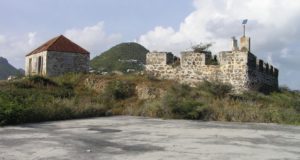
Fort Louis is a French military fort built in the eighteenth century on the heights of Marigot to defend the French side of the island of St. Martin from enemy attacks. In 1765, the Chevalier de Descoudrelles, organizes the defense of the small city of Marigot by installing three batteries of guns in three neuralgic places. A cannon battery on the cliff of Bluff Point, another on the Rond hill and the third on the hill of Marigot. In 1789, it was under the leadership of the Chevalier de Durat, governor of Saint-Martin and Saint-Barthélemy, that Fort Louis was built.

[divider]

[divider]

Categories
French Colonialism Oceania

Isle of Pines: Prison ruins and Cemetery of the Deported (Cemetery of the Communards) in New Caledonia

Written by Marco Ramerini. English text revision by Dietrich Köster.

Located south-east of Grande Terre (New Caledonia), the Isle of Pines is a small island full of natural wonders, endless white beaches and crystal clear water, caves and caverns, rich coral reef, natural wonders like the natural pool (piscine naturelle) with seawater, inhabited by a friendly population with rich traditions.

This enchanted island 14 km wide and 18 km long has a turbulent history. It was on this land of paradise that the protesters of the Paris Commune among other prisoners were exiled in the 19th century. Today the remains of the 19th-century buildings are touching witnesses to this period.

In 1872 the island became a French penal colony, home to 3,000 political deportees from the Paris Commune. The deportees were allocated to five different areas around the island, the most notable of which is that of Ouro. This is where you find the ruins of the penal colony, invaded by tropical vegetation. A little further upstream is the Cemetery of the Deportees (Cimetière des Déportés).

These places of sadness are just a few hundred metres away from the white sandy beaches of Kanumera and Kuto, two of the most fascinating places on the island.

[divider]

[divider]

Categories
French Colonialism Oceania

Fort Teremba: a prison for deportees in New Caledonia (Grande Terre)

Written by Marco Ramerini. English text revision by Dietrich Köster.

This fort is situated between La Foa and Bourail, 124 kilometers north of Nouméa.

In 1871 a group of 25 convicts, 2 wardens, 3 gendarmes and the head of the topographical department set up a camp on the left bank of La Foa river near the Kanak village of Uarai, later that year the camp was moved to a better site on the right bank of the river on a little hill.

This small camp was enlarged between 1871 and 1877 through the construction of several buildings: water tanks, cells, huts for military troops and for the convicts, the commander’s house, a chapel, some workshops and warehouses, a school, a bakery, an infirmary, a telegraph station, an anchorage etc..

The fort was built after the Kanak insurrection of 1878. Inside the perimeter of the walls were built a blockhouse, a watchtower and a prison. The number of the convicts was between 120 and 300, some of them worked at the farm penitentiary of Fonwhary, situated 8 kilometers away on a fertile and well irrigated land.

The settlement of Teremba was damaged by a cyclone in 1898.

In 1984 the Association Marguerite attempted to make Teremba a place of living memory. In 1989 the site was classified as historical monument. In 1992 the first buildings were restored. The site has actually a little museum and it is open Tuesday to Sunday from 9 AM to 4 PM, admission fee: 250 CFP.

Categories
French Bibliographies French Colonialism

Bibliography of French Colonial History: 16th-18th centuries

Written by Marco Ramerini. Text revision by Dietrich Köster.

FRENCH EMPIRE

GENERAL:

– Cornevin, M. & R. “La France et les Français outre-mer” 514 pp. Tallandier, 1990, Paris, France.

– Julien, Ch. A. “Les voyages de découverte et les premiers établissements (XV-XVI)” 553 pp. «Colonies et Empires”, 3ème série Histoire de l’expansion et de la colonisation françaises, tome I» Presses Universitaires de France, 1948, Paris, France.

AMERICA

CANADA ACADIA:

– Bonnault, Cl. de “Histoire du Canada Français 1534-1763” ? 349 pp. 1950, Paris, France.

– Borins, R. H. “La compagnie du Nord 1682-1700” Unpublished M.A. Thesis, Mc. Gill University, 1968,

– Campeau, L. “Monumenta Novae Franciae” Vol. I La première mission d’Acadie, 1602-1616. 276*-720 pp.(vol. 96). Monumenta Historica Societatis Iesu, 1967, Roma, Italia. Vol. II Établissement à Québec, 1616-1634. 142*-890 pp. (vol. 116). Monumenta Historica Societatis Iesu, 1979, Roma, Italia. Vol. III Fondation de la Mission Huronne (1635-1637). 54*-894 pp.(vol. 130). Monumenta Historica Societatis Iesu, 1987, Roma, Italia. Vol. IV Les grandes épreuves (1638-1640). 48*-808 pp. (vol. 135). Monumenta Historica Societatis Iesu, 1989, Roma, Italia. Vol. V La bonne nouvelle reçue (1641-1643). 50*-862 pp. (vol.138). Monumenta Historica Societatis Iesu, 1990, Roma, Italia. Vol. VI Recherche de la paix (1644-1646). 44*-806 pp. (vol. 144). Monumenta Historica Societatis Iesu, 1992, Roma, Italia. Vol. VII Le Témoignage du sang (1647-1650). 46*-888 pp. (vol. 146). Monumenta Historica Societatis Iesu, 1994, Roma, Italia.

– Campeau, L. “Mission des Jésuites chez les Hurons 1634-1650” 488 pp. Institutum Historicum Societatis Iesu, 1987, Roma, Italia.

– Champagne, Antoine “Les La Verendrye et le poste de l’Ouest” x, 589 pp. maps, ills. Les Presses de l’Université Laval, 1968, Québec, Canada.

– Cole Harris, R. ed. “Historical Atlas of Canada” Vol. 1 : “From the beginning to 1800” 198 pp. ills. University of Toronto Press, 1987, Toronto, Canada.

– Eccles, W. J. “The France in America” 312 pp. Fitzhenry & Whiteside, 1990 (1972), Ontario, Canada. The false starts 1500-1632, merchants and missionaries 1632-1663, Colbert’s colonies 1663-1685, war and trade 1683-1713, the long peace 1713-1744, the slave colonies 1683-1748, the preemptive conquest 1749-1763, aftermath 1760-1783.

– Eccles, W. J. “The Canadian frontier 1534-1760” 238 pp. University of New Mexico Press, 1992, New Mexico, USA (1969, New York). The nature of the Canadian frontier, New France 1524-1629, commerce and evangelism 1632-1662, institutions and enviroment, society and the frontier, the fur trade frontier 1663-1700, the imperial frontier 1700-1750, the military frontier 1748-1760, epilogue: the closing of the fur trade frontier.

– Faulkner, Alaric and Gretchen “The French at Pentagoet: 1635-1674 An Archaeological Portrait of the Acadian Frontier” 330 pp. ills. Maine Historical Preservation Commmission, 1987, Augusta, Maine, USA.

– Giraud, M. “Le Métis canadien: son rôle dans l’histoire des provinces de l’Ouest” two volumes, 1945, Paris, France.

– Harvey, D. C. “French Regime in Prince Edward Island” Harvard, 1926, New Haven, USA.

– Jaray, G. L. “L’Empire Français d’Amérique 1534-1808” 1938, Paris, France.

– Mahaffie, Ch. D. “A land of discord always: Acadia from its beginnings to the expulsion of its people 1604-1755” 317 pp. Down East Books, 1995, Cadmen, Maine, USA.

– Mc Grath, John Terrence “France in America 1555-1565: a reevalutation of the evidence” 408 pp. Unpublished PhD. Thesis Boston University, 1995.

– McLennan, John Stewart “Louisbourg from its foundation to its fall, 1713-1758” 328 pp. illustrations and fold-out map, Fortress Press, 1969,

– Nuffield, E. W. “Bay of the North. The struggle for control of Hudson Bay 1686-1713” 160 pp. Haro Books, 1998, Vancouver, Canada.

– Rosselli, Alberto “Conflitto Anglo-Francese in Nord America, 1756-1763” 222 pp. maps Erga, 1999, Genova, Italia. Index: 1755-1758, situazione di equilibrio; 1759, l’anno della svolta; attacco a Quebec; la conquista di Quebec; Saint Foy, l’ultima ma inutile vittoria francese; il ruolo strategico della marina nel corso della guerra dei sette anni; le tribù indiane coinvolte nel conflitto anglo-francese; cronologia; cartografia; bibliografia.

– Severance, Frank H. “An old frontier of France: the Niagara region and adjacent lakes under French control” 921 pp. 2 volumes ills. Dodd, Mead, 1917, New York.

– Trigger, B. G. “The French presence in Huronia: the structure of Franco-Huron relations in the first half of the seventeenth century” In: “An Expanding World” Vol. n° 8; Subrahmanyam. S. “Merchant network in early modern world” Ashgate Variorum, vol. n° 8; pp. 303-337, also in “Canadian Historical Review” XLIX, 1968, pp. 107-141.

– Trudel, Marcel “Histoire de la Nouvelle-France I: Les vaines tentatives 1524-1603” 307 pp. maps 1° vol. Fides, 1963, Montréal, Canada.

– Trudel, Marcel “Histoire de la Nouvelle-France II: Le Comptoir 1604-1627” 2° vol. Fides, 1966, Montréal, Canada.

– Trudel, Marcel “Histoire de la Nouvelle-France III: La Seigneurie des cent-associés 1627-1663. Tome 1: Les évènements” 3° vol. tome 1 Fides, 1969, Montréal, Canada.

– Trudel, Marcel ” Histoire de la Nouvelle-France III: La Seigneurie des cent-associés 1627-1663. Tome 2: La Societé” 3° vol. tome 2 Fides, 1983, Montréal, Canada.

– Trudel, Marcel “Histoire de la Nouvelle-France IV: Montréal. La formation d’une société 1642-1663” ? 4° vol. Fides, 1976, Montréal, Canada.

– Trudel, Marcel “Atlas de la Nouvelle-France. An Atlas of New France” 1968, Québec, Canada.

– Voorhis, Ernest “Historic Forts and Trading Posts of the French Regime and of the English Fur Trading Companies” 188 pp. maps Department of the Interior, 1930, Ottawa, Canada. Introductory remarks on the forts and posts, portages and waterways, French trading companies and free traders; the Northwest Company, the Hudson’s Bay Company, and extensive bibliography. Each of the 612 locations is described geographically and historically.

– Zoltvany, F. “Philippe de Rigaud de Vaudreuil. Governor of New France 1703-1725” Toronto, 1974

LOUISIANA, FLORIDA AND MISSISSIPI VALLEY:

– Various Authors “The French in the Mississippi valley” John Francis Mc. Dermott, Univ. of Illinois, 1965, Urbana, Illinois, USA.

– Various Authors “Charlesfort identified” In: “Archaeology” Newsbriefs Volume 49, n° 5 Sep/Oct 1996 – Belting, N. “Kaskaskia under the French Regime” 140 pp. University of Illinois Press, 1948, Urbana, Illinois, USA. Kaskaskia the beginnings, the village of Kaskaskia, life in the village, making a living, social life and customs, extracts from the parish registers, notes on the Census of 1752.

– Buzhardt, Gail Alexander & Hawthorne, Margaret “Rencontres sur le Mississippi, 1682-1763, French Language Reader of Historical Texts” University Press of Mississippi, 1993

– Caruso, John Anthony “Mississippi Valley Frontier: The age of French Exploration & Settlement” 423 pp. maps Bobbs-Merrill/Howard W. Sams., 1966, Indianapolis.

– Delanglez, Jean “The French Jesuits in Lower Louisiana 1700-1763” Ph.D. Thesis Catholic University of America, 1935.

– De Ville, Winston “Opelousas: The History of a French and Spanish Military Post in America, 1716-1803” ix+188 pp. ills. maps Polyanthos Inc., 1973, Cottonport, Louisiana The history of the Opelousas Post, its growth, during colonial times..under the French, Spanish.

– Ekberg, C. “French Roots in the Illinois Country: The Mississippi Frontier in Colonial Times” ? 376 pp. University of Illinois Press, 2000.

– Frégault, Guy “Le Grand-Marquis Pierre Rigault de Vaudreuil et la Louisiane” 385 pp. Fides, 1952, Montreal, Canada.

– Giraud, M. “Histoire de la Louisiane Française” 368+209+420+455 pp. 4Voll. (1698-1723) 1953-1974 Paris Volume 1: Le Règne de Louis XIV. Volume 2: Années de transition 1715-1717. Volume 3: L’époque de John Law 1717-1720. Volume 4: La Louisiane après le système de Law 1721-1723.

– Harris, John Brice “From Old Mobile to Fort Assumption. A Story of the French Attempts to Colonize Louisiana and Destroy the Chickasaw Indians” 139 pp. maps, drawings The Parthenon Press, 1959, Nashville, USA.

– Higginbotham, Jay “Old Mobile: Fort Louis de la Louisiane 1702-1711” 585 pp. 61 pp. of illustrations Museum of the City of Mobile, 1977, Mobile, USA. An exhaustive work chronicling the establishment of the French fort and settlement on the Mobile River in 1702.

– Lauvrière, E. “Histoire de la Louisiana Française 1673-1939” ? 445 pp., 52 plans and maps, Lib. Orientale et Americaine, G-P Maisonneuve Ed., 1940, Paris, France.

– Lyon “Louisiana in French Diplomacy 1759-1804” ? 268 pp. maps University Oklahoma Press, 1934, Norman, USA. Portrayal of French Interest in the Mississippi Valley.

CREOLE DIALECTS AND FRENCH LANGUAGE IN LOUISIANA:

– Cable, George W. “Créoles and Cajuns : stories of old Louisiana” 432 pp., Peter Smith, 1965, Gloucester [MA], USA.

– Thorne, Tanis Chapman “People of the river: mixed-blood families on the lower Missouri (Native-American; French Créole)” 451 pp. PhD. University of California,, Los Angeles, 1987.

– Valdman, Albert “French & Créole in Louisiana” ? 359 pp. Plenum Publishing Corporation, 1997, Describes the current state of research on language varieties spoken in southwestern Louisiana, with material on French and Créole in Louisiana as well as French-speaking communities in Acadia (currently New Brunswick and Nova Scotia) and in the Caribbean. Specific subjects include the sociolinguistic situation of Cajun French, field method in four Cajun communities in Louisiana, the structure of Louisiana Créole, the lexicon of Louisiana French, and research on Louisiana french folklore and folklife.

CARIBBEAN:

– Orizio, Riccardo “Tribù bianche perdute: viaggio tra i dimenticati” xv+281 pp. Editori Laterza, 2000, Bari, Italia. English edition: “Lost White tribes: Journeys among the Forgotten” 281 pp. Secker & Warburg, 2000 Indice: Sri Lanka: quattro secoli di nostalgia olandese; Giamaica: gli schiavi tedeschi di Seaford Town; Brasile: via con il vento degli ultimi sudisti; Haiti: i polacchi di Papà Doc; Namibia: la Terra Promessa dei Basters; Guadalupa: i duchi della canna da zucchero. The author investigates: the Dutch Burghers of Sri Lanka; the Germans of Seaford Town (Jamaica); the Confederados of Brazil; the Poles of Haiti; the Basters of Namibia; the Blancs Matignon of Guadeloupe.

– Parry, J. H. & Sherlock, P. “A short history of the West Indies” 337 pp. The Macmillan Press ltd, 1980, Brazil:

– Baez-Camargo, G. “The earliest Protestant Missionary venture in Latin America” In: “An Expanding World” Vol. n° 28; Cummins, J. S. “Christianity and Missions 1480-1800” Ashgate Variorum, vol. n° 28; pp. 303-313 Also in “Church History” XXI, 1952, pp. 135-145

– Laborie, Jean-Claude “Le Huguenot au Brésil: à travers les documents portugais (1560-1584) In: “Revue de l’Histoire du Protestantisme Français” Nov./Dec. 1998

– Leite de Faria, Francisco “Os primeiros missionários do Maranhão. Achegas para a história dos Capuchinhos Franceses que aí estiveram de 1612 a 1615” In “O Centro de Estudos Históricos Ultramarinos e as Comemorações Henriquinas” 83 – 216 pp. 1961, Lisbon, Portugal

– Tomlinson, R. J. “The struggle for Brazil: Portugal and the French interlopers” 127 pp. Las Américas Publishing Co, 1970 , New York, USA.

AFRICA

– Brooks, G. E. “The Signares of Saint-Louis and Gorée: women entrepreneurs in eighteenth-century Senegal” In: “An Expanding World” Vol. n° 27/2; Forster, Robert “European and non-European societies, 1450-1800; Vol. 2: Religion, Class, Gender, Race” pp. 567-592

– Delcourt, Jean “La turbulente histoire de Gorée” xi, 103 pp. illustr. 1982, Dakar, Senegal.

– Freeman-Grenville, G. S. P. “The French at Kilwa Island: An Episode in Eighteenth Century East African History” Clarendon Press, 1965, Oxford

– Deschamps, Hubert, “Les pirates à Madagascar aux XVIIème et XVIIIème siècles”, Berger-Levrault, 1949, Paris, France

ASIA

INDIA:

– Indrani, Ray “The French East India Company and the Trade of the Indian Ocean : A Collection of Essays” xiii, 256 p. edited by Lakshmi Subramanian, 1999, The present selection of the writings of the late Indrani Ray has been planned around certain identifiable factors that determined India’s changing tryst with the Indian Ocean in the late seventeenth and eighteenth centuries. While the protagonist in these writings is the Indian merchant, the biographer is the French East India Company’s official. Using a wide array of French sources, the author has reconstructed the changing world of the Indian merchant as he rubbed shoulders with the European trading companies in the palmy decades of the seventeenth century and retreated into his shell in the turbulent decades of the eighteenth. Taken together, these essays underscore both the prosperity and vitality of Indian trade in the seventeenth century as well as its inherent fragility in the face of political uncertainty and unrestrained competition in the succeeding years. The conclusions arrived at, tend to reinforce some of the better known propositions about the nature and orientation of pre-modern Indian trade and the making of its material context. Individually the essays constitute important interventions in ongoing debates about the extent and logic of Mughal decline, the benevolence of the Mughal state towards matters maritime and about the relative importance of European trade vis-a-vis Asian trade in the economy of eighteenth century Bengal. 1. Of trade and traders in the seventeenth-century India: an unpublished French memoir by Georges Roques. 2. The trade and traders in Ahmedabad in late seventeenth century: extracts from Georges Roques’ MSS. 3. The French Company and the merchants of Bengal (1680-1730). 4. Dupleix’s private trade in Chandernagore. 5. The English associates of Dupleix in Bengal. 6. Some aspects of French presence in Bengal: 1731-40. 7. Journey to Cassimbazar and Murshidabad: observations of a French visitor to Bengal in 1743. 8. India in Asian trade in the 1730s: a discussion by a French trader. 9. Trade in Basra in the mid-eighteenth century. 10. The multiple faces of the early eighteenth century Indian merchants. 11. European traders in Surat (1730-50). 12. Printed primary sources in French for Indian studies.

– Manning, C. “French country trade on Coromandel, 1720-1750” In: “An Expanding World” Vol. n° 10; Prakash, Om “European commercial expansion in early modern Asia” pp. 282-292 Also in: “The Asians Seas 1500-1800” Macao, 1991, pp. 162-172

– Martineau, Alfred “Dupleix et l’Inde Française” 4 Vols. 1920-1928, Paris, France.

– Mathew, K. S. “French in India and Indian Nationalism (1700 A.D. – 1963 A.D.)” xiii, 656 pp. 2 vols 1999, Delhi, India. Vol. I. Introduction. 1. Sher Khan Lodi et François Martin ou les premières relations Franco-Indiennes à Pondichéry/G. David. 2. Franco-Maratha relations/V.S. Kadam. 3. Indo-French cultural relations: 19th century Maharashtra (with special reference to Charles D’Ochoa)/A.R. Kulkarni. 4. French relations with Haidar Ali and Tipu Sultan: a record of blunders/B. Sheik Ali. 5. Observations on the French military presence in the Indian states 1750-1849/Jean-Marie Lafont. 6. The French relations with the native kingdom of Travancore (with special reference to Dupleix, the French Governor of Pondicherry)/M.O. Koshy. 7. Relevant data on Dupleix/M.P. Sridharan. 8. Neutrality and profit – Franco-Danish relations in 18th-century India/Martin Krieger. 9. Dupleix and the court of Murshidabad in Bengal, 1731-1739/Aniruddha Ray. 10. Dupleix in French fiction/R. Kichenamourty. 11. Les deux premiers gouverneurs de l’Inde française au XIXème siècle /Mireille Lobligeois. 12. Trois Siècles de Pr-é-sence Française en Inde/M. Douglas Gressieux. 13. L’Inde et l’Extrême-Orient dans les Périodiques francophones pour Enfants après la Deuxieme Guerre Mondiale (Vers 1945-Vers 1960). Premiers Pas d’une Recherche/François-Xavier Emmanuelli. 14. France in contemporary Indian fiction/P. Marudanayagam. 15. Social stratification in colonial India with special reference to French India/L.S. Vishwanath. 16. French missionaries and social changes in Pondicherry/P.P. Xavier. 17. Legoux De Flaix’s observations on Indian technologies unknown in Europe/Florence D’Souza. Vol. II. 18. Education of girls in French India/Emiliana Emprayil and Benjamin Kanjiramelkunnel. 19. The French language in Pondicherry: a vestige of the past (or) a link-language of the future?/Nalini J. Thampi. 20. Influence of French in 18th century Pondicherry Tamil dialect/S. Arokianathan. 21. Library movement in French India/Calaichelvy Ezhilan. 22. Pondicherry in the eighteenth century: town planning, streetscapes and housescapes/Fran11. Social stratification in colonial India with special reference to Françoise L’Hernault. 23. The French military engineers and geographers in India (1750-1778)/Alexis Rinckenbach. 24. Urban growth of Pondicherry and the French: a study of the town plans 1702-1798/S. Jeyaseela Stephen. 25. De quelques médecins français en Inde au 17ème siècle /Françoise de Valence. 26. Indo-Spanish trade connections with special reference to French India/Leena More. 27. Indians in French Indo-China/J.B.P. More. 28. Three French patriots in India 1797/Guy Deleury. 29. French ventures in Pondicherry today: enterprises, businesses and humanitarian associations/Pierre Lachaier. 30. Flux et Reflux dans les échanges textiles contemporains entre l’Inde et la France: Une Vue de Pondichéry/Brigitte Silberstein. 31. L’organisation judiciaire de Pondichéry au 18ème siècle L’exemple du tribunal de la Chaudrie/J.C. Bonnan. 32. Chandernagore – profile of a subordinate rebel French settlement/Ajit Neogy. 33. The Merger of French India/David Annoussamy. 34. Alexis De Tocqueville’s views on India and colonialism/J.A. Bernard. 35. The slave trade in the Indian Ocean: the French experience/Jeannette Pinto. 36. Indian merchants and the French during the seventeenth and eighteenth centuries – a study in partnership/K.S. Mathew. 37. Intellectual origins of nationalism in South India/G. Chandhrika. 38. Freedom struggle in Malabar with special reference to civil disobedience movement, 1930-34/K.J. John

– Mathew, K.S. & Jeyaseela, Stephen S. “Indo-French Relations” ? Pragati Hardbound, India. Contents: Preface. 1. French relations with Haidar Ali and Tipu Sultan: a record of blunders/B. Sheik Ali. 2. Dupleix and the court of Murshidabad in Bengal, 1731-1739/Aniruddha Ray. 3. Franco – Maratha relations/V.S. Kadam. 4. The French relations with the Native Kingdom of Travancore with special reference to Dupleix, the French Governor of Pondicherry/M.O. Koshy. 5. The merger of French India/David Annoussamy. 6. Chandernagore – profile of a subordinate rebel French settlement/Ajit Neogry engineers and geographers in India (1750-1778)/Alexis Rinckenbach. 10. Indian merchants and the French during the seventeenth and eighteenth centuries – a study of partnership/K. S. Mathew. 11. Social stratification in colonial India with special reference to Françoise L’Hernault. 14. Observations on the French military presence in the Indian states 1750-1849/Jean Marie Lafont. 15. A bibliographical survey of the sources on Indo-French history/S. Jeyaseela Stephen. Index.

REVIEWS:

– “Revue Française d’histoire d’outre-mer”

– “Mississipi Valley Historical Review”

– “The Canadian Historical Review”

– “Revue d’histoire de l’Amérique Française” Institut d’histoire de l’Amérique Française, Outremont, Québec, Canada.

Categories
Dutch Colonialism French Colonialism Sri Lanka

Trincomalee 6 – The French attempt

Written by Marco Ramerini. English text revision by Dietrich Köster.

Continued from: The new Dutch occupation and the reconstruction of the Fort

6.0 THE FRENCH ATTEMPT

A new threat encumbered on the Dutch possessions of Ceylon, it materialized in March 1672 in the shape of a great French fleet, that of admiral de la Haye. In the years between 1665 and 1670 the French governed by Colbert and with the aid of François Caron, a man of great experience and former director general of the VOC in Asia, had developed a plan of expansion in Asia to the expenses of the Dutch. Part of this plan was also the foundation of an important trading station in Trincomalee.

The French fleet under the command of the lieutenant general of India, Jacob Blaquet de la Haye on 29 March 1670, at the time of the departure from the French port of Rochefort, was composed of 9 vessels with 2,250 men on board and 251 guns. At their arrival in the bay of Trincomalee on 22 March 1672 the French fleet represented an enormous naval power for the Indian Ocean.

In March 1672 at the arrival of the French fleet of de la Haye and Caron the Dutch abandoned and burnt their outpost of Kottiyar Bay, whose garrison was sheltered in the fort of Trincomalee. The Dutch left 21 guns in their destroyed fort. The Dutch garrison of Trincomalee was forced to the defensive and remained inside the walls of the fortress to observe the movements of the French.

The French had chosen the wonderful bay of Trincomalee/Kottiyar as base for their future operations in Asia. Under the eyes of the Dutch, barricaded in their fort of Pagoodsberg, the French occupied and fortified the two islands at the entrance of the bay: calling them ‘Isle du Soleil’ (‘Dwars-in-de-weg’) and ‘Caron’ (“Compagnies Eyland”) and also occupied the outpost of Koddiyar Bay. The official Boisfontaine with 30 soldiers was soon sent to the court of Kandy in the capacity of French ambassador. He was well received by the king, who hoped to be able to drive away the Dutch, with whom he was at war, from the island.

On 28 May 1672 the French signed a treaty with Raja Sinha, in virtue of which the bays of Trincomalee and Kottiyar were ceded by the Singhalese to the French. On this occasion some pillars were raised to delimit the borders of the ceded territory. The main problem for the great French fleet was the food supply. From the moment the food dispatching from Kandy was not sufficient to feed such a great navy, the French sent three ships to India in search of supplies to resolve this problem.

A few days after the signing of the treaty with the Singhalese the Dutch fleet of van Goens arrived in the bay. The Dutch initially tried with a disembarkation in Tambalagama to stop the supply line, which came to the French from the interior. But a prompt attack by the Kandyan troops forced van Goens to withdraw his men to the ships. The Kandyans asked the French for assistance, to attack the Dutch jointly, but the French refused being still formally in peace with the Dutch. This refusal cooled down the enthusiasm of the Singhalese towards the French expedition.

The Dutch instead did not take care of being in peace with the French and at the first opportunity they attacked and succeeded in capturing two vessels, which the French had sent to India in search for supplies. A third vessel was forced to return. For the French troops the situation became more and more dramatic, in spite of the aid of Raja Sinha. The diseases and the lack of food provoked many death casualties among the French. On 9 July 1672 admiral de la Haye, after having sent another ambassador, de la Nerolle, to the court of Kandy, decided to sail with the entire fleet in search of aid, leaving in the fortification of the bay a garrison of 100 men and two boat vessels. The Dutch did not lose time. They attacked the garrison and the French, barricaded in their fort, were soon forced to surrender. A large contingent of Kandyan troops reached Trincomalee a few days after the departure of the French fleet. But it was too late by now. The short French intermezzo came to an end. Thus the hopes of the Kandyans to drive away the Dutch from the island did not materialize.1

To be continued by: The consolidation of the Dutch presence

Plan of Fort Trincomalee, made by the Chevalier de Suffren in August 1782

NOTES:

1 For the French episode you can see: Ames, G. J. “A Portuguese perspective on the emerging French presence in the East ca. 1670”, in: “Studia”, n° 46/1987, pp. 254-286; “History of Sri Lanka”, vol. II, pp. 223-225; Arasaratnam “Dutch power in Ceylon, 1658-1687”, pp. 62-63.

Categories
Brazil French Colonialism

The French in Brazil: Saint-Alexis, France Antarctique (Rio de Janeiro), Ipiapaba and Sao Luís do Maranhão

Written by Marco Ramerini. English text revision by Dietrich Köster.

The French ports of Normandy, especially Rouen and Dieppe, had a flourishing textile industry and thus became the principal competitors in trade for Portugal in Brazil in the 16th century. Due to the presence of vast forests of “Pau Brasil” on the Brazilian coast (used in the process of cloth colouring) the French soon started to trade with the Indians. The first voyage took place in 1503-1504, when the ship “Espoir” reached the Brazilian coast. After this first contact the French expeditions became more frequent.

In 1531 two French ships and 120 men under the command of Jean Dupéret landed on the Brazilian coast. On the island of Santo Aleixo (near Recife), named by the French “Ile Saint-Alexis”, they built a fort and a trading centre. This French settlement was short-lived. The Portuguese captured the French ships on their return voyage to Europe and in December 1531 they put the French fort under siege, which forced the French garrison to surrender.

The French made three other attempts to establish settlements in Brazil. The first attempt was in Rio de Janeiro (1555-1560), the second in Ibiapaba-Ceará (1590-1604), the third in São Luís do Maranhão (1612-1615).

FRANCE ANTARCTIQUE 1555-1560

In the 1550s the area from Cabo Frio to Rio de Janeiro was under French rather than Portuguese control. For about five years between 1555 and 1560 the French maintained a base on a little island in the Bay of Guanabara (Rio de Janeiro): Fort Coligny.

The Calvinist Nicolas Durand de Villegagnon was sent to Brazil in 1555 in order to materialise the French presence there. On 14 August 1555, with three ships, 600 sailors and colonists (French term: colons), he started for Brazil.

The French expedition arrived on 10-15 November 1555 in the Bay of Guanabara and landed on a deserted island, today Villegagnon island. Here Fort Coligny was built and good relations were established with an adjoining Indian village. The members of this first expedition were mainly Bretons and Normans and they were fairly subdivided between Catholics and Protestants.

A short time later, on 7 March 1556, arrived a second expedition of three ships with 190 men. The colony had good development prospects, but the hard and intolerant rule of Villegagnon stopped the promising growth of the colony. Villegagnon’s oppressive rule obliged a large number of colonists to leave the colony. Among others, some Huguenots returned to France, where their reports brought about the abandonment of an expedition of 700-800 colonists.

In 1559 Villegagnon also returned to France, leaving the command of the colony to his nephew Bois-le-Comte. Portugal, not disposed to tolerate the French presence in his possessions, sent an expedition of 120 Portuguese and 1.000 Indians under the command of Mem de Sá, Governor General of Brazil (1558-1570). After two days and two nights of savage fighting the Portuguese destroyed the French colony on 16 March 1560. The surviving 70 Frenchmen and their 800 Indian allies, demoralised, abandoned the fort and sheltered among other Indians.

Like W.J. Eccles writes in his book “France in America”: “For a century, French traders had challenged the Portuguese hold on this vast region, with little or no aid from the Crown. But for religious dissension in Rio de Janeiro and the unfortunate character of Villegagnon France rather than Portugal might well have established a vast empire in South America.”

IBIAPABA 1590-1604

In 1590 under the command of Adolf Montbille a French expedition settled in Ibiapaba (Viçosa-Ceará Here the Frenchmen established a settlement and a fort, and they traded “pau Brasil” with the Indios that had settled in the vicinity of the French trading station.

The French stayed here in peace with the natives for about 14 years, but in 1604 a Portuguese expedition under Pero Coelho attacked the settlement and, after a fierce battle, forced the Frenchmen to surrender.

SÃO LUIS DO MARANHÃO 1612-1615

On 19 March 1612 three French ships left from the French port of Canacale to Maranhão. These ships were the “Regent” under the command of Rasilly and La Ravardière, the “Charlotte” under the command of the Baron de Sancy and the “Sainte-Anne”.

On 24 June the ships arrived at the island of Fernando de Noronha, where they stayed until July 8. Here they found one Portuguese and 17 or 18 Indian slaves. All were removed to Maranhão. On 29 July the French landed on the island “Pequena do Maranhão”, which was found deserted. This island was named by the French Ile de Sainte-Anne. From here the French moved to the island “Grande do Maranhão”, where they found some ships from Dieppe and Le Havre with 400 Frenchmen that were trading with the Indians. Here the Capuchins built the convent of Sainte Françoise and near it a fort, named Fort Saint-Louis, was also built. On 20 December 1612 the missionary chapel was inaugurated.

Here the French lived in peace for nearly two years. In 1613 the leaders of the settlements resolved to return to France in search for reinforcements. After some attempts at the Court they succeeded in preparing a reinforcement expedition. At Easter 1614 the ship “Regent” with 300 Frenchmen left for Maranhão. On 14 June the ship cruised along the Portuguese fort of Ceará, and on 18 June the expedition arrived at “Buraco das Tartarugas” or Jaracoará, where another Portuguese fort was to be found. Despite the obstacles the French reinforcements arrived unharmed in Maranhão.

Due to the continuous presence of French ships in the area the Portuguese built several forts to control the coast with the purpose to stop the French with their trading. In 1611 or 1612 the Portuguese had founded the fort of Ceará, named Nossa Senhora do Amparo; in August 1613 they also founded the fort of Jaracoará, named Nossa Senhora do Rosário.

On 26 October 1614 a Portuguese force of 500 men (Portuguese and Indians) arrived on terra firme near the French settlements with the intent of driving the French out. The Portuguese encamped in Guaxenduba and there they built a fortified camp called Forte de Santa Maria. The French of Maranhão, being superior in number, decided to take the initiative and on 19 November 1614 7 ships, 50 guns and an armed force of 200 Frenchmen and 1.500 Indios attacked the Portuguese fort. The attack was, however, an overwhelming defeat for the French.

On 27 November 1614 a one-year armistice was signed with the purpose to permit the Kings of France and Spain to settle the issue diplomatically. It was also decided to send Portuguese and French emissaries to Europe to explain the question. Thus the ship “Regent” left for Europe with on board the Portuguese and French emissaries on 16 December 1614. The result of this mission is not known.

However, reinforcements for Maranhão never arrived from France. Meanwhile, on 1 November 1615, a Portuguese fleet of 9 ships and several hundred men under the command of Alexandre de Moura arrived in front of the French settlements. The Portuguese landed on the island “Grande do Maranhão” and entrenched themselves on the promontory of São Francisco. The fortification was named “Quartel de São Francisco”. On 3 November 1615 the French – already demoralized – surrendered without fighting.

BIBLIOGRAPHY:

– Parkman, Francis “Pioneers of France in the New World” University of Nebraska Press, 1996

– Daher, Andréa “Les Singularités de la France Équinoxiale : Histoire de la mission des pères capucins au Brésil (1612-1615)” Préface de Roger Chartier., Paris, Champion, coll. « Les Géographies du Monde »,‎ 2002, 346 p.

– Thevet, André “Les singularités de la France antartique” 1558, new ed. (Paul Gaffarel, ed.) 1878