Categories
Cape Verde Colonial Forts on Google Earth Portuguese Colonialism

The Portuguese fort of Santiago, Cape Verde

Photos by João Sarmento. Written by Marco Ramerini.

The Cidade Velha (Old Town) of the island of Santiago in Cape Verde islands is located 15 kilometers west of the city of Praia, along the Santiago island coast. It constitutes the first city built by Europeans in the tropics and the first capital of the Cape Verde archipelago.

The settlement was originally named as Ribeira Grande, been changing name to avoid ambiguity with the homonymous village on the island of Santo Antão. Because of its history, manifested by a valuable architectural heritage, on 26 June 2009 the old town was classified by UNESCO as a World Heritage site.

The Forte Real de São Filipe also referred to as Fortaleza Real de São Filipe ou Cidadela – which dominates the city 120 meters high – was erected in 1587. This fort was the first and most important fortification of the archipelago of Cape Verde. Work began in 1587 and were completed in 1593, in charge of military engineer João Nunes and with outlines of Italian military architect and engineer Filippo Terzi.

The Fort features a trapezoidal shape, with with stone walls, two full pentagonal bastions at the west and east corners, separated by curtains, and two half-bastions at the north and south corners, with its watchtowers. The interior of the fortress is accessed by two gates: the main gate is located on the southwest wall on the side facing the city. The defensive set was still integrated by seven small fortifications.

[divider]

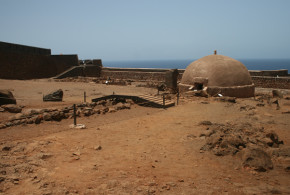
Portuguese Fort Santiago, Cape Verde. Author and Copyright João Sarmento

[divider]

Fortaleza Sao Filipe, Santiago, Cape Verde. Google Earth

[divider]

[divider]

Categories
Colonial Forts on Google Earth Portuguese Colonialism São Tomé and Principe

The Portuguese fort in São Tomé

Photos by João Sarmento. Written by Marco Ramerini.

The Portuguese Fort São Sebastião, São Tomé, São Tomé e Príncipe. The fort was built in 1575. The fort was occupied by the Dutch on 16 Oct. 1641. The Portuguese recaptured the fort on 15 December 1644.

The Fort São Sebastião is square-shaped with bastions at each corner and now houses the São Tomé and Príncipe National Museum.

[divider]

Statues outside Fort São Sebastião, São Tomé. Author and Copyright João Sarmento

[divider]

Portuguese Fort São Sebastião, São Tomé, São Tomé e Príncipe. Google Earth

[divider]

Fort São Sebastião, São Tomé. Author and Copyright João Sarmento.

[divider]

[divider]

Categories
Colonial Forts on Google Earth Morocco Portuguese Colonialism

The Portuguese forts in Morocco

Photos by João Sarmento. Written by Marco Ramerini.

Some pictures of what remains of forts built by the Portuguese in Morocco in the 15th and 16th century. Here are presented photos of Azamor (Azemmour), Safim (Safi) and Mazagão (El Jadida) taken by João Sarmento.

The fort of Azamor (Azemmour) was under Portuguese control between 3 September 1513 and October 1541.

The fort of Safim (Safi) called by the Portuguese as Castelo do Mar or Castelejo was founded by the Portuguese as a  feitoria in 1488. In 1508 the Portuguese built a fortress. The fortress was abandoned by the Portuguese on October 1541.

Mazagão Fort (El Jadida) built by the Portuguese in 1541 was the last Portuguese fort to be abandoned in 1769.

The Portuguese controlled the coast of Morocco and to that end they built many fortresses including those of: Arzila (Asilah), Ceuta, Tanger, Safim (Safi), Graciosa (Graciosa Island near Larache), Santa Cruz do Cabo de Gué (Agadir-Taddert Ougadir), Mogador (Essaouira), Aguz (Souira Guedima, Castelo de Aguz: South of Safi at the mouth of Tensift River), Azamor (Azemmour), Mazagão (El Jadida).

[divider]

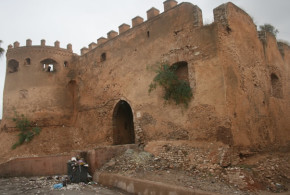
Azemmour, Morocco. Author and Copyright João Sarmento

[divider]

Azamor fort, Morocco. Google Earth

[divider]

Safi, Morocco. Author and Copyright João Sarmento

[divider]

Safi Fort, Morocco. Google Earth

[divider]

El Jadida, Morocco. Author and Copyright João Sarmento

[divider]

El Jadida-Mazagao Castle, Morocco. Google Earth

[divider]

[divider]

Categories
Bahrain Colonial Forts on Google Earth Portuguese Colonialism

Bahrain: Portuguese Fort of Qal’ at Arad

Written by Marco Ramerini. Photos by João Sarmento. English text revision by Dietrich Köster.

The Portuguese Fort of Qal’ at Arad, Bahrain.

The fort of Arad is located on the island of Muharraq – the northernmost island of the archipelago of Bahrain – the fort rises in front of the beach in a cove along the southern coast of the island. The fort is located about 1,5 km as the crow flies from the other fort on the island: the fort of Halat Bu Maher.

Qal’at Arad (16th century) is a beautifully restored Fort. It takes the shape of a square fort, and in each corner there is a control tower. The fort is surrounded by a fortification which is a trench fed with water through a well dug in the middle of the trench.

In the Portuguese maps of the 17th century the fort of Arad appears in its present form with a square plan with round towers at the sides. The entrance to the fort is characterized by a long staircase shaped bridge with two arches which served to overcome the moat surrounding the fort.

Fort Arad, Bahrain. Author and Copyright João Sarmento.

[divider]

[divider]

Qalat Arad, Bahrain
Qalat Arad, Bahrain
Categories
Bahrain Colonial Forts on Google Earth Portuguese Colonialism

Bahrain: Portuguese Fort of Halat Bu Maher

Written by Marco Ramerini

The fort of Halat Bu Maher (also know as Qal’at Abu Mahir) is located on Muharraq island – the northernmost island of the archipelago – and was strategically situated to control both the straits between Bahrain and Muharraq, and the bay between Muharraq Town and Arad Fort.

In 1630s. the Portuguese maps (“Livro das Plantas de todas as fortalezas, cidades e povoaçoens do Estado da Índia Oriental” da Biblioteca Pública e Arquivo Distrital de Évora de António Bocarro e Pedro Barreto de Resende) show a tower in the place where now is Fort of Halat Bu Maher (also know as Qal’at Abu Mahir).

Excavations in the fort were performed in 2010 by the Oxford Brookes Archaeology, whose results were published in 2011. These investigations have not led to the discovery of any architectural or artefactual remains could be associated with the Portuguese occupation. However, it is possible that the foundations remains of the Portuguese tower can be hidden within the large southwestern tower of the 19th century fort. The current fort dates back to the 19th century.

Fort of Halat Bu Maher, Bahrain

BIBLIOGRAPHY:

– Carter, Robert  “Bu Maher Fort, Muharraq. Report on Excavations in 2010 for the Ministry of Culture and Information, Bahrain. Investigations of a 19th century fort in Muharraq, Bahrain, with earlier elements” Robert Carter, Mike Morley and Chaz Morsewith contributions by Tony Grey and Tim Murphy Oxford Brookes Archaeology and Heritage August 2011 Bu Maher Fort, Muharraq. Report on Excavations in 2010 for the Ministry of Culture and Information, Bahrain. Investigations of a 19th century fort in Muharraq, Bahrain, with earlier elements

Categories
Bahrain Colonial Forts on Google Earth Portuguese Colonialism

Bahrain: Portuguese Fort of Qala’at al-Bahrain (Bahrain Fort)

Written by Marco Ramerini. Photos by João Sarmento. English text revision by Dietrich Köster.

The Portuguese Fort of Qala’at al-Bahrain (Bahrain Fort), Bahrain.

Remains of Qal’ At Al-Bahrain (16th century) or Portuguese Fort. The fort consists of three huge strongholds and the remnants of two towers in the middle and full walls linking the three strongholds together. It is surrounded by a trench. It lies on the northern coast of the island on the westernmost point of an open gulf close to the city of Manama.

The islands of Bahrain were under Portuguese control from the middle of the 16th century. At that time the Portuguese – who had their main base in the fortress of Hormuz  – dominated the trade in the Persian Gulf. The Portuguese control over the islands of Bahrain lasted until the early 17th century.

The fort was probably occupied by the Portuguese in 1559 under the command of D. Antao de Noronha. After the conquest the Portuguese enlarged and fortified the Arab fort who had occupied, it seems that to the design work of the fortifications have participated the Portuguese architect Inofre de Carvalho. A plant of the fortress of Bahrain is presented in the book “Livro das Plantas de todas as fortalezas, Cidades and povoaçoens do Estado da Índia Oriental” written by Pedro Barreto de Resende. The Portuguese were expelled from the islands of Bahrain in 1602 by the forces of Shah Abbas.

Fort Qal'at al-Bahrain, Bahrain. Author and Copyright João Sarmento,
Fort Qal’at al-Bahrain, Bahrain. Author and Copyright João Sarmento,

The Portuguese Fort of Qala’at al-Bahrain (Bahrain Fort) is on the UNESCO World Heritage list since 2005. Inscription criteria: Qal’at al–Bahrain is a typical tell – an artificial mound created by many successive layers of human occupation. The strata of the 300×600-metre tell testify to continuous human presence from about 2300 B.C. to the 16th century A.D. About 25% of the site have been excavated revealing structures of different types: residential, public, commercial, religious and military. They testify to the importance of the site, a trading port, over the centuries. On the top of the 12m high mound there is the impressive Portuguese fort, which gave the whole site its name, qal’a, meaning fort. The site was the capital of the Dilmun, one of most important ancient civilizations of the region. It contains the richest remains inventoried of this civilization, which was hitherto only known from written Sumerian references.

[divider]

[divider]

Qala'at al-Bahrain (Bahrain Fort), Bahrain
Qala’at al-Bahrain (Bahrain Fort), Bahrain

[divider]

BIBLIOGRAPHY:

– Monique Kervran, Fredrik Hiebert e Axelle Rougeulle “Qal’at Al-bahrain: A Trading and Military Outpost: 3rd Millenium B.cc.-17th Century A.d.”

Categories
Colonial Forts on Google Earth Oman Portuguese Colonialism

The Portuguese Forts in Oman

Written by Marco Ramerini. Photos by Fritz Gosselck. English text revision by Dietrich Köster.

Oman is a country rich in fortifications, some of these were built along the Omani coast by the Portuguese in the sixteenth and seventeenth century, often altered from the original forms several forts built or modernized by the Portuguese are still visible today.

Two impressive fortresses are located in the capital of the Sultanate, Muscat, these are the forts of Jalali (São João) and Mirani both built by the Portuguese around 1580. A few kilometers away is the fort of Matrah also built by the Portuguese in the late sixteenth century.

On the Musandam peninsula in the far north, overlooking the Strait of Hormuz, is the village of Khasab, where another fort was built by the Portuguese around 1620.

Suwayq Fort, Oman (photo © by Fritz Gosselck).

BIBLIOGRAPHY:

– Al Maamiry, Ahmed Hamoud “Omani – Portuguese history” 80 pp. illustrations, Lancers Publishers, 1982, New Delhi, India.

– Andrade, Rui Freire de “Comentários do Grande Capitão Rui Freire de Andrade” XII, 374 pp. [3] maps Ministério das Colónias, Agência Geral das Colónias 1940 Lisbon, Portugal.

– Dias Farinha, António “Os Portugueses no Golfo Pérsico 1507-1538” 266 pp., Dissertação Faculdade de Letras da Universidade de Lisboa, 1990, Lisbon.

– Dinteman, Walter “Forts of Oman” 128 pp., colour photographs . 1993.

– Gonçalves, Júlio “Mascate, Albuquerque e os sultanatos do Oman 1507-1659” In: “Anais” do Clube Militar Naval, pp. 421-435, 1940, Lisbon, Portugal.

– Muir, J. Reminiscências Portuguesas na Arábia Oriental” 13 pp. Separata do Boletim da Sociedade de Geografia de Lisboa 1961 Lisbon, Portugal.

– Ozbaran, Salih “The Ottoman response to European Expansion. Studies on Ottoman-Portugese relations in the Indian Ocean and Ottoman administration in the Arab lands during the sixteenth Century” xv, 222 pp. black-and-white illustrations, 4 maps, Analecta Isisiana XII, The Isis Press, 1994, Istanbul, Turkey.

– Risso, Patricia “Oman and Muscat: an early modern history” xvii + 258 pp., Croom Helm, 1986, London, United Kingdom.

– Vine, Peter; Casey and Vine, Paula (editors) “Oman in history” 560 pp., Immel Publishing, 1995, London, United Kingdom.

Categories
Colonial Forts on Google Earth Kenya Portuguese Colonialism

Fort Jesus Mombasa: a Portuguese fortress in Kenya


Written by Marco Ramerini. English text revision by Dietrich Köster.

In 1498 the Portuguese explorer Vasco da Gama arrived in Mombasa on his route to India. Fort Jesus was built after the Portuguese had become masters of the East African coast for nearly a hundred years. During this time they had as main base an unfortified factory at Malindi.

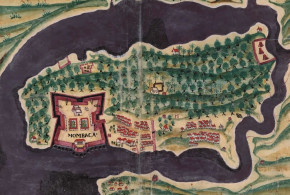
The Turkish raids of 1585 and 1588 were decisive for the Portuguese to decide on the construction of the fort in Mombasa. On 11 April 1593 the fortress was dedicated and named “Fortaleza de Jesus de Mombaça” by Mateus de Mendes de Vasconcelos (he was the captain of the coast, residing at Malindi). The fort was completed in 1596, the plan was a quadrilater with four bastions: S. Felipe, S. Alberto, S. Mathias and S. Mateus. The main gate was near S. Mathias bastion. Above the gate is a Portuguese inscription, which records the dedication to the fort: “Reinando em Portugal Phellipe de Austria o primeiro … por seu mandado ……. fortaleza de nome Jesus de Mombaça a omze dabril de 1593 ….. Visso Rei da Índia Mathias Dalboquerque ……. Matheus Mendes de Vasconcellos que pasou com armada e este porto ……. arquitecto mor da Índia João Bautista Cairato servindo de mestre das obras Gaspar Rodrigues.”

Fort Jesus, located on the edge of a coral ridge overlooking the entrance to the Old Port of Mombasa, was built by the Portuguese in 1593-1596 to protect their trade route to India and their interests in East Africa. It was designed by the Italian architect Giovanni Battista Cairati*. Mombasa became Portugal’s main trading centre along the East Coast of Africa.

The relation between the Portuguese and the Sultan of Mombasa began to deteriorate after the departure of the first captain Mateus de Mendes de Vasconcelos. In 1626 Muhammad Yusif, who had received education in Goa and who was baptized as Dom Jerónimo Chingulia, was made Sultan. On 16 August 1631 the Sultan Dom Jerónimo Chingulia entered the fort and took the Portuguese by surprise. He killed the Portuguese captain Pedro Leitão de Gamboa and massacred the whole Portuguese population of Mombasa (45 men, 35 women and 70 children). A Portuguese expedition was sent from Goa to retake the fort, but after two months of siege (10 January 1632-19 March 1632) they abandoned the enterprise. On 16 May the Sultan abandoned Mombasa and became a pirate. On 5 August 1632 a small Portuguese force under the captain Pedro Rodrigues Botelho, who had remained in Zanzibar, reoccupied the fort.

In February 1661 the Sultan of Oman sacked the Portuguese town of Mombasa, but did not attack the fort. It was in 1696 that a large Omani Arab expedition reached Mombasa. From 13 March 1696 the fort was under siege, the fort having a garrison of 50-70 Portuguese soldiers and several hundred loyal Coast Arabs. The fort was relieved in December 1696 by a Portuguese expedition, but in the following months a plague killed all the Portuguese of the garrison and by 16 June 1697 the defence of the fort was in the hands of Sheikh Daud of Faza with 17 members of his family: 8 African men and 50 African women.

On 15 September 1697 a Portuguese ship arrived with some reinforcement and also at the end of December 1697 another ship came from Goa with a few soldiers. After another year of siege the Portuguese garrison was reduced to the Captain, 9 men and a priest (Fr. Manoes de Jesus) in December 1698.

After a siege of two years and nine months the Omani Arabs took the fort. They could do this, because the garrison was reduced to nine soldiers, the others having died by disease. On the morning of 13 December 1698 the Omani Arabs did the decisive attack and took the fort. Just seven days later a Portuguese relief fleet arrived in Mombasa, but it was too late. With the conquest of Fort Jesus the whole coast of Kenya and Tanzania with Zanzibar and Pemba fell into the hands of the Omani Arabs.

The Portuguese retook the fort in 1728, because the African soldiers in the fort mutinied against the Omanis. The Sultan of Pate, to whom the fort was offered, handed the fort over to the Portuguese on 16 March 1728. In April 1729 the Mombasans revolted against the Portuguese and put under siege the garrison, who was forced to surrender on 26 November 1729.

The Fort is today known as one of the best examples of 16th century Portuguese military architecture. In 2011, Fort Jesus was declared a World Heritage Site by UNESCO.

*Giovanni Battista Cairati, born in Milan, was a leading military architect in the the service of King Philip II of Spain, who was also King of Portugal. He worked in Malacca, Mannar, Ormuz, Muscat, Damão, Bassein and Mombasa. He probably never saw Fort Jesus completed, because he died in Goa in 1596.

FORT JESUS TIMELINE

Mombasa: Fortaleza de Jesus (1593), Forte de São Joseph, Fortim da Ponta Restinga, Forte do Sorgidouro, Fortes da Macupa (three forts).

Portuguese: 11 Apr. 1593 Fortaleza de Jesus – 15 Aug. 1631
Sultan of Mombasa: 15/16 Aug. 1631 – 16 May 1632
Abandoned: 16 May 1632 – 5 Aug. 1632
Portuguese: 5 Aug 1632 – 13 Dec. 1698
Oman: 13 Dec. 1698 – Mar. 1728
Portuguese: 16 Mar. 1728 – 26 Nov. 1729
Oman: Nov. 1729 – 1741
Governor of Mombasa: 1741 – 1747
Oman: 1747
Governor of Mombasa: 1747 – 1828 (English protection 1824-1826)
Oman: 1828
Governor of Mombasa: 1828 – 1837
Oman: 1837 – 1856
Zanzibar: 1856 – 1895
English: 1895 – 1963

The Portuguese built several small forts around Fort Jesus in Mombasa for a better defence of the island. So many documentation exists on Fort Jesus, but about the others nearly nothing. There is also a confusion about the names.

The following list is the result of the research work done by Hans-Martin Sommer, M.A. Marine Archaeologist of the Fort Jesus Museum, Mombasa.

Information and photos by Hans-Martin Sommer (M.A. Marine Archaeologist of the Fort Jesus Museum, Mombasa). 

LIST OF PORTUGUESE FORTIFICATIONS IN MOMBASA:

FORT JESUS: the main Portuguese Fortress.

MAKUPA FORTS (Pos: 04 02′ 12,7″ S 39 39′ 09,7″ E): a small fort (15×15 m) and two towers at each side in a distance of about 100 metres.

“Os tres fortes da Macupa sao tres cazas, que estao feitas em quadro, ao longo do rio, na ilha de Mombaça, pera a banda da terra firme, em hum paço seco, os quaes se fizerao pera tolher a passajem aos Muzungulos da tierra firme pera a ilha. O de meyo he mayor, e nao tem mais que hua caza de sobrado com hua logea em baixo, a que se entra e sobe pella mesma logea (que tera sinco braças de vao tanto de largo como de comprido) cuberta por sima de terrado, onde asistem quinze soldados e hum bombardeiro portugues. Aos soldados se paga dezacete larins cada mes de mantimentos e ao capitao cento e sincoenta xerafins de ordinaria cada anno, o qual capitao o he tambem dos outros dois fortes que lhe fica cada hum de sua ilharga, distancia de hum tiro de espingarda pera cada parte, os quaes tamben sao cada hum hua caza de sobrado cuberta de terrado, mais pequena que o de meyo, que terao tres braças do vao. E asistem sinco soldados em cada hua, que pelejao com seus mosquetes por seteiras que estao feitas a rroda.” Antonio Bocarro “O Livro das Plantas de Todas as Fortalezas, Cidades e Povoaçoes do Estado da India Oriental”

Actual situation: This site was destroyed between 1900 and 1920. Rediscovered on July 2006, were found small wall remains in the ground. At the Eastside of the complex (distance to the fort about 120 m) were found the remains of a “wall, made from sundried bricks”. The east-tower was inside the complex. The other one is probably complete destroyed by the road and railway which leads in a distance of 120 m from the fort. The “Fortes de Macupa” were one fort with towers on each side. In Rezendes map of 1635 you can see the buildings of Makupa in nearly real shape.

Recostruction of Makupa Fort. A sketch by Hans-Martin Sommer after the first excavation and additional description of a german explorer in 1865. Exist an old photo from about 1900 which shows the ruins as very similar to the recostruction sketch.

ST. JOSEPH FORT (Pos: 04 04′ 18,1″ S 39 40′ 56.1″ E): a horseshoelike fortification in good condition. At about 100 metres distance to St. Joseph it was the Portuguese chapel “Nossa Senhora das Merces” (Pos: 04 04′ 21,2″ S 39 40′ 50,7″ E).

At about 100 metres distance to St. Joseph there used to be the Portuguese chapel “Nossa Senhora das Mercês” (Pos: 04 04′ 21,2″ S 39 40′ 50,7″ E).

GOLF COURSE FORT (Pos: 04 04′ 20,8″ S 39 39′ 07,5″ E): a few remains near the Golf Course.

HORSE SHOE FORT (Pos: 04 04′ 43,8″ S 39 40′ 20,2″ E): a very small fortification in good condition. Horseshoe Fort is a small bastion in good condition, no much infos available about its history

FORT OF THE ANCHORAGE (Pos: 04 04′ 33,06″ S 39 39′ 52,33″ E): also called ‘the round fort’ or ‘the hexagonal fort”, completly gone.

BIBLIOGRAPHY:

– Hinawi Mbarak Ali “Al Akida and Fort Jesus, Mombasa” 85 pp. East African Literature Bureau, 1950, Nairobi, Kenya.

– Boxer,Ch.R. – de Azevedo,C. “A fortaleza de Jesus e os Portugueses em Mombaça 1593-1729” 127 pp. 6 maps, Centro de Estudos Historicos Ultramarino, 1960 Lisboa, Portugal. History of Mombasa under the Portuguese, description of Fort of Jesus.

– Freeman-Grenville, G. S. P. “The Portuguese on the Swahili Coast: buildings and language” In STUDIA N° 49, pp. 235-253, 1989, Lisbon, Portugal.

– Kirkman,J. “Fort Jesus: a Portuguese fortress on the East African coast” 327 pp. 38 maps, Oxford University Press, 1974 London, United Kingdom. Detailed description of Fort Jesus by an archeological point of view.

– Nelson, W.A. “Fort Jesus of Mombasa” 84 pp. Canongate Press, 1994, Edinburgh, UK

– Pearson,M.N. “Port cities and intruders: the Swahili Coast, India and Portugal in the Early Modern Era” 202 pp. 2 maps, The Johns Hopkins University Press, 1998, Baltimore and London. Index: The Swahili coast and the Afrasian sea; the Swahili coast and the interior; East Africa in the world-economy; the Portuguese on the coast.

Written by Marco Ramerini. English text revision by Dietrich Köster.

Some old walls inside Fort Jesus, Mombasa. Author and Copyright Dietrich Köster
Cannons and buildings inside Fort Jesus, Mombasa. Author and Copyright Dietrich Köster..
This is the plaque presented by the Oman embassy in Kenya to the National Museum of Kenya with some historical dates of Fort Jesus. Author and Copyright Dietrich Köster.
This gun was salvaged from the German warship Konigsberg in World War I. Author and Copyright Dietrich Koster