Categories
America Portuguese Colonialism

America. Portuguese Colonial Remains 16th-18th centuries

Written by Marco Ramerini. English text revision by Dietrich Köster.

If you know something on colonial remains or if you have photos of such remains – they may be anywhere in the world -, send them to me. I’ll be happy to publish them on this website. Thank you. Marco. My e-mail is on the home page.

PORTUGUESE COLONIAL REMAINS

SOUTH AMERICA

BRAZIL

Peoples, Portuguese language, religion, surnames, culture …

HISTORICAL TOWNS

ALAGOAS: Penedo.

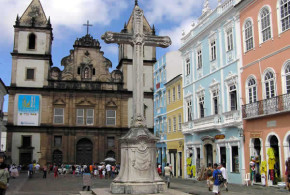
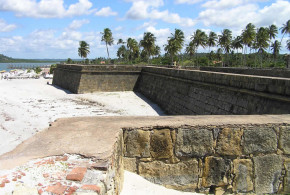
BAHIA: Salvador, Porto Seguro, Nazaré.

ESPIRITO SANTO: São Matheus, Vila Velha, Anchieta.

FERNANDO DE NORONHA: Vila dos Remédios (Igreja de Nossa Senhora dos Remédios (1772)), Forte de Nossa Senhora dos Remédios (1737) and the ruins of several other forts.

[divider]

[divider]

MARANHÃO: São Luís do Maranhão, Alcântara.

MINAS GERAIS: Ouro Preto, Congonhas, Sabará, Tiradentes, São João del Rei.

PARAIBA: João Pessoa

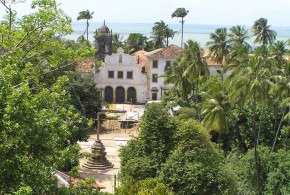
PERNAMBUCO: Recife, Olinda, Igaraçu, Itamaracá.

[divider]

[divider]

RIO DE JANEIRO: Parati (National Monument), Angra dos Reis.

RIO GRANDE DO SUL: São José do Norte.

SERGIPE: São Cristóvão.

FORTRESSES

BAHIA: Casa da Torre de Garcia d’Ávila (1551-today), Forte de Santo Antônio da Barra (Salvador)(1583-today), Forte de Nossa Senhora de Mont Serrat (Salvador)(1586-today), Forte de Santo Alberto (1590-today), Portas de São Bento (século XVII-1732), Reduto de Água de Meninos (século XVII-1637), Forte de São Marcelo (Salvador)(1608-today), Forte de São Diogo (1609-today), Forte de Santa Maria (Salvador)(1614-today), Forte de São Pedro (Salvador)(1627-today), Fortim da Forca (1630-1???), Fortaleza do Morro de São Paulo (1631-today), Forte de São Lourenço (Itaparica)(1631-today), Forte de Nossa Senhora do Monte do Carmo [do Barbalho] (Salvador)(1638-today), Forte de São Paulo da Gamboa (Salvador)(1646-today), Forte de Santo Antônio Além do Carmo (1694-19??), Forte do Paraguaçú (16??-1???), Forte de São Bartolomeu da Passagem (séc. XVII-1900), Reduto do Rio Vermelho (1711-1759), Fortim de São Fernando (1797-1???), Forte de Santa Cruz do Paraguaçú (séc. XVIII-1???), Fortim da Ribeira (1???-1???), Fortim de Pinaúnas (1???-1???), Fortim de São Filipe (1???-1???), Fortim de São Tiago e São Filipe (1???-1???), Forte Jequitaia (1???-18??), Reduto da Costa (1???-1???), Redutos do Soubára (1822-23), Baterias de Santo Amaro (1822-23), Bateria da Ilha de Cajaíba (1822-23), Redutos da Vila de São Francisco (1822-23).

For this list my thanks to Carlos Luís da Cruz. 

[divider]

[divider]

MARANHÃO: Fortaleza de Santo Antonio (Sao Luis do Maranhao)

PERNAMBUCO: Fortaleza de Orange (Itamaraca), Forte de Cinco Pontas (Recife), Forte do Brum (Recife), Forte de São Francisco (Olinda)

[divider]

[divider]

RIO DE JANEIRO: Forte da Lage (1555-today), Fortaleza de Santa Cruz da Barra (1555-today), Fortaleza de São João da Barra (1565-today), Fortaleza de São Francisco Xavier de Villegaignon (1567-1938), Forte do Pico (1567-today), Fortaleza de São Sebastião (1567-1920), Forte de São Tiago da Misericórdia (1603-today), Forte de Santa Cruz (1605-1632), Forte de Santo Antônio de Monte Frio (1613-1900), Forte de Santo Inácio (1615-1616), Forte de São Matheus do Cabo Frio (1616-today), Fortaleza de São Francisco Xavier da Ilha das Cobras (1624-19??), Forte de Nossa Senhora da Boa Viagem (1695-19??), Forte de Gragoatá (1696-today), Forte da Praia Vermelha (1710-1935), Reduto de São Januário (1710-1920), Forte de Nossa Senhora da Conceição (1711-today), Forte Duque de Caxias (1769-today), Forte de São Luís (1775-today), Bateria da Glória (1791-1???), Bateria do Arsenal (1791-1???), Forte Caetano Madeira (1793-1???), Forte Barão do Rio Branco (séc. XVIII), Forte de Santa Teresa (séc. XVIII), Forte de São Diogo (séc. XVIII), Forte Defensor Perpétuo (1822-today), Forte de Nossa Senhora da Glória do Campinho (1822-19??), Forte do Imbuhy (1863-today), Forte de Marechal Hermes (1900-today), Forte de Copacabana (1908-today).

For this list my thanks to Carlos Luís da Cruz. 

RONDÔNIA: Forte Príncipe da Beira (1776/1783-today).

For this my thanks to Carlos A. Páscoa Machado. 

PARAÍBA : Fortaleza de Santa Catarina (Cabedelo), Forte Velho (Cabedelo)

RIO GRANDE DO NORTE : Forte dos Reis Magos (Natal)

To be completed

[divider]

[divider]

CARIBBEAN

JAMAICA

Many Portuguese Jews settled in Jamaica in the 1500s. The Jamaica patois is a mixture of Dutch, Spanish, Portuguese, English, German etc….

For this info my thanks to Jacqueline Brooks from the UK.

URUGUAY

Colonia do Sacramento: ruins of the town (Barrio historico, fortifications, churches, houses (1680)). Fortaleza de Santa Teresa (1762). Forte de San Miguel.

For this info my thanks to Mario Luis Pienovi Eyras. 

NORTH AMERICA

USA

Dighton (Massachusetts): Dighton Rock, a rock with the name of a Portuguese captain (Miguel Cortereal) and the date 1511 inscribed on the rock. (Is it Portuguese ?)

Newport (Rhode Island): Newport Tower. (Is it Portuguese ?)

Ninegret (Rhode Island): Ninegret Fort. (Is it Portuguese ?)

For this info my thanks to Dr. Manuel Luciano da Silva.

Categories
America Dutch Colonialism

America. Dutch Colonial Remains 16th-18th centuries

Written by Marco Ramerini. English text revision by Dietrich Köster.

If you know something on colonial remains or if you have photos of such remains – they may be anywhere in the world -, send them to me. I’ll be happy to publish them on this website. Thank you. Marco. My e-mail is on the home page.

BRAZIL

Dutch surnames.

Itamaracá: Fortaleza de Orange.

Recife: Forte do Brum (1631), Forte das Cinco Pontas (1630).

GUYANA

Dutch Creole language (Berbice Creole Dutch, Skepi Creole Dutch Essequibo). The Dutch Creole languages in Guyana are nearly extinct.

Bartica: ruins of Fort Kykoveral (1616).

Berbice River: ruins of Fort Nassau.

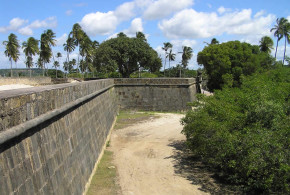
Flag or Fort Island (Essequibo River): Fort Zeelandia (well-preserved).

JAMAICA

The Jamaica patois is a mixture of Dutch, Spanish, Portuguese, English, German etc…. In Jamaican history there was an influx of at least 1,000 Suriname settlers in the parish of St. Elizabeth, Jamaica. They were granted British Citizenship from the British when the British defeated the Dutch in Suriname in the 1600’s.

For this info my thanks to Jacqueline Brooks from United Kingdom.

NETHERLANDS ANTILLES

Dutch language, Dutch surnames.

Willemstad (Curacao): Punda Quarter (17th-18th century), Otrobanda Quarter (late 17th century), Handelskade, Waterfront, Governor’s Building, Fort Amsterdam, Fort Nassau, Riffort, Synagogue “Mikve Israel or Emanuel” (1732), Fort Kerk Garrison Church, St Anna Basilica (1734).

Oranjestad (Aruba): Fort Zoutman (18th century).

Saba:

Kralendijk (Bonaire): Fort Oranje (19th century).

Philipsburg (St. Maarten): Only a few ruins and some old cannons remain of Fort Amsterdam (1631).

Oranjestad (St. Eustatius): Fort Oranje (1636), Government‘s House (18th c..), Simon Doncker House (1770s.), Synagogue “Honen Dalim” (1739), Jewish Cemetery, ruins of Dutch Reformed Church (1755). Remains of several Dutch batteries around the Island (Fort De Windt, etc.), ruins of Lower Town (18th c.).

[divider]

[divider]

SURINAME

Dutch language, Dutch surnames.

Paramaribo: Fort Zeelandia (1667), Synagogue, old buildings, Hervormde Church.

Nieuw Amsterdam: Fort Nieuw Amsterdam, church.

Jodensavannah: ruins of a Jewish/Brazilian colony (1650s).

TRINIDAD AND TOBAGO

Scarborough (Tobago): part of the area around the harbour is still called Dutch Fort, but nothing remains of it.

USA

New York State: many people with Dutch descent, Dutch surnames. Streetnames in Manhattan still point to the dutch past. Parts of New York City are named after original Dutch colonial settlements: Brooklyn, after Breukelen, Harlem after Haarlem. Staten Island, was originally called Staten Eylandt after the Dutch parliament (Staten) who payed for the expeditions up the Hudson river. The place Old Town on Staten Island was originally called Oude Dorp. The current name is merely the translation of the old name into English.

For this info my thanks to Ton Zijlstra from The Netherlands

Croton on Hudson (New York State): van Cortlandt Manor (1639).

For this info my thanks to Michael D. Bathrick from USA 

Albany (New York State): Thousands of artifacts and remains of a 14-foot-long, 5-foot-high wall were recovered in rescue excavations at the Dutch colonial site of Fort Orange in Albany, New York, in: “Archaeology” Newsbriefs, Volume 50 Number 3 May/June 1997

For this info my thanks to Michael D. Bathrick from USA 

Branford (Connecticut): archeological remains of the Dutch fort “Goede Hoop”

For this info my thanks to Michael D. Bathrick from USA 

Claverack, Columbia County: Locals pronounce it in two and a half syllables, “CLAH (va) rek.” From two Dutch words, klaver, meaning “clover,” perhaps for the scalloped marks on the bank of the river resembling three-leafed clover, and rack, a straight stretch of a waterway (the Hudson River) between two points.

For this info my thanks to Michael D. Bathrick from USA 

Cobleskill, Schoharie County: Named after Jacob Kobel, an early Palatine German settler. The creek on which he lived became known as Cobus Kill by Dutch residents, and soon, the nearby community was called Cobleskill.

For this info my thanks to Michael D. Bathrick from USA 

(East and North) Greenbush, Rensselaer County: A Dutch map of 1656 refers to this area as grenen bos, meaning “pine wood”.

For this info my thanks to Michael D. Bathrick from USA 

Guilderland, Albany County: Named not for the Dutch coin called a guilder, but instead after the province of Gelderland in the Netherlands.

For this info my thanks to Michael D. Bathrick from USA 

Kinderhook, Columbia County: Translates to “children’s corner” or “children’s point.” Along this early navigational point on the Hudson River, it is thought that objects (or real people) on the shore resembled a group of children.

For this info my thanks to Michael D. Bathrick from USA 

Lindenwald, in Kinderhook: The home of the eighth U.S. president, Martin van Buren, who was born in Kinderhook of Dutch ancestry. The name refers to the property’s linden trees plus the Dutch word woud, meaning “forest.”

For this info my thanks to Michael D. Bathrick from USA 

Muitzes Kill, Rensselaer County: From the Dutch word mutsje, meaning “shot glass,” probably a nickname of an imbibing settler there.

For this info my thanks to Michael D. Bathrick from USA 

Moordener’s Kill: Reputed to commemorate a murder along the stream.

For this info my thanks to Michael D. Bathrick from USA 

Nassau, Rensselaer County: Nassau, the county, where Prince Willem van Oranje (William of Orange) was born, was given to several places in New Netherland.

For this info my thanks to Michael D. Bathrick from USA 

Plattekill, Ulster County: Plat kil refers to a calm stream. Plat means flat and describes water without strong currents or turbulence.

For this info my thanks to Michael D. Bathrick from USA 

Poestenkill, Rensselaer County: Possibly from the Dutch word poesten, which means “foaming water.” But more likely from the nickname “Poest” for Jan Barentzen Wemp, who operated a farm and grist mill in the town in the 17th century. (“Poest” can mean a bump on the face or to breathe heavily, suggesting Wemp may have had a large nose or asthma.)

For this info my thanks to Michael D. Bathrick from USA 

Rensselaer, Rensselaer County: Kiliaen van Rensselaer was the Dutch West India Co. director and patroon of Rensselaerswijck, encompassing what is both Albany and Rensselaer counties today.

For this info my thanks to Michael D. Bathrick from USA 

Saugerties, Ulster County: Recorded in 1663 as Zagers Killetje, meaning “sawyers creek,” for its sawmills.

For this info my thanks to Michael D. Bathrick from USA 

Stuyvesant, Columbia County: Named after the director general of New Netherland, Petrus (Peter) Stuyvesant.

For this info my thanks to Michael D. Bathrick from USA 

Tappan Zee Bridge: A combination of the local Tappan Indians and the Dutch word zee for “sea” or an “open expanse of water.”

For this info my thanks to Michael D. Bathrick from USA 

Valatie, Columbia County: Pronounced “vah-LAY-shah,” from the Dutch words, val, “falls” (waterfalls), and je, “little,” to form valletje, meaning “little falls.” The village has three falls today, created by the Valatie Kill and the Kinderhook Creek.

Vley Road in Scotia and Vly Road in Colonie: From the Dutch words vly, vley, vla vlij, which all come from vallei, meaning “valley.”

Voorheesville, Albany County: Named after an early Dutch settler Steven Coerts van Voorhees from Hees in the province of Drenthe in the Netherlands.

Watervliet, Albany County: From vlakte, meaning “overflowed plains,” or the verb vlieten, meaning “streaming” or “flowing.”

Wynantskill, Rensselaer County: Wijnant Gerritsen van der Poel was a kistemaecker (a furniture maker and carpenter) who bought a sawmill near the town on the east bank of the Hudson River.

For this info my thanks to Michael D. Bathrick from USA 

Ten Broeck Street, Albany: From the Dutch settler Dirck Wesselse Ten Broeck (Dirck, son of Wessel, who lives in Broeck, a trader and the mayor of Albany from 1696 to 1698.

For this info my thanks to Peter Slegers The Netherlands

BRITISH VIRGIN ISLANDS

Road Town (Tortola): foundation remains of Fort Burt.

West End (Tortola): remains of Fort Recovery (1660).

US VIRGIN ISLANDS

Dutch Creole language (Negerhollands: St. Thomas and St. John islands). The Dutch Creole language is nearly extinct, there are remaining, only, a few second language speakers.

Categories
Africa America Asia Danish Colonialism

List of Danish colonial forts and possessions

Written by Marco Ramerini

DANISH COLONIAL SETTLEMENTS

ASIA

INDIA:

Tranquebar (Dansborg castle):

Danish: 1620-May 1801

English: (May 1801-Aug. 1802)

Danish: Aug. 1802-1808

English: (1808-20 Sep. 1815)

Danish: 20 Sep. 1815-7 Nov. 1845

English occupation: (7 Nov. 1845- 1947)

(U. B. J. p 41, 44) (H.F. p 298)

Pipely (Pipli): factory

1625- abandoned before 1643 (U. B. J. p 28)

Masulipatam: factory

1626 -abandoned before 1643 (U. B. J. web site)

Balasore: factory

1636-abandoned before 1643 1763-1845 (C. p 126) (U. B. J. web site)

Oddeway Torre (Malabar coast):

factory 1696 – 1722 (U. B. J. web site)

Gondalpara (Dannemarksnagore) (S-E of Chandernagore): Fortified factory

A part of Gondalpara is still (1919) called “Dinemardanga”, that is the land of the Danes.

1698/1700-1714 abandoned (C. p 126+U. B. J. p 28)

Calicut: factory

1752-1791 abandoned (U. B. J. p 29, 37)

Serampore (Frederiksnagore):

Danish: Oct. 1755-1808

English: (1808-1815?)

Danish: 1815 ?-11 Oct. 1845

English: (11 Oct. 1845-1947)

(C. p 126) (U. B. J. p 28, 41, 44) (H.F. p 302) (R. p 232)

Colachel (Malabar coast): factory

1755-1824 abandoned (U. B. J. p 29, 37)

NICOBAR ISLANDS (Frederik Oerne islands):

Grand Nicobar (Sambellong, northern side of the island):

1754/56-1760 abandoned (B2 p?) (R. p 232)

Kamorta island (Canlaha or Frederikshoi):

1760- 1768 abandoned (B1 p?) (B2 p?)

Nangkowry island:

Danish: 1768 Danish Mission -1773 abandoned

Danish: 1784 -1807/9 abandoned

Danish: 1830-1834 abandoned

Danish: 1846- ? abandoned

Denmark officially handed over the rigths of the Nicobar Islands to the British on 16 October 1868.

(B1 p?) (B2 p?) (U. B. J. p 29, 30)

SRI LANKA:

Trincomalee:

1620-1621 attempt to build a fort (U. B. J. p. 11,12)

INDONESIA:

Macassar (Sulawesi island): factory

? (H.F. p 326)

Bantam (Java island): factory

?-1682 (H.F. p 300)

AFRICA:

SIERRA LEONE:

Bagos:

16 lodge – 16

1661 lodge – Dec. 1662 destroyed by the Dutch (Nørregård “Danish settlements in West Africa 1658-1850” p. 25)

GHANA:

Cape Coast or Cabo Corço (Swedish name: Carolusborg or Carlsborg):

The Portuguese, English and Dutch had trading lodges in Cape Coast, but when the Swedes arrived they were unoccupied.

Swedish: (Apr. 1650 fort Carolusborg – Jan./Feb. 1658)

Danish: Jan./Feb. 1658 – 16 Apr. 1659

Dutch: (16 Apr. 1659- May/Jun. 1659)

Fetu: (May/Jun. 1659 – 10 Dec. 1660)

Swedish: (10 Dec. 1660 – 22 Apr. 1663)

Dutch: (22 Apr. 1663 – 3 May 1664)

English: (3 May 1664 – 1957)

(According to Nørregård “Danish settlements in West Africa 1658-1850”)

Dutch: 1638 factory – ? abandoned

Swedish: (1657-1658) the Swedes built the fort in 1657

Danish: 1658 – Apr. 1659

Dutch: (Apr. 1659-1659)

Fetu: (1659- 10 Dec. 1660)

Swedish: (10 Dec. 1660 -1660)

Danish: 1660-1663

Fetu: (1663-1663)

Dutch: (1663-1664)

English: (1664-1957)

(According to Lawrence “Trade castles and forts of West Africa” p 198)

Cape Coast or Cabo Corço:

Danish: 1659 lodge – 23 Mar. 1664 destroyed by the Dutch

Danish: May 1664 lodge – ?

(Nørregård “Danish settlements in West Africa 1658-1850” p. 26)

Cong (Cong Height):

Dutch: (? – 1659 abandoned)

Danish: 1659 – 24 Apr. 1661 destroyed by the Dutch

(Nørregård “Danish settlements in West Africa 1658-1850” p. 24)

Gemoree or Jumoree: 

Its location is not known.

Swedish: (165 ? fortified lodge – 1658)

Danish: 1658 – ? (Nørregård “Danish settlements in West Africa 1658-1850”)

Takoradi: (04°53’N – 01°45’W)

Swedish: (1653 fortified lodge – 1658)

Danish: 1658 – Apr. 1659 abandoned

Adja or Agga:

1658 lodge – ? (Nørregård “Danish settlements in West Africa 1658-1850”)

Anomabu:

Dutch: (1640 lodge – ?)

Swedish: (1652 lodge – 1658)

Danish: 1658 lodge – Apr. 1659 abandoned

Dutch: (lodge)

English: (166 ? lodge – ?)

(Van Dantzig “Les Hollandais sur la côte de Guinée 1680-1740”, A. W. Lawrence “Trade castles and forts of West Africa” p. 198, Nørregård “Danish settlements in West Africa 1658-1850”)

Amanful or Amanfro, Cape Coast (Ft. Fredriksborg or Frederiksberg): 

Danish: 1659 fort – 16 Apr. 1685

English: (16 Apr. 1685 – ) called by the British: Fort Royal.

(L. p 199) (E. p. 32; 40; 85) (Nørregård “Danish settlements in West Africa 1658-1850” )

Accra-Osu (Ft.Chistiansborg): 

Swedish: (1652 fortified lodge – 1658)

Danish: 1658 lodge – Apr. 1659 abandoned

Danish: 1661 fort – Dec. 1680

Portuguese: (Dec. 1680-29 Aug. 1682) abandoned

Akwamu: (Sep. 1682-Feb. 1683)

Danish: Feb. 1683-1693

Akwamu: (1693-1694)

Danish: 1694-1850

English: (1850-1957) (L. p 199-217)

(V. p 202-204) (E. p.83) (Nørregård “Danish settlements in West Africa 1658-1850” p. 10)

Provesten:

Watch-tower situated several hundred yards west of Christiansborg.

Before 1729-1850

Ningo (Ft.Fredensborg): 

Danish fort 1734 – Mar. 1850

English: (Mar. 1850-1957)

(E. p. 32; 40; 83)

Ada (Ft. Kongensten): 

Danish fort 1784 – Mar. 1850

English: (Mar. 1850-1957)

(E. p. 32; 40; 83)

Teshe (Ft. Augustaborg): 

Danish fort 1787- Mar. 1850

English: (Mar. 1850-1957)

(L. p 87) (E. p. 32; 40; 83)

Keta (Ft. Prinsensten):

Danish: lodge 1780 fort 1784 – 12 Mar. 1850

English: (12 Mar. 1850-1957)

(L. p 361-368) (E. p. 32; 40; 83)

Kpomkpo (Frederiksberg):

Hill-station 1788- ? (L. p 43)

SÃO TOMÉ:

São Tomé: lodge ?

Nørregård “Danish settlements in West Africa 1658-1850” p. 30

AMERICA, CARIBBEAN:

VIRGIN ISLANDS:

St. Thomas Island:

Danish: 1672- Apr. 1801

English: (Apr. 1801-Feb. 1802)

Danish: Feb. 1802-1807

English: (1807-1815)

Danish: 1815-31 Mar. 1917 (31 Mar 1917 sold to USA).

(W. p 2, 251, 261)

St. Jan Island (St. John):

Danish: 1716/17- Apr.1801

English: (Apr. 1801-Feb. 1802)

Danish: Feb. 1802-1807

English: (1807-1815)

Danish: 1815-31 Mar. 1917 (31 Mar 1917 sold to USA).

(W. p 2, 251, 261)

St. Croix Island:

French: (? -1733)

Danish: 1733 – Apr. 1801 (The Danes purchased St. Croix from France in 1733)

English: (Apr. 1801-Feb. 1802)

Danish: Feb. 1802-1807

English: (1807-1815)

Danish: 1815-31 Mar. 1917 (31 Mar 1917 sold to USA).

(W. p 2, 251, 261)

GREENLAND:

ICELAND:

FAROE:

Legend:
U.B.J.= Uno Barner Jensen “Danish East India: trade coins and the coins of Tranquebar” Brovst, 1997
C.= Campos “History of the Portuguese in Bengal” Calcutta, 1919
B1= Babudieri “L’espansione mercantile Austriaca nei territori d’oltremare nel XVIII sec. e i suio riflessi politici ed economici” Milano, 1978
B2= Babudieri “Trieste e gli interessi Austriaci in Asia nei sec. XVIII-XIX” Padova, 1966
W= Westergaard “Danish West Indies under company rule 1671-1754, with a supplementary chapter 1755-1917” New York, 1917
L.= Lawrence “Trade castles and forts of West Africa” London, 1963
V.= Vogt “Portuguese rule on the Gold Coast 1469-1682” Athens, 1979
H.F.= Holden Furber “Imperi rivali nei mercati d’oriente 1600-1800” Bologna, 1986 English edition: “Rival Empires of trade in the Orient 1600-1800” Minneapolis, 1976
R.= Reinhard “Storia dell’espansione europea” Napoli, 1987 German edition: “Geschichte der europäischen Expansion” Stuttgart, 1983
E.= Epson “Ancient forts and castles of the Gold Coast (Ghana)” 1970

Categories
America Dutch Bibliographies Dutch Colonialism

America. Bibliography of Dutch Colonial History 17th-18th century

Written by Marco Ramerini. English text revision by Dietrich Köster.

DUTCH EMPIRE: AMERICA

NORTH AMERICA

– Various Authors, “The Colonial History of New York under the Dutch”, CD-Rom in 5 volumes. Includes: “Narratives of New Netherland” (Jameson), “History of New Netherland” (O’Callaghan), “History of New York” (Brodhead) and also includes Cadwallader Colden and four Munsell tracts, edited by O’Callaghan.
– Various Authors “A brief outline of Dutch history and the province of New Netherland”, Internet article.

– Armstrong, Edward, “The History and Location of Fort Nassau on the Delaware”, in: “Proceedings of the New Jersey Historical Society”, n° 6, 1853, pp. 187-207.

– Bachman, van Cleaf, “Peltries or Plantations: The Economic Policies of the Dutch West India Company in New Netherland, 1623-1639”, Johns Hopkins Press, 1969, Baltimore, USA.

– Bonine, Chesleigh A., “Archeological Investigations of the Dutch “Swanendael” Settlement under Devries, 1631-1632″, in: “The Archeologue”, n° 8,(3), 1956

– Cohen, David, “How Dutch were the Dutch of New Netherland?”, in: New York History Journal, 1981.

– Condon, Thomas J., “New York Beginnings: The Commercial Origins of New Netherland”, New York University Press, 1968, New York, USA.

– Fernow, Berthold, “New Netherlands Documents: The Records of New Amsterdam: From 1653 to 1674”, 7 vols., Syracuse University Press.

– Folkerts, Jan, “The failure of the West India Company farming on the island of Manhattan”, Article on the internet: “The American Revolution project”.

– Gehring, Charles T., “New Netherlands Documents: Correspondence, 1647-1653”, Syracuse University Press.

– Gehring, Charles T., “New Netherlands Documents: Council Minutes, 1655-1656”, Syracuse University Press.

– Gehring, Charles T., “New Netherlands Documents: Fort Orange Court Minutes, 1652-1660”, Syracuse University Press.

– Gehring, Charles T., “New Netherlands Documents: Fort Orange Records, 1656-1678”, Syracuse University Press.

– Gehring, Charles T., “New Netherlands Documents: Laws and Writs of Appeal”, Syracuse University Press.

– Gehring, Charles T. & Starna, William A., “A Journey into Mohawk and Oneida Country, 1634-1635: The Journal of Harmen Meyndertsz van den Bogaert”, Series: “The Iroquois and their neighbors”, Syracuse University Press.

– Griffis, W. E. “The story of New Netherland. The Dutch in America”, 292 pp., Houghton, 1909, Boston/New York, USA. – Heywoood, Linda M. & Thornton, John K., (2007) “Central Africans, Atlantic Creoles and the making of the Foundation of the Americas, 1585-1660”, Cambridge and New York : Cambridge University Press.

– Hiss, Philip Hanson, “Netherlands America: the Dutch territories in the West”, xxiii, 225 pp., 64 pp. of photos, Duell, Sloan and Pearce, 1943, New York, USA. A study of the territories of the Netherlands in the Western Hemisphere from the discovery of the New World to the present day.

– Huey, Paul R., “Aspects of Continuity and Change in Colonial Dutch Material Culture at Fort Orange, 1624-1664”, unpublished Ph.D. dissertation, Department of American Civilization, University of Pennsylvania, 1988.

– Huey, Paul R. “The Dutch at Fort Orange”, in: “Historical Archaeology in Global Perspective”, edited by Lisa Falk, pp. 21-67, Smithsonian Institution Press, 1991, Washington and London.

– Huey, Paul R., “The Archeology of Fort Orange and Beverwijck”, in: “A Beautiful and Fruitful Place: Selected Rensselaerswijck Seminar Papers”, edited by Nancy Anne McClure Zeller, pp. 326-349, New Netherland Publishing, 1991, Albany, New York.

– Innes, J. H. “New Amsterdam and its People. Studies, Social and Topographical of the Town under Dutch and Early English Rule”, 365 pp., 35 maps, Charles Scribner’s Sons, 1902, New York, NY, USA. Princeton University Press, 1902, Princeton, USA.

– Jameson, J. Franklin “Narratives of New Netherland 1609-1664”, 480 pp., Charles Scribner’s Sons, 1909, New York, USA.

– Jameson, J. Franklin, “Willem Usselinx: founder of the Dutch and Swedish West India Companies”, 234 pp., Papers American Historic Association 2(2), 1887, NY, USA.

– Kupp, T. J., “Fur trade relations, New Netherland – New France; a study of the influence exerted by the fur trade interests of Holland and New Netherland on the settlement of New France during the years 1600 to 1664”, Ph.D. Thesis University of Manitoba, 1968.

– Lowensteyn, Peter, “The role of the Dutch in the Iroquois wars”, Internet article. – Meurs, Paul, “Nieuw Amsterdam op Manhattan 1625-1660”, in: Various Authors, “Vestingbouw overzee. Militaire architectuur van Manhattan tot Korea”, pp. 19-31, Vestingbouwkundige bijdragen, Walburg Pers, 19–, The Netherlands.

– Murray, Jean E., “The fur trade in New France and New Netherland prior to 1645”, Ph.D. Thesis University of Chicago, 1937.

– O’Callaghan, E. B., “The History of New Netherland”, 2 vols., D. Appleton, 1848, New York, USA.

– Otto, Paul Andrew, “New Netherland frontier: Europeans and Native Americans along the lower Hudson River 1524-1664, 269 pp., Ph.D. Thesis Indiana University, 1995.

– Rink, Oliver, “The people of New Netherland: notes on non-English immigration to New York in the seventeenth century”, in: New York History Journal, 1981.

– Rink, Oliver, “Holland on the Hudson: The Economic and Social History of Dutch New York”, 1986, Ithaca and London.

– Shattuck, M. Dickinson, “A civil society: court and community in Beverwijck, New Netherland 1652-1664”, 325 pp., Ph.D. Thesis Boston University, 1993.

– Schomette, Donald G. and Haslach, Robert D., “Raid on America: The Dutch Naval Campaign of 1672-1674”, 386 pp., University of South Carolina Press, 1988, Columbia, South Carolina, USA. Reconstructs the Evertsen expedition from contemporary English and Dutch records, journals, secret minutes and narratives, a campaign that resulted in a major naval invasion of the Chesapeake Bay, the capture or destruction of nearly 200 English and French vessels and the reconquest and restoration of New York, New Jersey and Delaware to the United Provinces of the Netherlands’ control.

– Schomette, Donald G. “The Empire strikes back. On the East End in 1674: the military and political contest for dominion of the East riding townships during the Third Anglo-Dutch War”, Internet article. Lecture delivered on 12 September 1998.

– Teensma, B. N., “Take Florida or the unattended project of a Dutch Sephardi phantast”, in: “Itinerario”, vol. XXI, 3/1997 pp. 142-150.

– Trelease, Allen W., “Indian relations and the fur trade in New Netherland 1609-1664”, Ph.D. Thesis Harvard University, 1955.

– Ward, C., “The Dutch and Swedes on the Delaware 1609 – 1664”, 393 pp., University of Pennsylvania Press, 1930 Philadelphia, Pennsylvania, USA.

– Welling, George, “The United States of America and the Netherlands”, article on the internet: “The American Revolution project”.

– Weslager, C.A., “Dutch explorers, traders and settlers in the Delaware valley 1609-1664”, 329 pp., illustrations, University of Pennsylvania Press 1961, Philadelphia, U.S.A.

– Zwierlein, L. D., “Religion in New Netherland: A History of the Development of the Religious Conditions in the Province of New Netherland 1623-1664”, 327 pp., John Smith Printing Co, 1910, Rochester, New York, USA.

CARIBBEAN, GUYANAS:

– Various Authors “Graveyard at Jodensavanne: translation of the tombstone in English” (wanting)

– Archibald, D. “Tobago: melancholy isle, vol. I 1498-1771” 137 pp. Westindiana, 1987, Port of Spain, Trinidad & Tobago. Chapter I, The Caribs of the Island of Tabaco; Chapter II, the European Presence 1498-1627; Chapter III, Early Settlements 1628-1637; Chapter IV, The Courland Adventure 1639-1690; Chapter V, the Dutch at Roodklyp Bay 1654-1678; Chapter VI, Captain John Poyntz 1666-1704; Chapter VII, A neutral Island 1683-1686; Chapter VIII, the British settle Tobago 1763-1771.

– Benoit, P.J., “Post Gelderland en de Joden-Savanna van de rivierzijde gezien”.

– Bethencourt, Cardozo de, “Notes on the Spanish and Portuguese Jews in the United States, Guiana and the Dutch and British West Indies during the seventeenth and eighteenth centuries”, in: A.J.H.S., n° 29, 1925.

– Böhm, Günter, “The first Sephardic Synagogues in South America and in the Caribbean area”, in: “Studia Rosenthaliana” vol. XXII.

– Böhm, Günter, “The first Sephardic Cemeteries in South America and in the West Indies”, in: “Studia Rosenthaliana” vol. 25/1, 1991.

– Böhm, Günter, “The Synagogues of Surinam”, in: “Journal of Jewish Art” vol. 6, 1978.

– Bosman, L., “De ontwerpen van François Samel de Veye (1726-1797) voor Berbice”, in: Various Authors, “Vestingbouw overzee. Militaire architectuur van Manhattan tot Korea”, pp. 44-63, Vestingbouwkundige bijdragen, Walburg Pers, 19–, The Netherlands.

– Bruyn, Adrienne and Veenstra, Tonjes, “The creolization of Dutch”, pp. 29-80, Journal of Pidgin and Creole Languages (JPCL), N° 8/1 (April 1993), John Benjamins Publishing Company. Investigation of certain grammatical aspects of three languages that came about as by-products of colonial expansion of the Dutch during the seventeenth century: Afrikaans, Negerhollands, and Berbice Dutch.

– Byams, William, “Journal of Guiana, 1665 to 1667”, British Library Mss n° 3662, fol. 27-37.

– Bubberman, F. C., “Tobago en zijn Nederlands verleden”, in: Various Authors, “Vestingbouw overzee. Militaire architectuur van Manhattan tot Korea”, pp. 37-43, Vestingbouwkundige bijdragen, Walburg Pers, 19–, The Netherlands.

– Carmichael, Gertrude, “The history of the West Indian Islands of Trinidad and Tobago, 1498-1900”, 463 pp., 8 plates, 1961, London, United Kingdom.

– Edmundson “The Dutch in Western Guiana”, English historical review: 1901, Vol. XVI 640 – 675 pp. An interesting article on the first period of Dutch settlements in Guiana and Tobago. There is also some information about the Courland attempts of colonizing Tobago.

– Efraim, Frank Martinus, “The Kiss of a Slave: Papiamentu’s West-Africa Connections”, Ph.D. thesis, University of Amsterdam, 1996, Reprinted with corrections in Curaçao, 1997. This book contains a linguistic study about the origins of Papiamentu, especially considering its connections with other Creole languages.

– Felsenthal, B. and Gottheil, R., “Chronological sketch of the history of the Jews in Surinam”, in: A.J.H.S., n° 2, 1894.

– Goslinga,C.Ch., “The Dutch in the Caribbean & on the Wild Coast 1580-1680”, 647 pp., 12 maps, van Gorcum & Co., 1971 Assen, The Netherlands. A detailed and a very interesting and complete study on the Dutch in the Caribbean area: Guyana and Caribbean Islands. This is the vol I of the study. Index: The beggars and the Broom, dreamers and realists, the tardy interlopers, the truce, the rise of a brilliant star, the battle for salt, the first great designs, the silver fleet, the king’s veins, Pie de Palo, the Dutch pearls, the years of crisis, the decline of a brilliant star, black ebony, “that superb nation”, the Wild Coast, New Walcheren, the last Dutch stand.

– Goslinga, C.Ch., “The Dutch in the Caribbean and in the Guianas 1680-1791”, 712 pp., 13 maps, van Gorcum, 1985 Assen, The Netherlands. A detailed and a very interesting study on the Dutch in the Caribbean area: Guyana and Caribbean Islands. This is the vol II of the study. Index: The rise and the decline of the new Dutch West India Company 1675-1770, the Dutch in West Africa, the Company and the colonists on the Curaçao islands, the Company and the colonists of the Dutch Leeward islands, the Dutch Caribbean slave trade, the “Kleine Vaart” in the Caribbean, Antillean colonial society, the colonists and the society of Suriname, Surinam: plantation colony, the Surinam Maroons, the Surinam slave trade, Essequebo and Demerara, the Berbice slave rebellion, a tale of two cities: Willemstad and Paramaribo, the Dutch black and red codes, the fall of the West India Company.

– Goslinga,C.Ch., “The Dutch in the Caribbean and in Surinam 1791-1942”, 824 pp., maps, van Gorcum, 1990 Assen, The Netherlands.

– Gramberg, Anne-Katrin and Robin Sabino (translators) from the original by Erik (1881) “Some notes on the Creole Language of the Danish West Indian Islands”, pp. 130-8, Journal for Ethnology, N° 13, 1998 – Graves, Anne Victoria Adams, “The present state of the Dutch Creole of the Virgin Islands”, 257 pp., Ph.D. Thesis University of Michigan, 1977

– Hartog, J., “De Forten, verdedigingswerken en geschutsstellingen van Curaçao en Bonaire; van Walbeeck tot Wouters 1634-1942”, 184 pp., plans and maps, numerous black-nd-white photos, drawings, 1997. Tells the history of the fortifications on Curacao and Bonaire from 1634-1942.

– Hartog, J., “De Forten, verdedigingswerken en geschutsstellingen van Sint Eustatius en Saba; van Pieter van Corsellers tot Abraham Heylinger 1636-1785”, 152 pp., plans and maps numerous black-and-white photos, drawings 1997. Tells the story of the fortifications on St. Eustatius and Saba from 1636-1785.

– Hartog, J., “De Forten, verdedigingswerken en geschutsstellingen van Sint Maarten en Saint Martin; van Jan Claeszen tot Willem Rink 1631-1803”, 118 pp., plans and maps, numerous black-and-white photos, drawings, 1997. Tells the story of the fortifications of St. Martin from 1631-1803.

– Hartog, J., “Het fort van Saba”, in: Various Authors, “Vestingbouw overzee. Militaire architectuur van Manhattan tot Korea”, pp. 32-36, Vestingbouwkundige bijdragen, Walburg Pers, 19–, The Netherlands.

– Hilfman, Reverend P. A., “Notes, Jews of Surinam”, in: A.J.H.S. n° 16, 1907. – Hilfman, P. A., “Some further notes on the history of the Jews in Surinam”, in: A.J.H.S. n° 16, 1907.

– Hilfman, P. A., “Notes on the history of the Jews in Surinam”, in: A.J.H.S. n° 18, 1909.

– Hollander, J. H., “Documents relating to the attempted departure of the Jews from Surinam in 1675”, in: A.J.H.S. n° 6, 1897.

– Ishmael, Odeen, “The trail of diplomacy. A documentary history of the Guyana-Venezuela border issue, part one: the Dutch and British colonization (1500-1895)”, Internet article, 1998.

– Karner, P. “The Sephardics of Curaçao”, 84 pp., van Gorcum, 1969, Assen, The Netherlands. Contents: In the beginnings; The Sephardics and Curaçao: socio-historical patterns of the 17th, 18th and 19th century; Generation II: the transition years, 1880-1910; Generation III: the Shell oil refinery, 1910-1940; Generation IV: the new order, 1940 to present; Conclusions; Bibliography.

– Klooster, Wim, “Illicit riches: Dutch trade in the Caribbean, 1648-1795” 283 pp. maps, KITLV Press, 1998, Leiden, The Netherlands. According to the author the Dutch commerce with Spanish, English and French colonies was far more important than historians have realized. This contraband trade helped the Dutch to survive the 17th-century loss of most of their territorial empire in the Western Hemisphere.

– Klooster, Wim and Oostindie, Gert “El Caribe holandés en la época de la esclavitud”, in: Anuario de estudios americanos, n° 51/2, 1994, pp. 233-259. An overview of historiography of Suriname and Dutch Antilles from late 16th century to abolition of slavery in 1863.

– Kouwenberg, Silvia “A grammar of Berbice Dutch Creole”, XVII, 693 pp., illustrations, Mouton de Gruyter, 1994, Berlin, Germany.

– Maniram, Hemraj, “The Dutch legacy to Guyana”, Internet article.

– Menkman, W. R., “De Nederlanders in het Caraibische Zeegebied”, 1942, Amsterdam, The Netherlands.

– Mordechai, Arbell, “Leghorn: center of immigration of the Sephardic Jews to America, 17th century”, in: “Los Muestros. The Sephardic Voice”, n° 36, September 1999.

– Mordechai, Arbell, “Early relations between the Jewish communities in the Caribbean and the Guianas and those of the Near East, 17th to 19th century”, in: “Los Muestros. The Sephardic Voice”, n° 38, March 2000.

– Oppenheim, Samuel, “An early Jewish colony in Western Guiana, 1658-1666 and its relation to the Jews in Surinam, Cayenne and Tobago”, in: A.J.H.S. n° 16, 1907.

– Oppenheim, Samuel, “An early Jewish colony in Western Guiana, Supplemental data”, in: A.J.H.S. n° 17, 1909.

– Pontoppidan, Eric, “Det dansk-vestindisk Kreolsprog”, translated from Danish by Robin Sabino and Anne-Katrin Gramberg: “The Danish West Indian Creole Language”, in: “Tilskueren” 4 (1887), pp. 295-303. An old essay on Negerhollands, the original creole language of the Virgin Islands, lexically closely related to Dutch.

– Pontoppidan, Eric, “Einige Notizen über die Kreolensprache der dänisch-westindischen Inseln”, translated from German by Anne Gramberg and Robin Sabino: “Some notes on the Creole language of the Danish West Indian Islands”, in: “Zeitschrift für Ethnologie” 13, (1881) pp. 130-138. An old essay on Negerhollands, the original creole language of the Virgin Islands, lexically closely related to Dutch.

– Price, Richard, “To slay the hydra: Dutch colonial perspectives on the Saramakan Wars”, 247pp., illustrations, Karoma Publishers, 1983, Ann Arbor, Michigan, USA. This book deals with the 18th century colonial Dutch wars in Surinam.

– Rens, L.L.E., “Analysis of annals relating to early Jewish settlements in Surinam”.

– Robertson, Ian E., “The Dutch linguistic legacy and the Guyana/Venezuela border question”, in: “Boletín de Estudios Latinoamericanos”, Centro de Estudios y Documentación Latinoamericanos, n°34, p. 75-97, map, June 1983, Amsterdam, The Netherlands. Dutch lexical loans in Amerindian languages, use of Dutch Creole and nature of Creole Dutch.

– Scott, John, “The description of Guyana, 1669”, British library Mss n° 3662, fol. 37v.-42v.

– Sluiter, Engel, “Dutch-Spanish Rivalry in the Caribbean Area, 1594-1609”, in: “Hispanic American Historical Review”, vol. 28, no. 2, May, pp. 165-196, Duke University Press, 1948, Durham, North Carolina, USA.

– van Rossem, Cefas and van der Voort, Hein, “De Creol Taal: 250 Years of Negerhollands Texts”, 325 pp., Amsterdam University Press, 1996, Amsterdam, The Netherlands. Negerhollands is the original creole language, lexically closely related to Dutch, of the Virgin Islands. It emerged as a separate language around 1700 and died out completely only a few years ago, having gradually been replaced by English in the course of the nineteenth century. Apart from giving information about the history and the features of this language, this book is an attempt to document the various phases of Negerhollands and make texts accessible to a wider public.

– Williams, Denis, “Archeology in the Guianas”

– Williamson, J. A. “English colonies in Guiana and on the Amazon 1604-1688”, 191 pp., Clarendon Press, 1923, Oxford,

– Wise, K. S., “Historical sketches of Trinidad & Tobago”, Vol. I, 1934, articles IX, X, XI The Dutch settlements in Trinidad 1636, the Dutch settlements in Tobago 1633-1636, the Dutch attack on St. Joseph 1637.

BRAZIL:

– Various Authors, “Johan Maurits van Nassau-Siegen, 1604-1679”, E. van den Boogaart editor, The Johan Maurits van Nassau Stichting, 1979, ‘s Gravenhage, The Netherlands, pp. 247-255.

– José Antônio Gonsalves de Mello, “Vicent Joaquim Soler in Dutch Brazil”

– Various Authors, “História do Rio Grande do Norte”, in: “Cadernos Especiais – Tribuna do Norte”, Internet article.

– Various Authors, “Tempo dos Flamengos e outros tempos. Brasil século XVII”, 351 pp., Fundação Joaquim Nabuco – Editora Massangana, 1999, Recife, Brazil, Seminário Internacional em comemoração aos 500 anos do descobrimento, 18 articles on Dutch Brazil. Index: Tambores de Marte em Guararapes; Nassau: uma perspectiva cultural em Pernambuco; Nassau no Recife: aspectos culturais da ocupação do espaço urbano; António Vieira e o tempo dos Flamengos: retórica anti-holandesa e alvitrismo político económico; A revelação do Brasil por João Maurício de Nassau; Flamengos e Ibéricos no Nordeste Brasileiro; Padroado Português e missionação nos tempos dos Flamengos; Igreja sociedade e poder; Presença Flamenga no Nordeste; Calvinismo Holandês e libertade religiosa; Igreja, reforma, contra-reforma e estado em Pernambuco no sêculo XVII; Pernambuco e Angola; A cidade do Recife – urbanismo lusitano e holandês; Portugal e Holanda no Pernambuco setecentista; Luís Cardoso; Pernambuco na história da companhia geral do comércio do Brasil; Réflexions sur les géopolitiques atlantiques – le cas du Brésil au XVIIème siècle; Algumas notas críticas sobre a história da restauração portuguesa (1640-1668).

– Angelini, Claudio Marcos, “Os Holandeses no Brasil e sua cunhagem obsidional”, Internet article.

– Arlégo, Edvaldo, “Os Holandeses no Nordeste: Uma Aventura Flamenga”, 40pp., Edições Edificantes, 1995, Recife, Pernambuco.

– Barlaeus, Gaspar “História dos feitos recentemente praticados durante oito anos no Brasil”, prefácio de José Antônio Gonçalves de Mello, Fundação de Cultura Cidade do Recife, 1980, Recife, Brazil. Gaspar van Baerle, alias Gaspar Barlaeus (1584-1648) was a humanist, who accompanied Count Johann Moritz von Nassau-Siegen to Brazil in order to write the history of his administration for the Dutch Crown in Pernambuco (1637-44). The result was this book, a major title in rare Brasiliana, published in Latin (Amsterdam 1647). The printer and publisher, Johann Blaeu, included 55 prints after drawings by Frans Post in the first edition. They covered many cities in Northeastern Brazil other than Pernambuco, but also important places in Portuguese Africa and Chile.

– Bezerra, Rubens Borges, “Moedas holandesas em Pernambuco, Dutch coins in Pernambuco”, 136 pp., illustration, Gráfica e Editora, 1980, Recife, Brazil.

– Bloom, H.I.M.H.L., “A study of Brazilian Jewish history 1623-1654, based chiefly upon the findings of the late Samuel Oppenheim”, in: A.J.H.S., vol. n° 33, 1934.

– Boxer, Ch. R., “The Dutch in Brazil 1624-1654”, xiii, 327 pp., 4 maps, Oxford University Press 1957, London, United Kingdom. A complete study on the Dutch presence in Brazil. I think, it is the best about Dutch Brazil.

– Boxer, C.R., “In the time of the Flemings: the Dutch in Brazil, 1624-54”, in: “History Today” n° 4/3, Mar. 1954, pp. 159-168, London, United Kingdom. – Boxer, C.R., “The recovery of Pernambuco, 1645-1654”, in: “Atlante” n° 2/1, January 1954, pp. 1-17.

– Brienen, R. P, “Georg Marcgraf (1610- ca. 1644) a German Cartographer, Astronomer and Naturalist-Illustrator in Colonial Dutch Brazil”, in: “Itinerario” 1/2001 pp. 85-122

– Brunn, Gerhard, “Comunicação Intercultural entre Europa e Brasil. A contribuição de Johann Moritz von Nassau-Siegen 1637 – 1644”, Paper presented in: “6º Congresso da Associação Internacional de Lusitanistas”, Universidade Federal do Rio de Janeiro – Universidade Federal Fluminense, Rio de Janeiro, 8 a 13 de agosto de 1999.

– Cabral de Mello, E., “Olinda restaurada, guerra e açucar no Nordeste 1630 – 1654”, 470 pp., Topbooks Editora, 2° edição, 1998, Rio de Janeiro, Brazil

– Camara Cascudo, L. da, “Geografia do Brasil Holandês. Presença holandesa no Brasil. Bahia, Sergipe, Alagoas, Pernambuco, Paraíba, Rio Grande do Norte, Ceará, Maranhão. Mapa de Maarcgrave. Carta de Matias Beck”, 303 pp., illustrations, Livraria José Olympio Editôra, 1956, Río de Janeiro, Brasil. – Correia de Andrade, M., “Guararapes 350 anos III”, Internet article, 1995.

– Cunha e Souza, Marcos da, “Soldados da Companhia das Índias Ocidentais”, Internet article.

– Dantas Silva, Leonardo, “Uma comunidade judaica na América Portuguesa”, Texto apresentado no Seminário: “O mundo que o Português criou”.

– Di Pace, Vittorio, “Napoletani in Brasile nella guerra di liberazione dall’invasione olandese: 1625-1640”, 129 pp., [42], con tavole, illustrazioni, Casa Editrice Fausto Fiorentino, 1991, Naples, Italy.

– Doria, Gino, “I soldati napoletani nelle guerre del Brasile contro gli olandesi, 1625-1641”, in: Archivio Storico per le Province Napoletane, a.57, 31 pp., Ricciardi editori, 1932, Napoli.

– Edmundson, “The Dutch on the Amazon and Rio Negro in the Seventeenth Century”, English historical review: 1903, Vol. XVIII, pp. 642 – 663 and 1904, Vol. XIX, pp. 1 – 25. Article dealing with the Dutch settlements in the Amazon basin.

– Edmundson, “The Dutch power in Brazil. The struggle for Bahia 1624-1627”, English historical review: 1896, Vol. XI, 231 – 259 pp.

– Edmundson, “The Dutch power in Brazil. The first conquest”, English historical review: 1899, Vol. XIV, 676 – 699 pp.

– Emmer, Pieter C., “The struggle over sugar: the abortive attack of the Dutch on Portugal in the South Atlantic 1600-1650”, in: Mare Liberum, Revista de História dos Mares Nº 13 , pp. 59-68, 1997, Lisbon, Portugal.

– Galvão, Sebastião de Vasconcellos, “Expulsão dos Holandeses de Pernambuco”, Tomo Especial, ICHN, V. 5, 1915, p. 371-420.

– Girão, Raimundo, “Matias Beck, fundador de Fortaleza”, 168 pp., Imprensa Oficial do Ceará, 1961, Fortaleza, Ceará, Brazil.

– Gonçalves de Mello, J. A. Neto, “Tempo dos Flamengos: influência da ocupação holandesa na vida e na cultura do Norte do Brasil” 337 pp., José Olympio, 1947, Rio de Janeiro, Brazil. The Dutch heritage in Northern Brazil. Index: Os Holandeses e a vida urbana, os Holandeses e a vida rural, atitude dos Holandeses para com os Negros e a escravidão, atitude dos Holandeses para com os Índios e a catequese, atitude dos Holandeses para com os Portugueses e os Judeus e as religiões católica e israelita.

– Gonsalves de Mello, José Antônio, “Gente da Nação: Cristãos-novos e judeus em Pernambuco 1542-1654”, XIV, 552 pp., illustrations, Massangana, 1989, Recife, Brazil.

– Guerra, Flávio, “Uma aventura holandesa no Brasil”, 275 pp., Companhia Editora de Pernambuco, 1977, Recife, Brazil.

– Herkenhoff, Paulo, “Brasil e os Holandeses 1630-1654”, 272 pp., color plates, maps, plans, GMT Editores Ltda., 1999, Rio de Janeiro, Brazil. Beautifully illustrated volume on Dutch influence in Brazil in the 17th century. Essays covering Art, Architecture, Urbanism, Cartography, Science and Religion.

– Heróncio de Melo, Paulo, “Os holandêses no Rio Grande”, 108 pp., Edição ABC, 1937, Brasil.

– Homem, Joaquim de Salles Torres, “Expulsão dos Holandeses de Pernambuco”, Tomo Especial, ICHN, V. 5, 1915, p. 7-47.

– Hulsman, Lodewijk, “Os Índios Brasileiros nos Paises-Baixos”, 3 pp., Amsterdam, The Netherlands.

– Hulsman L., Het Rasphuis, A prisão do pau-brasil Continente Multicultural, Edição Nº01 –Recife 2001.

– Hulsman, Lodewijk, Marcos Galindo, organizadores, apresentação Francisco Weffort, estudo introdutório e organizacional-editorial Leonardo Dantas Silva, “Guia de fontes para a história do Brasil holandês: acervos de manuscritos em arquivos holandeses” Uitgever: Brasília : Minc Recife: Fundação Joaquim Nabuco, Editora Massangana 2001.

– Hulsman, Lodewijk, “Braziliaanse suiker: een organisatiestudie over de Hoge Regering van de West Indische Compagnie in Recife tussen 1636 en 1646”, doctoraalscriptie voor de Faculteit der Maatschappij- en Gedragswetenschappen, Opleiding Sociologie, Amsterdam 2002.

– Hulsman Lodewijk, “Brazilian Indians in the Dutch Republic, The Remonstrances of António Paraupaba to the States General in 1654 and 1656”, Itinerario, international journal on the history of European expansion and global interaction, Vol. 29/1, 51-78, Leiden 2005.

– Hulsman Lodewijk, Gisberth de With, Paes, Anna, “De geschiedenis van het huwelijk van een Dordtenaar en een Braziliaanse in de 17e eeuw”, Oud Dordrecht, Jaargang 23/2, 52-62, Dordrecht 2005.

– Krommen, Rita, “Mathias Beck e a Cia. das Índias Ocidentais: o domínio holandês no Ceará colonial”, 310 pp., illustrations, Casa de José de Alencar, 1997, 1. edition, Fortaleza, Brazil. Tese de Graduação apresentada à Universidade de Colónia.

– Lima, Felício, “Expulsão dos holandeses do Brasil”, Conferência pronunciada no Circulo de Oficiais Reformados do Exército e da Armada do Brasil, 16 April 1948.

– Lisboa, J. Carlos, “Uma peça desconhecida sobre os holandeses na Bahia”, 150 pp., (MEC – INL. Coleção de obras raras VI), 1961, Rio de Janeiro. Contém a peça “La Pérdida y Restauración de la Bahía de todos los Santos”, de Juan Antonio Correa, com tradução e notas do autor.

– Lyra, Augusto Tavares de, “Domínio Holandês no Brasil, especialmente no Rio Grande do Norte”, Tomo Especial, CIHN, V. 1, 1915, p. 439-506.

– Medeiros Filho, Olavo de, “No rastro dos flamengos”, 104 pp., maps Fundação José Augusto, 1989, Natal, Brazil. Dutch adventurers in Rio Grande do Norte and Paraíba during the period of Dutch occupation. Reconstituição geográfica, com base em relatórios neerlandeses, dos locais percorridos pelos flamengos no interior do Rio Grande do Norte e da Paraíba, no século XVII, entre 1641 e 1650. Reproduz trechos de mapas da época e fotografias atuais com vistas dos lugares identificados na pesquisa.

– Meireles, Mário Martins, “Holandeses no Maranhão: 1641-1644”, 169 pp., illustrations, maps PPPG/EDUFMA, 1991, São Luís, Brazil.

– Monteiro da Costa, Luíz, “Um manuscrito raro: Holandeses na Bahia em 1638”, 7 pp., Centro de Estudos Bahianos, 1967, Salvador, Brazil.

– Moreira Bento, Cláudio, “As guerras Holandesas 1624-1654”, Internet article. “Comemorativo do 350° aniversário em 19 de Abril de 1998 da vitória luso-brasileira na 1° Batalha dos Montes Guararapes em Recife em Pernambuco, Brasil”

– Moreira Bento, Cláudio, “As batalhas dos Guararapes”, Brasil. Detailed study on the two battles of the Guararapes.

– Nederveen Meerkerk, H. van, “Recife. The rise of a 17th-century trade city from a cultural-historical perspective”, 459 pp., illustrations, van Gorcum, 1989, Assen-Maastricht, The Netherlands. The history of architecture in Recife of the years of Dutch occupation.

– Nederveen Meerkerk, H. C. van, “Fortificaties in Hollandsch Brasil : theorie en praktijk van enige vestingbouwkundige werken van de West-Indische compagnie op de noordoostkust van Brazilië”, in: “Bulletin KNOB”, 90/6 (1991), pp. 205-210.

– Netscher, P.M., “Os Holandeses no Brasil. Notícia histórica dos Países Baixos e do Brasil no século XVII”, Companhia Editora Nacional, 1942, (first published in French in 1853), São Paulo, Brazil. Historical study of Dutch colonization and trade with Brazil in the 17th century.

– Nieuhoff, Jan, “Voyages and Travels into Brazil and the East Indies: containing an exact description of Dutch Brazil, and diverse parts of the East Indies”, iv + pp. 156 + 181-369, 49 plates (18 full-page, 27 folding, 4 folding maps) and 33 plates in the text, Awnsham and John Churchill, 1703, London, United Kingdom.

– Oliveira, André Frota, “A fortificação holandesa do Camocim”, 148 pp., illustrations, maps, Expressão Gráfica e Editora, 1995, Fortaleza, Brazil.

– Perez de Tudela y Bueso y Contestación, Don Juan, “Sobre la Defensa Hispana del Brasil contra los Holandeses (1624-1640)” ?, 76 pp., Discurso leído el Dia 3 de Febrero de 1974, Real Academia de la Historia, 1974, Madrid, Spain.

– Rosado, Vingt-un, “Os holandeses nas salinas do Rio Mossoró”, 235 pp., Fundação Guimarães Duque, 1986, Mossoró, Brazil. The Dutch in Rio Grande do Norte.

– Schalkwijk, F. L. & Smith, W.S., “The Reformed Church in Dutch Brazil 1630-1654”, xiv + 353 pp., Boekencentrum, 1998, Zoetermeer, The Netherlands. Portuguese edition: “Igreja e estado no Brasil Holandês, 1630-1654”, Recife : Fundarpe, 1986. – (Colecção Pernambucana ; 2a fase, vol. 25) and 2ª edição. (São Paulo: Vida Nova, 1989).

– Schalkwijk, Frans Leonard, “A Igreja Cristã Reformada no Brasil Holandês. Atas de 1636 a 1648”, pp. 145-284, in: Revista do Instituto Arqueológico, Histórico e Geográfico Pernambucano, LVIII,(1993).

– Schalkwijk, Frans Leonard, “Índios Evangélicos no Brasil Holandês”, Internet article.

– Schalkwijk, Frans Leonard, “Porque Calabar? O motivo da traição”, Internet article.

– Sedycias, João, “Straddling Two Worlds: The Sephardic Presence in Northeastern Brazil”. This paper was presented by the author at the Annual Convention of the Modern Language Association, December 1990, Chicago, USA.

– Silva, Luíz Geraldo, “O Brasil dos Holandeses: a vida urbana em Pernambuco sob o domínio flamengo”.

– Studart Filho, Carlos, “História do Ceará holandês: considerações em torno de dois pontos controversos”, in: “Revista do Instituto do Ceará”, n°91, 1977, pp. 7-47, Fortaleza, Brazil.

– Teensma, B. N., “O diário de Rodolfo Baro (1647) como monumento aos Índios Tarairiú do Rio Grande do Norte”, Internet article.

– van Alphen, G., “Jan Reeps en zijn onbekende kolonisatiepoging in Zuid-Amerika 1692”, 103 pp., van Gorcum, 1960, Assen, The Netherlands. The history of Jan Reeps, who tried to settle in the northern part of Brazil in 1692; he was several years in Brazil and went through a lot of adventures to finally return via Suriname back to Holland.

– van Balen, W.J., Leopolds, H.P., “Johan Maurits in Brazilië”, 188pp., Uitgeverij MIJ N.V, 1941, Den Haag, The Netherlands.

– van der Straaten, Harald S., Uitgeverij van Wijnen-Franeker, “Hollandse pioniers in Brazilië”, 160pp., 1988, The Netherlands.

– van der Straaten, Harald S., “Brazil – A Destiny: Dutch Contacts through the Ages”, 164 pp., Government Publishing Office, 1984, The Hague, The Netherlands.

– van Hoboken, W.J., “Witte de With in Brazilië, 1648-1649” 324 pp., N.V. Noord-Hollandsche Uitgevers Maatschappij, 1955, Amsterdam, The Netherlands.

– Varnhagen, F. A., “História das lutas com os holandeses no Brazil desde 1624 a 1654”, 1874, Lisbon, Portugal.

– Whitehead, P.J. P. & Boseman, M., “Portrait of Dutch 17th Century Brazil”, 358 pp. black-and-white and color plates, illustrations, map, North-Holland Publishing Company, 1989, Amsterdam/Oxford/New York. Animals, plants and people by the artists of Johan Maurits of Nassau. Comprehensive study of all the drawings, the watercolours, the oil paintings, the engravings, the books, the manuscripts, the maps, the frescoes, the tapestries and so on, that ultimately owed their existence to the patronage given by Johan Maurits to the arts and sciences.

– Wiznitzer A., “The number of the Jews in Dutch Brazil 1630-1654” 8 pp. Conference on Jewish relations, Jewish social studies, 16 nr. 2 1954 New York; USA.

– Wiznitzer, Arnold, “Jewish Soldiers in Dutch Brazil, 1630-1654”, in: “Publication of the American Jewish Historical Society” n° 46/1, September 1956, pp. 40-50. New York, USA. The Jews who served with the Dutch were of three classes: mercenaries in the Dutch expedition of 1629-1630, 350 militia-men, about half of the total (1645-1654) and 40 naval volunteers (1645).

– Wiznitzer, Arnold, “The members of the Brazilian Jewish community, 1648-1653”, in: “Publication of the American Jewish Historical Society”, n° 42, 1953, New York, USA.

– Wiznitzer, Arnold, “The Synagogue and cemetery of the Jewish community in Recife, Brazil (1630-1654)”, in: “Publication of the American Jewish Historical Society” n° 43, 1953, New York, USA.

– Wiznitzer, Arnold, “The exodus from Brazil and arrival in New Amsterdam of the Jewish pilgrim fathers, 1654”, in: “Publication of the American Jewish Historical Society” n° 44, 1954, New York, USA.

– Wolff, Egon and Wolff, Frieda, “Quantos Judeus estiveram no Brasil Holandês e outros ensaios”, 131 pp., wrps., The authors, 1991, Rio de Janeiro, Brazil. With lists of Jews in various categories in Dutch Brazil including a list of those who died there. The authors are the preeminent and extremely prolific scholars of Jewish life in Brazil.

PACIFIC COAST, MEXICO, PERU:

– Bradley, Peter T., “The lessons of the Dutch blockade of Callao, 1614”, in: “Revista de Historia de América”, n° 83, enero/junio de 1977, pp. 53-68, Instituto Panamericano de Geografía e Historia, Comisión de Historia. México.

– Wills, John E., “Dutch ships on Mexico’s Pacific coast: 1747”, in: “Southern California Quarterly”, n° 61/4, Winter 1979, pp. 337-350, Historical Society of Southern California. Los Angeles. In 1747 the Dutch East India Company tried to establish a trading port near Tepic.

CHILE:

– Various Authors, “Chile a la vista”, Catálogo de exposición de la Biblioteca Nacional, Santiago, Chile. Catálogo da Exposição, tratava mais especificamente das sete grandes expedições holandesas entre 1599 e 1722 que foram ao Chile, incluindo a de Hendrick Brouwer e Elias Herckmans (1642-43) que passou por Pernambuco e ficou em Valdivia por alguns meses. Os holandeses fizeram aliança com os Mapuches e chegaram a construir um forte, mas desistiram de ficar por falta de viveres e desconfiança dos seus aliados.

– Various Authors, “Collección de Historiadores de Chile y de Documentos Relativos a la Historia Nacional. Tomo XLV: “Los Holandeses en Chile”, x+438 pp., Imprenta Universitaria, 1923, Santiago, Chile. Index: “Población de Valdivia: motivos y medios para aquella fundación, defensas del Reino del Perú para resistir las invasiones enemigas en mar y tierra, paces pedidas por los indios rebeldes de Chile, acetadas y capituladas por el gobernador; y estado que tienen hasta nueve de Abril del año de 1647 A.D. Felipe IV N. S., el piadoso Rey Católico de las Españas y Emperador de las Indias/por el Padre Maestro Fray Miguel de Aguirre. Lima: Casa de Julián Santos de Saldaña, 1647”

– “Journael ende historis verhael van de Reyse gedaen by Oosten de straet le Maire, naer de Custen Chili, onder het beleyt van den Heer Generael Hendrick Brouwer, in den jare 1643 voor gevallen, etc.” Notas bibliográficas sobre el viaje ejecutado de Enrique Brouwer a Chile. Documentos.

– Feliú Cruz, Guillermo, “Viajes relativos a Chile. Traducidos y prologados por José Toribio Medina” ?, 2 vols., 312 & 440 pp., maps, plates, Fondo Histórico y Bibliográfico José Toribio Medina, 1962, Santiago, Chile. Anthology of facsimiles of Medina editions, translations, and first printings of coeval accounts of Chile, ranging from 1615 through 1851. Index: Vol. I: Jacob Le Maire and Guillermo Cornelio Schouten, Relación diaria del viaje de… en que descubrieron nuevo estrecho y pasaje del Mar del Norte al Mar del Sur, a la parte austral del Estrecho de Magallanes (Madrid, 1619; Santiago de Chile, Imprenta Elzeviriana 1897) pp. 3-47.

– Henry Brouwer and Elías Herckmans, Viaje al Reino de Chile en América, realizado por los señores… en los años de 1642 y 1643 (Frankfurt, 1649), translated by José Toribio Medina (Revista Chilena de Historia y Geografía, 52, 1923, pp. 78-127) pp. 49-91.

– P. Antonio María Fanelli, Relación de un viaje a Chile en 1698 desde Cádiz, por mar y por tierra … (Venetia, 1710), translated by Elvira Zolezzi (Revista Chilena de Historia y Geogafía, 65, 1929, pp. 99-149), pp. 93-143.

– Manuel Brizuela, Primer viaje de exploración a la isla de Tenqueguén: diario y derrotero de don…, 1750 (Revista Chilena de Historia y Geografía, 23, 1916, pp. 5-29) pp. 145-165.

– Juan Francisco Sobrecasas, Relación orthographia, physicomédico, matemática de la Isla de San Juan Baptista, alias de Juan Fernández … [1750-1751], (Revista Chilena de Historia y Geografía, 49, 1923, pp. 456-473) pp. 167-184.

– Samuel B. Johnston, Cartas escritas durante una residencia de tres años en Chile… [1811-1814] (Erie, Pennsylvania, 1816), translated by José Toribio Medina (Anales de la Universidad de Chile, 139, noviembre/diciembre de 1916, pp. 573-620; 140, enero/febrero de 1917, pp. 3-99) pp. 185-295. Vol. II: John [or Isaac?] Francis Coffin, Diario de un joven norte-americano detenido en Chile durante el período revolucionario de 1817 a 1819 (Boston, 1823), translated by José Toribio Medina (Santiago de Chile, Imprenta Elzeviriana, 1898) pp. 3-112.

– Richard Longeville Vowell, Memorias de un oficial de marina inglés al servicio de Chile durante los años de 1821-1829 (selections from work published in London in 1831), translated by José Toribio Medina (Santiago de Chile, Imprenta Universitaria, 1923), pp. 113-268.

– E.H. Appleton, Insurrección en Magallanes: relación del apresamiento y escapada del Capitán Chas. H. Brown del poder de los penados chilenos (Boston, 1854), translated by José Toribio Medina (Santiago de Chile, Imprenta Universitaria, 1923) pp. 269-360

– Gilbert Farquhar Mathison, Santiago y Valparaíso ahora: un siglo: relato de un viajero inglés (selections from work published in London in 1825), translated by José Toribio Medina (Revista Chilena de Historia y Geografía, 46, 1922, pp. 16-46) pp. 361-394.

– José Toribio Medina, Quienes fueron los autores, hasta ahora ignorados, de los libros ingleses que interesan a América (in Bibliographical essays: a tribute to Wilberforce Eames, Cambridge, Massachusetts, Harvard University Press, 1925, p. 79-84) pp. 397-405.

– José Toribio Medina, Dos obras de viajeros norteamericanos traducidos al castellano (Hispanic American Historical Review, 1:1, February 1918, pp. 106-114).

– Floore, P. M., Gawronsky, Jerzy, Hefting, O., Zeeberg, J. J., “Nederlanders in de straat van Magalhães/Holandeses en el estrecho de Magellanes. A la busquerda de las huellas de la invernada de la flota de Mahu y de Cordes en 1599”, 60 pp., 1999, Amsterdam, The Netherlands.

Categories
America Portuguese Bibliographies Portuguese Colonialism

America. Bibliography of Portuguese Colonial History 16th-18th century

Written by Marco Ramerini. English text revision by Dietrich Köster.

PORTUGUESE EMPIRE: AMERICA

NORTH AMERICA:

– Silva, Manuel Luciano da, “Portuguese Pilgrims and Dighton Rock” 100 pp. Nelson D. Martins Editor, 1971, Bristol, Rhode Island, USA This book deals with the inscriptions of Dighton Rock. Index: Portuguese pilgrims and Dighton Rock; the known world in 1415; Prince Henry’s school of navigation at Sagres; discovered by the Portuguese until proven otherwise; documents of the Corte Reais voyages to North America; Portuguese discovery markers; Dighton Rock; white American Indians; Portuguese tower of Newport; Ninigret a Portuguese fort; Portuguese bulls first in North America; before Columbus was born.

– Silva, Manuel Luciano da, “The True Antilles: Newfoundland and Nova Scotia”, 16 pp., Nelson D. Martins Editor, 1987, Bristol, Rhode Island, USA This book deals with the author’s theory of Portuguese discovery of North America.

BRAZIL:

(see also Dutch Bibliography: BRAZIL)

– Amorim, Annibal “História das Fortificações do Brazil (II Capítulo)” In: “Boletim Mensal do Estado Maior do Exército” N° 1, Julho de 1915, Vol. X. Rio de Janeiro: Imprensa Militar, 1915.

– Aragão, R. B. “História do Ceará: Obra enciclopédica” (Vol. I, II, III, IV, V), Fortaleza, 1990, Brazil. Index: Vol. 1 : Capítulo I – Estrutura Administrativa, Capítulo II – Expedição Aventureira, Capítulo III – Bravos da Missão, Capítulo IV – Soares Moreno, Capítulo V – Domínio Holandês, Capítulo VI – Retomada do Processo Colonialista, Capítulo VII – Igreja – Influência no Processo Colonialista, Capítulo VIII – Organização Política e Judiciária, Capítulo IX – Guerras Indígenas, Capítulo X – Mineração, Capítulo XI – Vilas e Cidades. pp. 382

– Barreto, Aníbal “Fortificações no Brasil (Resumo Histórico)” Biblioteca do Exército Editora, 1958, Rio de Janeiro, Brazil.

– Bethell, L. “Colonial Brazil”, Cambridge, 1987, United Kingdom

– Boxer, Charles Ralph “The Golden Age of Brazil 1695-1750: Growing Pains of a Colonial Society” xiii+443 pp. University of California Press, 1962 (1969), Berkeley

– Carita, R. “O codice de Santa Catarina, suas fortalezas e seus uniformes” In: “Oceanos” n° 28 Oct/Dec. 1996 pp. 73-78

– Cruz, Carlos Luis M. C. da “Fortificações no Brasil: história, engenharia e arquitetura”, Internet article.

– Diffie, Baley W. “A history of Colonial Brazil 1500-1792” Robert E. Krieger Publishing Company, 1987, Malabar, Florida, USA.

– Dutra, Francis “Matias de Albuquerque and the defence of Northeastern Brazil 1620-1625” In STUDIA N° 36, pp. 117-166, 1973, Lisbon, Portugal.

– Emmer, Pieter C. “The struggle over sugar: the abortive attack of the Dutch on Portugal in the South Atlantic 1600-1650” In: Mare Liberum, Revista de História dos Mares Nº 13 , pp. 59-68, 1997, Lisbon, Portugal.

– Faria, M. “Príncipe da Beira: a fortaleza para além dos limites” In: “Oceanos” n° 28, October/December 1996 pp. 54-68

– Galvão, Hélio, “História da Fortaleza da Barra do Rio Grande” MEC-Conselho Federal de Cultura, 1979, Rio de Janeiro, Brazil.

– Garrido, Carlos Miguez “Fortificações do Brasil” In: “Subsídios para a História Marítima do Brasil” Vol. III Imprensa Naval, 1940, Rio de Janeiro, Brazil.

– Geipel, J. “Brazil’s African legacy”, in: “History Today” August 1997

– Kent, R. K. “Palmares: an African state in Brazil” In: “An expanding world” vol. n° 25 “Settlement patterns in early modern colonization, 16th-18th centuries” pp. 245-261 Ashgate Variorum, 1998 In: Journal of African History, VI, n° 2, pp. 161-175 Cambridge University Press, 1965, Cambridge, United Kingdom.

– Kuhnen, Alceu “Formação da Igreja no Brasil, sob o signo da colonização e do padroado português, nos anos de 1500-1550” Unpublished Ph. D. Thesis, Pontificia Universitas Gregoriana, 2000.

– Leite de Faria, Francisco “Os primeiros missionários do Maranhão. Achegas para a história dos Capuchinhos Franceses que ai estiveram de 1612 a 1615” In “O Centro de Estudos Históricos Ultramarinos e as Comemorações Henriquinas” 83 – 216 pp. 1961, Lisbon, Portugal.

– Monteiro, Vilma dos Santos Cardoso “História da Fortaleza de Santa Catarina” Universidade Federal da Paraíba, Imprensa Universitária, 1972, João Pessoa, Brazil.

– Mota Menezes, José Luiz “Olinda e Recife, 1537-1630” In: “Oceanos” n° 41, 2000. – Nizza da Silva, Maria Beatriz, “Dicionário da história da colonização portuguesa no Brasil” 839 pp. Verbo, 1994, Lisbon & São Paulo, Brazil.

– Osório de Noronha, Antonio Henrique “Fortificações construídas pelos Portugueses no Brasil” 29 pp. , 1 map, Fundação Cultural Brasil-Portugal, 1982 List of Portuguese fortification in Brasil, with the date of building and the description of actual remains.

– Reis, Arthur César Ferreira “A Expansão Portuguesa na Amazônia nos Séculos XVII e XVII” SPVEA, 1959, Rio de Janeiro, Brazil.

– Schwartz, Stuart B. “Cities of empire: Mexico and Bahia in the Sixteenth Century”, in: “An expanding world” vol. n° 25 “Settlement patterns in early modern colonization, 16th-18th century” pp. 223-244 Ashgate Variorum, 1998, in: Journal of Inter-American studies, XI, n° 4, pp. 616-637 Coral Gables, FL, 1969

– Souza, Augusto Fausto de, “Fortificações no Brazil” 140 pp. Revista Trimensal do Instituto Histórico Geográfico e Ethnográfico do Brazil, Tomo XLVIII, Parte II, 1885, Rio de Janeiro, Brazil.

– Tomlinson, Regina Johnson “The Struggle for Brazil: Portugal and the French Interlopers 1500-1550” 127 pp. Las Americas Publishing Co. 1970, New York, USA.

– Varnhagen Porto Seguro, Francisco Adolfo de “História geral do Brasil; antes de sua separação e independência de Portugal” 5 vols., Melhoramentos, São Paulo, Brazil.

URUGUAY:

– Bailby, E. “Colonia del Sacramento remembers its turbulent past” in: “Unesco Courier” January 1997

– Carita, R. “A colónia do Sacramento no Uruguay”, in: “Oceanos” n° 28 October/December 1996 pp. 81-94

Categories
Dutch Colonialism Guianas

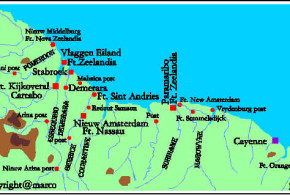
Map of Dutch settlements in Guyana and Suriname 1600-1750

Written by Marco Ramerini. English text revision by Dietrich Köster.

Around 1600 Spain had occupied in the Caribbean four large islands: Cuba, Hispaniola, Jamaica and Puerto Rico. These islands together with Mexico and Central America as far south as Guatemala formed the viceroyalty of New Spain.

The Lesser Antilles were left unoccupied by Spain due to the ferocity of their Carib inhabitants, the little gold and silver found and because the north-east trade winds rendered them difficult to accede from Cuba and the other islands under Spanish control. The remaining Spanish colonies formed the viceroyalty of Perú. It claimed all South America except Guyana and Brazil.

On the Caribbean coast of South America Spain had its main settlement in the town of Cartagena, down the coast to Guyana they had a few outposts as Cumaná, San Thome and the island of Trinidad. Portugal was the other power in South America. It held the Brazilian coast from Santos to Pernambuco.

The coast between the Portuguese and Spanish possessions was known as Wild Coast or Guyana and at that time was left unoccupied by Spain and Portugal. For this reason it was on this coast, where in a first time the attempts of colonization by the Dutch, French and English were concentrated.

Map of Dutch settlements in Guyana and Suriname 1600-1750. Author Marco Ramerini

BIBLIOGRAPHY:

– Edmundson “The Dutch in Western Guiana”
English historical review: 1901 Vol. XVI 640 – 675 pp.
An interesting article on the first period of Dutch settlements in Guiana and Tobago. There is also some information about the Courland attempts of colonizing Tobago.

– Edmundson, George “The Dutch on the Amazon” English Historical Review vol. XVIII

– Goslinga,C.Ch. “The Dutch in the Caribbean & on the Wild Coast 1580-1680”
647 pp. 12 maps Van Gorcum & C. 1971 Assen, The Netherlands.
A detailed and a very interesting and complete study on the Dutch in the Caribbean area: Guyana and Caribbean Islands. This is the vol I of the study.
Index: The beggars and the Broom, dreamers and realists, the tardy interlopers, the truce, the rise of a brilliant star, the battle for salt, the first great designs, the silver fleet, the king’s veins, Pie de Palo, the Dutch pearls, the years of crisis, the decline of a brilliant star, black ebony, “that superb nation”, the Wild Coast, New Walcheren, the last Dutch stand.

– Goslinga, C.Ch. “The Dutch in the Caribbean and in the Guianas 1680-1791”
712 pp. 13 maps Van Gorcum 1985 Assen, The Netherlands
A detailed and a very interesting study on the Dutch in the Caribbean area: Guyana and Caribbean Islands. This is the vol II of the study.
Index: The rise and the decline of the new Dutch West India Company 1675-1770, the Dutch in West Africa, the Company and the colonists on the Curaçao island, the Company and the colonists of the Dutch Leeward islands, the Dutch Caribbean slave trade, the “Kleine Vaart” in the Caribbean, Antillean colonial society, the colonists and the society of Suriname, Surinam: plantation colony, the Surinam Maroons, the Surinam slave trade, Essequibo and Demerara, the Berbice slave rebellion, a tale of two cities: Willemstad and Paramaribo, the Dutch black and red codes, the fall of the West India Company.

– Williamson, J. A. “English colonies in Guiana and on the Amazon 1604-1688”
191 pp. Clarendon Press, 1923, Oxford,

Categories
Bolivia Spanish Colonialism

Santa Ana de Velasco Mission: Jesuit Missions of Chiquitos (Eastern Bolivia)

Written by Marco Ramerini. Photos by Geoffrey A. P. Groesbeck 

Santa Ana de Velasco is a small village in the department of Santa Cruz  in the Amazonian plains of Bolivia near the border with Brazil. The village lies at an altitude of 464 metres and at about 40 km south-east of San Ignacio de Velasco.

The mission of Santa Ana de Velasco is one of the last founded by the Jesuits in Chiquitania. Santa Ana was in fact founded in 1755 by Fr. Julian Nogler. In the new mission settled some residents from the neighboring mission of San Rafael de Velasco.

Santa Ana mission was declared a World Heritage Site by UNESCO in 1990.

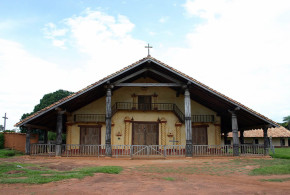
Santa Ana de Velasco mission, Bolivia. Photo Copyright by Geoffrey A. P. Groesbeck
Columna tallada, Santa Ana de Velasco mission, Bolivia. Photo Copyright by Geoffrey A. P. Groesbeck.
Hornacina, Santa Ana de Velasco mission, Bolivia. Photo Copyright by Geoffrey A. P. Groesbeck
Columna tallada, Santa Ana de Velasco mission, Bolivia. Photo Copyright by Geoffrey A. P. Groesbeck
Categories
Bolivia Spanish Colonialism

San Xavier Mission: Jesuit Missions of Chiquitos (Eastern Bolivia)

Written by Marco Ramerini. Photos by Geoffrey A. P. Groesbeck 

San Javier is a small town in the department of Beni in the Amazonian plains of the State of Bolivia. The city lies at an altitude of 537 metres between the Rio Paquius and the Río San Julián. The town of Concepcion is located 60 km north-east, while the city of Santa Cruz de la Sierra is located 220 km south-west.

This mission was the first to be established between the missions of the Chiquitania. It was founded in 1691 by the Jesuits Fr Antonio de Rivas and José de Arce. In subsequent years after its foundation, the mission was relocated several times, this happened in the years 1696 and 1698, and 1705-6.

This mission was declared a World Heritage Site by UNESCO in 1990.

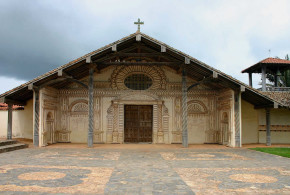
San Xavier mission, Bolivia. Photo Copyright by Geoffrey A. P. Groesbeck.
San Xavier mission, Bolivia. Photo Copyright by Geoffrey A. P. Groesbeck..
Altar Mayor, San Xavier mission, Bolivia. Photo Copyright by Geoffrey A. P. Groesbeck
Categories
Bolivia Spanish Colonialism

San Rafael de Velasco Mission: Jesuit Missions of Chiquitos (Eastern Bolivia)

Written by Marco Ramerini. Photos by Geoffrey A. P. Groesbeck 

This mission is located in the town of  San Rafael de Velasco which is located in Eastern Bolivia, about 40 km east of the city of San Miguel de Velasco and approximately 470 km north-east of the city of Santa Cruz de la Sierra. The city lies at an altitude of 408 meters in the region of Chiquitania.

The mission of San Rafael de Velasco is one of the oldest missions founded in the territory of the Chiquitos, in fact it was founded in 1695 by the Jesuits Fr. Juan Bautista Zea and Fr. Francisco Herbás. Only a year after its founding – in 1696 – the mission was merged with the neighboring mission of Santa Rosa de los Taucas.

This mission was declared a World Heritage Site by UNESCO in 1990. The church of the mission is richly decorated with frescoes.

San Rafael de Velasco mission (1696), Bolivia. Photo Copyright by Geoffrey A. P. Groesbeck
Entrance, San Rafael de Velasco mission, Bolivia. Photo Copyright by Geoffrey A. P. Groesbeck
Frescoes, San Rafael de Velasco mission, Bolivia. Photo Copyright by Geoffrey A. P. Groesbeck.
Frescoes, San Rafael de Velasco mission, Bolivia. Photo Copyright by Geoffrey A. P. Groesbeck
Categories
Bolivia Spanish Colonialism

San Miguel de Velasco Mission: Jesuit Missions of Chiquitos (Eastern Bolivia)

Written by Marco Ramerini. Photos by Geoffrey A. P. Groesbeck 

This mission is located in the town of  San Miguel de Velasco which is located in Eastern Bolivia, about 30 km south of the city of San Ignacio de Velasco. The city lies at an altitude of 485 meters in the region of Chiquitanía, an unspoilt area of Bolivia between the cities of Santa Cruz de la Sierra and the Brazilian border.

The mission of San Miguel de Velasco was founded in 1722 by the Jesuits Fr. Felipe Suarez and Fr. Francisco Hervás. In the mission were settled inhabitants of the mission of San Rafael de Velasco, whose population had become too abundant.

This mission was declared a World Heritage Site by UNESCO in 1990. The mission church is famous for its very elaborate and richly decorated interior.

San Miguel de Velasco mission, Bolivia. Photo Copyright by Geoffrey A. P. Groesbeck
Detail of the Altar Major, San Miguel de Velasco mission, Bolivia. Photo Copyright by Geoffrey A. P. Groesbeck
San Miguel de Velasco mission, Bolivia. Photo Copyright by Geoffrey A. P. Groesbeck..
Categories
Bolivia Spanish Colonialism

San Ignacio de Velasco Mission: Jesuit Missions of Chiquitos (Eastern Bolivia)

Written by Marco Ramerini. Photos by Geoffrey A. P. Groesbeck 

This mission is located in the town of San Ignacio de Velasco which is located in Eastern Bolivia, about 480 kilometers north-east of the city of Santa Cruz de la Sierra on a hill near the headwaters of the river Paragua. The town is located at a height of 410 meters on the banks of the artificial lake Guapomó.

San Ignacio de Velasco is the gateway to the Noel Kempff Mercado National Park, located north of the city on the border with Brazil. This park, in 2000, was declared by UNESCO as a World Heritage Site for its rich biodiversity.

The mission of San Ignacio de Velasco was founded in 1748 by the Jesuits Fr. Miguel Streicher and Fr. Diego Contreras. The church of San Ignacio de Velasco has been reconstructed from scratch and is not part of the UNESCO World Heritage Site.

San Ignacio de Velasco mission, Bolivia. Photo Copyright by Geoffrey A. P. Groesbeck
Querubin, San Ignacio de Velasco mission, Bolivia. Photo Copyright by Geoffrey A. P. Groesbeck
Pulpito, San Ignacio de Velasco mission, Bolivia. Photo Copyright by Geoffrey A. P. Groesbeck
Altar Mayor, San Ignacio de Velasco mission, Bolivia. Photo Copyright by Geoffrey A. P. Groesbeck
Categories
Bolivia Spanish Colonialism

Concepción Mission: Jesuit Missions of Chiquitos (Eastern Bolivia)

Written by Marco Ramerini. Photos by Geoffrey A. P. Groesbeck 

This mission is located in the town of Concepción which is located in Eastern Bolivia, about 280 km north-east of the city of Santa Cruz de la Sierra.

The mission of Concepción was founded in 1699 by the Jesuits Fr. Francisco Lucas Caballero and Fr. Francisco Herbás.

A few years after its foundation, precisely in 1704, the mission was abandoned. The Jesuits founded it back in 1709.

In 1712, the mission of Concepción was merged and re-established along with that of San Ignacio de Boococas.

In 1722 the mission was relocated again to its current location.

This mission is today a UNESCO World Heritage Site.

Concepcion mission (1699), Bolivia. Photo Copyright by Geoffrey A. P. Groesbeck
Altar Mayor, Concepción mission, Bolivia. Photo Copyright by Geoffrey A. P. Groesbeck.
Confesionario, Concepción mission, Bolivia. Photo Copyright by Geoffrey A. P. Groesbeck
Altar Mayor, Concepción mission, Bolivia. Photo Copyright by Geoffrey A. P. Groesbeck
Escalera, Concepción mission, Bolivia. Photo Copyright by Geoffrey A. P. Groesbeck
Campanario, Concepción mission, Bolivia. Photo Copyright by Geoffrey A. P. Groesbeck
Categories
Bolivia Spanish Colonialism

Who Constructed the Mission Churches? Jesuit Missions of Chiquitos (Bolivia)

Evanescence and Permanence: Toward an Accurate Understanding of the Legacy of the Jesuit Missions of Chiquitos.

Written by Geoffrey A. P. Groesbeck

– Part 2: How Many Jesuit Missions Were Founded?

Who Constructed the Mission Churches?

Another often-repeated error is that the first permanent (not provisional) churches of the mission complexes, or conjuntos misionales, of the Jesuit missions in the Chiquitania were constructed by a single individual, invariably assumed to be Fr. Martin Schmid.

Schmid did indeed construct a church, or templo as it is called in the Chiquitania – that of San Rafael de Velasco – and assisted in the building of at least two others, those of San Xavier and Concepción. He was a voluminous writer, apparently more so than at least the Jesuits who built the remaining churches. Furthermore, much of his correspondence – but little of that of the other builders – has been preserved, most recently by Kühne.1

Consequently, there is ample evidence of his handiwork, and far less of that of other Jesuit architects. Even so, there is nothing to suggest that simply because Schmid’s work is well documented he should ipso facto receive credit for constructing all of the Jesuit churches, which, given their dates of construction, would be impossible in any case.

Altar Mayor, Concepción mission, Bolivia. Photo Copyright by Geoffrey A. P. Groesbeck.

In fact, there is no longer any doubt in scholarly circles that Schmid did not build all of the Jesuit churches of Chiquitos. But earlier researchers reading his letters often jumped to the conclusion that as he built or had a hand in building those of which he wrote, he likely was the builder of others as well, yet with no supporting evidence for this claim. Subsequent research and discoveries by Roth and others have confirmed that the remaining templos were constructed by different parties. Additional corroborating information has come to light in the form of new primary resource materials, overlooked or unknown by earlier researchers, which point to other builders beside Schmid.

In some cases, there still remain doubts as to exactly who constructed which church, but the pieces of the puzzle are coming together as new documents – many of which remain uncatalogued and in manuscript form – are discovered. The following table presents the information as it is known today. The dates in the last column reflect the status of an existing church, with the caveat that it is not necessarily a Jesuit church.2

JESUIT CHURCHES IN THE CHIQUITANIA

[divider]

Settlement

(Original Name)

Jesuit Church Built by

When

Current Status

San Xavier

San Francisco Xavier [de los Piñocas]

Fr. Martin Schmid,

Fr. Johann Messner

B 1749-523

R Roth, et al., 1987-93

San Rafael de Velasco

Fr. Martin Schmid

B 1745-49

R Roth, et al., 1972-79

San José de ChiquitosSan José [de los Borós]

Fr. Bartolomé de Mora?

B c. 1745-604

R Roth, et al., 1988-2010

San Juan Bautista

San Juan Bautista [de los Xamarus]

Fr. Martin Schmid?

B by 17455;

P/B 1772 (after relocation)

F 1781;

P/B 1783;

B 1798-1800;

F 1811;

P/B by 1834

ruins of second Jesuit church at 1717-1772 site;

B c. 1960 1st modern church at San Juan de Taperas;

B 2009-12 modern church at Taperas

Concepción

La Inmaculada Concepción

Fr. Martin Schmid,

Fr. Johann Messner

B 1752-55

R Roth, et al., 1975-82

San Ignacio [de Boococas]

unknown

P/B unknown;

A 1712

nothing remains

San Ignacio [de Zamucos]

unknown

P?/B unknown;

D 1748

nothing remains

San Miguel de Velasco

San Miguel Arcángel

probably Fr. Johann Messner,

with Antonio Rojas

B c. 1752-596

R Roth, et al., 1973-83

San Ignacio de Velasco

San Ignacio de Loyola de Velasco

Fr. Johann Messner,

with Antonio Rojas?

B by 1761;

A 1942;

D 1948;

P/B 1948;

D 1964;

B modern church 1964-68

A 1979

RC (Jesuit church) Roth, et al., 1972-94

Santiago de Chiquitos

Santiago Apóstol

unknown

B c. 1762-71;

A by 1793;

RC 1793;

D 1880

B (modern church) 1916-20

Santa Ana de Velasco

unknown

B c. 1773-807

R Roth, et al., 1997-2001

Santo Corazón

Santo Corazón de Jesús de Chiquitos

unknown

B by 17958

F c. 1851

B (modern church) 1875

[divider]

B Built A Abandoned

P Provisional D Destroyed

R Restored RC Reconstructed

F Burned

– Part 4: How Did the Jesuits of Chiquitos Communicate with the Jesuits of Paraguay? The Way Forward, Success and Failure

NOTES:

1 See Eckart Kühne, ed., Las misiones jesuíticas de Bolivia: Martin Schmid, 1694-1772; Misionero, músico y arquitecto entre los chiquitanos (Santa Cruz de la Sierra: Asociación Suiza por la Cultura Pro Helvetica, 1996).

2 By “church” is meant the physical building itself, not the entire conjunto misional. In some cases (e.g., San Xavier, Santa Ana de Velasco, San José de Chiquitos) restoration on other areas of the complex continues.

3 This was the second church and first “permanent” one erected in San Xavier; a provisional one was constructed c. 1725-6. See Kühne, “Historia Breve de los Pueblos de Chiquitos y de sus Edificios Patrimoniales”, p. 2.

4 This was the third church and first “permanent” one erected in San José de Chiquitos; provisional ones were constructed before 1723 and again by 1731 (and subsequently restored in 1739). See Kühne, op. cit., p. 20.

5 This was the second church and first “permanent” one erected in San Juan Bautista; a provisional one was constructed before 1731. See Kühne, op. cit., p. 24.

6This was the second church and first “permanent” one erected in San Miguel de Velasco; a provisional one was constructed c. 1725. See Kühne, op. cit., p. 8.

7 This was the third church and first “permanent” one erected in Santa Ana de Velasco; provisional ones were constructed by 1762 and again in 1772. See Kühne, op. cit., p. 13.

8 This was the second church and first “permanent” one erected in Santo Corazón; a provisional one was constructed by 1762. See Kühne, op. cit., p. 28.

Categories
Bolivia Spanish Colonialism

Jesuit Missions of Chiquitos (Eastern Bolivia)

Evanescence and Permanence: Toward an Accurate Understanding of the Legacy of the Jesuit Missions of Chiquitos.

Written by Geoffrey A. P. Groesbeck

This article and its companion piece, “The Long Silence: The Jesuit Missions of Chiquitos after the Extrañamiento”, are two halves of a whole, written primarily to remedy the fact that no accurate historical overview of the twelve Jesuit missions of Chiquitos or their subsequent status as important settlements in the Chiquitania1 exists in English.F2F

These two articles serve a second purpose as well. They seek to dispel a number of commonly held errors and misunderstandings – five in particular – that have developed over time, which in turn aids in constructing an accurate historical synopsis of the region. Regardless of which purpose is at hand, emendations are drawn wherever possible from primary sources (i.e., the writings of the Jesuits and their contemporaries, and others during Bolivia’s colonial and post-independence periods).

In so doing, it is hoped that researchers and historians – in particular those new to the study of the Jesuit missions of Chiquitos – will at last have a reliable English-language source for conducting research on the era of the Jesuit presence in the Chiquitania, one informed by primary-source materials. The ultimate goal is historiographical: to help demarcate between what previous writers have claimed or assumed was the reality of the period from what it actually was (as revealed in contemporaneous documents), and, from this vantage point, to assist in uncovering its true legacy.

This work covers the years from 1572 – the year of the Jesuits’ arrival in Bolivia3 – to 1767 – the year of their expulsion4. A second article, “The Long Silence: The Jesuit Missions of Chiquitos after the Extrañamiento” treats the history of this region from the aftermath of the Jesuits’ expulsion in 1767 to the present. Especial emphasis on the second work is placed upon the chaotic years following Bolivia’s independence in 1825 through the final collapse of the Jesuit-installed administrative system by 1851, roughly a quarter-century that has yet to undergo extensive research.

Traditional and Later Research Efforts

San Miguel de Velasco mission, Bolivia. Photo Copyright by Geoffrey A. P. Groesbeck..

It must be admitted that a critical approach to the history of the region was, until very recently, woefully lacking in academic rigour. To understand the cumulative impact that this oversight has had on its scholarship, a look at the historiography of the Chiquitania is in order.

Whilst no extensive history of the Chiquitania or the Jesuit missions of Chiquitos in English has appeared, there are of course numerous accounts in Spanish, and several in German and other languages. Most of these rely heavily upon three secondary sources written well into in the nineteenth century, long after the Jesuits left and the settlements in the Chiquitania were fundamentally and irrevocably altered.

These three accounts are D’Orbigny’s recollections of his travels in the region between 1831 and 1833F5F; Castelnau’s natural history travelogue from the 1840s entitled Expédition dans les parties centrales de l’Amérique du Sud: De Rio de Janeiro à Lima, et de Lima au Para6; and René-Moreno’s writings, collected in 1888 as Catálogo del Archivo de Mojos y Chiquitos.F7F With the exception of René-Moreno (who had access to a limited number of them only), none of these authors worked much with primary resources.

Twentieth-century assessments by Enrique Finot, Guillermo Furlong, Werner Hoffman, Plácido Molina, Alcides Parejas, and others followed, many of which were gathered together and edited by Pedro Querejazu to form the massive Las Misiones Jesuíticas de ChiquitosF8F, universally considered the most exhaustive treatment of these missions. In many cases based upon research initially conducted by earlier writers, some egregious mistakes in these works were carried over. Nonetheless, these later efforts deserve credit for shedding a more accurate light on this often misunderstood and much mythologised era.

In the 1980s and 1990s, many more primary resources were uncovered, in the Chiquitania and elsewhere, partly as a direct result of ongoing restoration efforts to the region’s mission complexes, led by a former Jesuit turned architect named Hans Roth.

These discoveries, combined with the admirable practice of historians such as José María García, Eckart Kühne, Javier Matienzo, Antonio Menacho, Carlos Page, Cynthia Radding, Roberto Tomichá, Oscar Tonelli (with all but Kühne and Page hailing from Bolivia) and others using primary resources whenever possible9F, have greatly expanded our knowledge and understanding of the Jesuits’ unique mission strategy and practice throughout Latin America, these twelve settlements, and the Chiquitos and Moxos regions as a whole during the Jesuit era and even beyond. F10

Recent Research and Its Consequences

Altar Mayor, San Ignacio de Velasco mission, Bolivia. Photo Copyright by Geoffrey A. P. Groesbeck

There is now heightened interest in the Chiquitos missions (often referred to by their Spanish name, reducciones11) for several reasons. Chief amongst these are the unique musical and architectural legacies of these communities, forged by more than seven decades of cultural collaboration between the Jesuits and the indigenous peoples who lived in the reducciones. These two artistic heritages are well recognised today. The first, of a musical nature, is most prominently displayed in the increasingly popular biennial “Festival Internacional de Música Renacentista y Barroca Americana ‘Misiones de Chiquitos’”F12F; the second, architectural in form, was first recognised when six former missions were named World Heritage Sites by the United Nations Educational, Scientific and Cultural Organization (UNESCO) in 1990.F13F

In the academic arena, the Jesuit missions of Chiquitos hold promising research for several fields of scholarly activity, including acculturation and adaptation studies, Jesuit history and the Jesuit modus operandi, and missiology. Formal associations dedicated to the study of these missions in particular do not yet exist, although the biennial Jornadas Internacionales sobre Misiones Jesuíticas14, held every other year since 1982 in a location associated with the Jesuit colonial missions of Argentina, Bolivia, Brazil, Chile, or Paraguay, provides a forum for exchange of scholarly research and ideas on the region. Universities throughout North and South America, notably Boston College, also sponsor similar academic forums.

Finally, the combined efforts of the departmental government of Santa Cruz – the department in which the mission towns are located – and several cultural organisations, spearheaded by the Santa Cruz de la Sierra-based Asociación Pro Arte y Cultura (APAC), have raised interest in and awareness of the region and its unique patrimony. Collectively, these culminated in 2006’s much-anticipated “Lanzamiento Mundial del Destino Turístico ‘Chiquitos’, Misiones Jesuíticas de Bolivia” initiativeF15F, which showcased the Chiquitos missions as examples of cultural tourism. Regrettably, under the current administration of President Juan Evo Morales Ayma, the national government of Bolivia has done nothing to protect and responsibly promote the missions or the region as a whole.

Challenges to Current Research

Concepcion mission (1699), Bolivia. Photo Copyright by Geoffrey A. P. Groesbeck

Lifting the carefully constructed veil of tourist-centric reinterpretation to assess the Jesuit past of Chiquitos has proven difficult. Two significant challenges in particular confront historians and others attempting to access information on this period and utilise it as a foundation for research.

In spite of the genuine singularity and undoubted richness of the cultural patrimony of these settlements (and of the Chiquitania as a whole), there remains a paucity of reliable information available in English. What does exist – in any language – often is not anchored in primary sources and is riddled with errors.

These mistakes arise when writers cite earlier works without verifying their accuracy, injudiciously extrapolate conclusions from them, or attempt to fill lacunas without sufficient documentation.

The point cannot be over-emphasised: scholars seeking to glean accurate information or buttress hypotheses must tread carefully when citing previous research on the Jesuit missions of Chiquitos, and especially when it does not cite primary sources.

Examples of these compounded mistakes abound. Five commonly repeated ones that have found their way into accepted accounts of the region with unfortunate consequences for later research will be examined individually here.

The majority of these errors – and others that stem from these foundational ones – often result from incorrect attempts to respond to a small number of repeatedly asked, basic questions. These are often formulated in one way or another along the lines of the following five queries.

  • How many Jesuit missions were founded in the Chiquitania?

  • Who constructed their churches – the best-known visual attributes of these communities?

  • How did the Jesuits of Chiquitos communicate with the Jesuits of Paraguay?

  • What happened to the descendants of the original inhabitants of these communities?

  • What is the reality of these communities vis-à-vis their perception as living legacies of the Jesuits’ presence?

– Part 2: How Many Jesuit Missions Were Founded?

[divider]

NOTES:

1 The Chiquitania technically includes the six eastern provinces of Santa Cruz Department: Guayaros; Ñuflo de Chávez; [José Miguel de] Velasco; Ángel Sandoval; Germán Busch; and Chiquitos, although Guarayos is often excluded. These provinces originally were part of a much larger area known until 1880 as Chiquitos province. The extant Jesuit missions of Chiquitos are found in all but Guarayos (which was and is considered a separate mission field – earlier referred to as Mojos and then Moxos) and Germán Busch provinces. For this article, the terms Chiquitania and Chiquitos are understood as interchangeable when employed in a geographical context.

2 An English-language translation of Alcides Parejas’ HChiquitos: un paseo por su historiHa (Santa Cruz: APAC Fondo Editorial, 2004) exists, although this work is no more than a brief overview.

3 Bolivia was known as Upper Peru until its independence on 6 September 1825.

4 In Spanish, the Extrañamiento, the royal decree expelling the Jesuits from the Chiquitania and all Spanish possessions in the New World, proclaimed by King Carlos III on 27 February 1767. For a copy of the decree, see Mariano B. Gumucio, Las Misiones Jesuíticas de Moxos y Chiquitos: Una Utopía Cristiana en el Oriente Boliviano, 3rd ed., (La Paz: Lewylibros, 2003), pp. 162-3.

5 First published in nine volumes as Voyage dans l’Amerique Meridionale (le Brasil, la Republique Orientale de l’Uruguay, la Republique Argentine, la Patagonie, la Republique du Chili, la Republique de Bolivia, la Republique du Perou), exécuté pendant les années 1826, 1827, 1828, 1829, 1830, 1831, 1832 et 1833 (Paris: Chez Pitois-Levrault et Cie., 1835–1847). The 4-volume 1945 edition published by Editorial Futuro in Buenos Aires is the latest unabridged version. Richard Gott retraces much of D’Orbigny’s Bolivian expedition in Land without Evil: Utopian Journeys across the South American Watershed (Avon, UK: Bath Press, 1993), in which, see pp. 65-294, passim.

6 First published in seven volumes by Chez P. Bertrand in Paris in 1850. Volume six contains the section “Voyage dans le sud de la Bolivie”, which was written not by Castelnau but by his colleague and fellow-traveller Hugh A. Weddell.

7 Conceived originally as a catalogue of René-Moreno’s historical essays and papers, Catálogo del Archivo de Mojos y Chiquitos (Santiago: Imprenta Gutenberg, 1888) was published at the expense of the Bolivian government. Intended as a tribute to its author, it – along with D’Orbigny’s earlier work – became a de rigueur source for future historians. A second edition, edited by Hernando Sanabria in 1973, provides additional documentation not found in the original materials. Recent scholarship and the discovery of new primary-source accounts have shown none of these three nineteenth-century works to be free from error. Of the three, D’Orbigny’s writings are generally considered more historically reliable and less prone to speculation. Those of Castelnau are deemed mostly accurate when describing flora and fauna but less so in their observation of the region’s cultural and social phenomena.

8 Pedro Querejazu, ed., Las Misiones Jesuíticas de Chiquitos (La Paz: Fundación BHN, 1995).

9 Of the primary sources that have been extensively researched, perhaps the most useful is the monumental, multi-volume Historia general de la Compañía de Jesús en la Provincia del Perú: Crónica anónima de 1600 que trata del establecimiento y misiones de la Compañía de Jesús en los países de habla española en la América meridional (especially Vol. II), edited by Francisco Mateos (Madrid: Consejo Superior de Investigaciones Científicas, 1944). Also of importance, although of greater relevance to the study of the Paraguay missions, is the unedited archive of correspondence from the Jesuits of Paraguay from the years from 1690 through 1718. Collectively known as “Cartas a los Provinciales de la Provincia del Paraguay 1690-1718,” these manuscripts are housed in the Jesuit Archives of Argentina in Buenos Aires, which also contain the invaluable annals of the Paraguay Province of the Company of Jesus, covering the years from 1689 through 1762. The letters and reports of the Jesuit missionaries themselves, many of which are in manuscript form and housed in the Archivo General de Indias in Seville or the Archivo General de la Nación in Buenos Aires, are of course supremely important. The cartas and relaciones of Frs. Agustín Castañares, Ignacio Chomé, Esteban Palozzi, José Rodríguez, José Sánchez Labrador, and Martín Schmid are amongst the most valuable. Those of Fr. José de Arce, including “Relación de la fundación del colegio de Tarija y de la conversión de los chiriguanos” (1692), “Carta original del P. José de Arce en la que da testimonio sobre las promesas que se hacen para que se conviertan los indios de las misiones del Paraguay” (1707), and “Breve relación del viage que hizieron dos Padres de la Compañía de Jesús por el Río Paraguay arriva a las Misiones de los Chiquitos en el año de 1715” (1715) – the first two in the Biblioteca Nacional de Rio de Janeiro, and the third in the Archivo General de la Nación in Buenos Aires – are essential. Likewise, the seven memoriales of Fr. Felipe Suárez written in 1725 treating six Chiquitania missions, also archived in the Archivo General de la Nación in Buenos Aires, are invaluable. The most-often quoted primary sources are the cartas of Fr. Martin Schmid, written between 1726 and 1770. Fr. Julián Knogler’s “Inhalt einer Beschreibung der Missionen deren Chiquiten”, Archivum Historicum Societatis Jesu, 39/78 (Rome: Company of Jesus, 1970), is indispensable for providing an account of the missions immediately after the Extrañamiento, as is his 1769 account “Relato sobre el país y la nación de los Chiquitos en las Indias Occidentales o América del Sud y en la misiones en su territorio”, for which, see Werner Hoffman, Las misiones jesuíticas entre los chiquitanos (Buenos Aires: Fundación para la Educación, la Ciencia y la Cultura, 1979). Fr. Juan de Montenegro’s Breve noticia de las missiones, peregrinaciones apostólicas, trabajos, sudor, y sangre vertida, en obsequio de la fe, de el venerable padre Augustín Castañares, de la Compañía de Jesús, insigne missionero de la provincia del Paraguay, en las misiones de Chiquitos, Zamucos, y ultimamente en la missión de los infieles Mataguayos. (Madrid: Manuel Fernández, Impresor del Supremo Consejo de la Inquisición, de la Reverenda Cámara Apostólica, y del Convento de las Señoras de la Encarnación, en la Caba Baxa, 1746) is useful. Fr. Juan Patricio Fernández’s Relación historial de las misiones de los indios, que llaman chiquitos, que están a cargo de los padres de la Compañía de Jesús de la provincia del Paraguay (Madrid: Manuel Fernández, 1726), and Relación historial de las Misiones de Indios Chiquitos que en el Paraguay tienen los padres de la Compañía de Jesús, Vols. I and II (Madrid: Manuel Fernández, 1727) are of much value, as his Historica relatio, de apostolicis missionibus patrum societatis jesu apud chiquitos, paraquaræ populos, primò hispano idiomate conscripta (Augustæ Vindelicorum: Sumptibus Mathiæ Wolff, 1733). Also important is Fr. Pedro Francisco Xavier de Charlevoix’s Historia del Paraguay (Paris: Desaint, 1756), Vols. I-VI. Carlos Page’s compilations of colonial-era Jesuit correspondence, El Colegio de Tarija y las misiones de Chiquitos según las Cartas Anuas de la Compañía de Jesús (Buenos Aires: Edición On-line, 2011), and Chiquitos en las Anuas de la Compañía de Jesús (1691-1767), co-authored with Isabelle Combès, W. Javier Matienzo, and Roberto Tomichá, OFMConv. (Cochabamba: Itinerarios Editorial, 2011); and Tomichá’s edition of Francisco Burgés y las misiones de Chiquitos: El memorial de 1703 y documentos complementarios (Cochabamba: Editorial Verbo Divino e Instituto de Misionología de la Universidad Católica Boliviana, 2008) are the latest additions, with excellent examples and bibliographies of primary source materials. There are other primary sources as yet unexamined, many of which are archived in Cochabamba, Sucre, and Tarija (Bolivia); Buenos Aires, Córdoba, and Tucumán (Argentina); Asunción (Paraguay); Madrid; and Rome.

10 See, for example, José María García, “Los jesuitas en Santa Cruz de la Sierra hasta los inicios de las reducciones de Moxos y Chiquitos: Posibilidades y limitaciones de la tarea misional”, in Quinto Centenario 14 (Madrid: 1988, pp. 73-92); Antonio Menacho, S.J., Fundación de las Reducciones Chiquitos (Santa Cruz: Verbo Divina, 1987) and Por Tierras de Chiquitos (San Xavier: Vicario Apostólico de Ñuflo de Chávez, 1991); Alcides Parejas, Historia del Oriente Boliviano: Siglos XVI y XVII (Santa Cruz: Universidad Gabriel René Moreno, 1979); Eckart Kühne, ed., Las misiones jesuíticas de Bolivia: Martin Schmid, 1694-1772; Misionero, músico y arquitecto entre los chiquitanos (Santa Cruz de la Sierra: Asociación Suiza por la Cultura Pro Helvetica, 1996); Roberto Tomichá, OFMConv., La Primera Evangelización en las Reducciones de Chiquitos: Protagonistas y Metodología Misional (Cochabamba: Editorial Verbo Divino, 2002) and La Iglesia en Santa Cruz (Cochabamba: Editorial Verbo Divino, 2005); and Oscar Tonelli, Reseña histórica social y económica de la Chiquitania (Santa Cruz: Editorial El Pais, 2004). Mariano B. Gumucio’s Las Misiones Jesuíticas de Moxos y Chiquitos: Una Utopía Cristiana en el Oriente Boliviano, 3rd ed., (La Paz: Lewylibros, 2003), which covers the Moxos missions as well as those of Chiquitos, also merits mention, as do a number of works by Guillermo Furlong, S.J. For a truly landmark account of the missions seen through their artistic output, see María José Diez, Los bienes muebles de Chiquitos: Fuentes para el conocimiento de una sociedad. (Madrid: Agencia Española de Cooperación Internacional, 2006). Perhaps most important of all are the works of the late Hans Roth and the other ongoing publications of his associate Eckart Kühne.

11 The Jesuits were not the first to employ the reducción method, but their genius led to its perfection. The first reducción in the New World was established between 1515 and 1522 by the Franciscan friar Bartolomé de las Casas in Cumaná, Venezuela. His idea was adopted and perfected by the Jesuits when they were given possession of the Dominican doctrina of Juli in 1576 by order of the viceroy of Peru, Francisco de Toledo.

12 For information on these festivals, sponsored by the Asociación Pro Arte y Cultura (APAC), see http://www.festivalesapac.com.

13 See http://whc.unesco.org/archive/repcom90.htm#529, for the document “United Nations Educational, Scientific and Cultural Organization Convention Concerning the Protection of the World Cultural and Natural Heritage: Report of the World Heritage Committee, Fourteenth Session, Banff, Alberta, Canada, 7-12 December 1990”.

14 See http://www.ucbch.edu.bo/index.php/71.

15 See http://www.lostiempos.com/diario/actualidad/economia/20060315/preparan-lanzamiento-de-chiquitos-hacia-el-mundo_5465_5465.html, for further information on this important but as yet unrepeated Bolivian public-/private-sector joint initiative.

Categories
Brazil Portuguese Colonialism

The forts of Salvador (Bahia)

Written by Marco Ramerini. English text revision by Dietrich Köster.

Right from the founding of the city the Portuguese started with the construction of a defensive system against foreign invasions, which occurred until the 18th century.

The main works of fortification were executed after the Dutch conquest of the town (1624-1625) and the successive reconquest by the Portuguese. Fearing another Dutch invasion, which materialized in 1638 and 1647, they started with the building of several forts to defend Salvador, the capital of the Brazilian colony.

FORTE DE SANTO ANTÔNIO DA BARRA

The first fortification on this place was built between 1583 and 1587 during the government of D. Manuel Telles Barreto: a poligonal tower of “taipa”.

The entrance gate, Forte de Santo Antônio da Barra, Salvador (Bahia), Brazil. Author and Copyright Marco Ramerini

A better fortification was built during the government of D. Francisco de Souza (1591-1602). This time it was a fort with an octagonal shape and was artilled with 4 cannons. In 1624 the fortification did not resist the Dutch landing in the port.

During the govern of D. João de Lencastre, between 1696 and 1702, the fort got its current shape due to the project of the engineer João Coutinho. Its design, as in other fortifications, is in the Italian style. The access is by a ramp tunnel, ending in a stairway.

[divider]

[divider]

Forte de Santa Maria, Salvador (Bahia). Author and Copyright Marco Ramerini.

FORTE DE SANTA MARIA

This fort was built, “de pedra e cal” during the government of D. Diogo Luís de Oliveira (1627-1635). Itis certain, that during the second Dutch invasion in 1638 the fort was part of the city defences. In 1671 it had 1 bronze cannon and 2 iron cannons, but according to the “Relatório, 1671” it needed three more cannons. It has an Italian-style design and was built in stonemasonry.

[divider]

[divider]

Forte de São Diogo, Salvador (Bahia). Author and Copyright Marco Ramerini

FORTE DE SÃO DIEGO

This fort was built, “de pedra e cal” during the government of D. Diogo Luís de Oliveira (1627-1635). With the forts of Santa Maria and Santo Antônio da Barra it is a part of the defense system of Porto da Barra. It has an irregular shape and it is built at the foot of the hill, where the original Vila Velha de Pereira Coutinho was situated.

[divider]

Forte de Nossa Senhora do Pópulo e São Marcelo (Forte do Mar), Salvador (Bahia). Author and Copyright Marco Ramerini

FORTE DE NOSSA SENHORA DO PÓPULO E SÃO MARCELO (FORTE DO MAR)

This is a circular fort. Its construction during the government of Francisco Barreto (1657-1663), far from the shore is due to the fear of a new invasion. Its objective was to avoid any invasion of the port. In the 1670s it had 9 cannons. Its slightly circular project is formed by a central turret, surrounded by a ring of equal height, constituting the perimeter and the quarters. It was built in sandstone up to the waterline and the remaining in stonemasonry.

[divider]

[divider]

Forte de Nossa Senhora de Monte Serrat, Salvador (Bahia). Author and Copyright Marco Ramerini

FORTE DE NOSSA SENHORA DE MONTSERRAT

Montserrat Fort is located in the western part of the Itapagipana Peninsula. Probably it was built in 1586 during the government of D. Manuel Telles Barreto (1583-1587). Its construction was continued during the government of D. Francisco de Souza (1591-1602), when it was known as Castelo de São Felipe. Perhaps it was designed by Baccio da Filicaia 1565 Firenze – 1628 Salvador/Bahia), who worked under this governor.

Its design is inspired by the Italian fortification style and it is one of the best examples of early military architecture in Brazil. Its shape is an irregular polygon with circular turrets. It had 3 cannons and from the fort, the entire Port of Salvador could be protected. In 1616 its garrison was composed by 16 men: a captain, a head, a gunner, a tamburine and 12 musketeers. On 9 May 1624 this fort, which had 4 cannons, was attacked by the Dutch army. After a furious resistence the garrison was forced to surrender.

During the Dutch occupation the Portugueses built in the vicinities of the fort a trench, where they placed 2 bronze cannons. Captain Manuel Gonçalves succeeded during one of the numerous attacks the Portuguese directed towards the garrison of the fort in capturing the commander of the fort. On 17 July 1624 general Johan Van, the Dutch commander of the troops of the garrison of Salvador was attacked and killed in the locality Água de Meninos, while he was returning with 200 men from an inspection of the Montserrat Fort. In 1625 the Hispano-Portuguese under D. Fradique de Toledo retook the fort and on 1 May 1625 the entire Dutch garrison of Salvador capitulated.

In 1638 a Dutch army under Johann Moritz von Nassau-Siegen put under siege Salvador and on 21 April 1638 a platoon under Major van den Brand attacked the fort of Montserrat, which soon capitulated, the captain of the fort at that time being Pedro Aires de Aguirre. This time the Dutch were forced to abandon the siege of the city after a month (16 April 1638-26 May 1638).

In October 1655 the Conde de Ataugia ordered to rebuild the fortress and later in 1693 D. João de Lencastre ordered the same. During these reconstruction works the fort reached the actual hexagonal shape with a tower at each angle. In 1717 it had 12 cannons.

[divider]

[divider]

Forte de Saõ Pedro, Salvador (Bahia). Author and Copyright Marco Ramerini

FORTE DE SÃO PEDRO

The first fortification in the area dates from 1624 and construction work started by the Dutch during their brief occupation of Salvador (1624-1625). In 1648 the old trench was replaced by a fort. Located on a strategic place, Fort São Pedro, along with Fort São Paulo da Gamboa, played a main role in the defense of the south portion of the city. In 1671 it had only 2 cannons. During the government of Roque da Costa Barreto (1678-1682) the fort was repaired. During the 1710s the fort was improved and the works were terminatad on 12 August 1723. In 1759 it had 5 bronze “colubrinas”, 1 bronze “morteiro” and 37 iron cannons. It is a stonemasonry construction. The fort has a quadrangular polygonal shape, possessing bastions on each side with turret-shaped watch posts.

[divider]

[divider]

[divider]

BIBLIOGRAPHY:


Categories
Brazil Portuguese Colonialism

Salvador (Bahia): the capital of Colonial Brazil

Written by Marco Ramerini. English text revision by Dietrich Köster.

The Florentine Amerigo Vespucci, on 1 January 1502, came to a gulf at 13° latitude south, to which he gave the name Bahia de Todos Santos, on the shores of which the city of Bahia now stands. Salvador was founded in 1549 by Tomé de Souza, the first governor-general of Colonial Brazil, and remained the capital of Portuguese Brazil until 1763.

During colonial times the city was invaded by the Dutch, who occupied Salvador for about a year in 1624/1625. Later they made several other attempts to take the city in 1638 and 1647. The growth of the capital city of Salvador came with the sugar plantations at the end of the 16th century and continued throughout the 17th century. Bahia became the most prosperous and important slave trade center not only in Brazil but in all of the Americas.

Cloister of the Convento (Convent) de São Francisco, Igreja de São Francisco, Salvador (Bahia), Brazil. Author and Copyright Marco Ramerini

Today Salvador preserves in his historic centre, the “pelourinho”, his historical colonial architectural monuments, magnificent mansions, baroque churches and forts. Restoration projects have recuperated the glory of many of the oldest buildings. Among the finest worth to be be mentioned are the Convent and Igreja de São Francisco, a baroque church with a beautiful azulejos cloister. Forced to build their masters’ church and yet prohibited from practising their own religion (Candomblé), the African slave artisans responded through their work: the faces of the cherubs are distorted, some angels are endowed with huge sex organs, some appear to be pregnant. Another beautiful church is the Igreja da Ordem Terceira de São Francisco, Salvador (Bahia). This church is adjacent to Igreja de São Francisco and it was constructed in 1702. It has a gorgeous sandstone facade, which is unique in Brazil. The facade remained hidden until it was accidentally discovered in the 1930s.

Igreja da Ordem Terceira de São Francisco, Salvador (Bahia). Author and Copyright Marco Ramerini

The Basílica do Senhor Bom Jesus do Bomfim, Salvador (Bahia) is a 18th-century church that houses a curious room called Sala dos Milagres (Room of Miracles), where people leave votive offerings in thanks for cures. The votives forming a rather bizarre collection of hanging plastic replicas of multitudinous problematic body parts. The Mercado Modelo is the major craftsmanship pole in Salvador, built in 1861 to be a Customs House, nowadays it has 259 stalls, which offer every kind of popular production in leather, straw, tissue, wood, laces, semiprecious stones and silver, besides candies, fruits in syrup and craft drinks.

This is the text design of the inscription of the Historic Centre of Salvador da Bahia in the UNESCO list of the World Heritage Monuments: “As the first capital of Brazil, from 1549 to 1763, Salvador da Bahia witnessed the blending of European, African and Amerindian cultures. It was also, from 1558, the first slave market in the New World, with slaves arriving to work on the sugar plantations. The city has managed to preserve many outstanding Renaissance buildings. A special feature of the old town are the brightly coloured houses, often decorated with fine stucco-work.”

[divider]

[divider]

[divider]

Categories
Brazil Dutch Colonialism Portuguese Colonialism

Recife Forts: Fort do Brum, Fort das Cinco Pontas

Written by Marco Ramerini. English text revision by Dietrich Köster.

FORTE DO BRUM

One of the most important remains of the Dutch rule in northeast Brazil is the Forte do Brum (Fort de Bruyne), on the northern end of Recife island. The fort was originally started to built in 1629 by the Portuguese, when the Dutch took control of Pernambuco they rebuilt the fort, which was named after Johan de Bruyne. He was the president of the political council of Olinda and called it Fort de Bruyne. When the Portuguese retook control of Recife, the fort was renamed Forte de São João Batista do Brum. The Museu Militar is housed in this fort.

[divider]

[divider]

The Forte das Cinco Pontas (Five Bastions Fort), which today has only four bastions, houses the Museu da Cidade (Municipal Museum). Author and Copyright Marco Ramerini

FORTE DAS CINCO PONTAS

Forte das Cinco Pontas, built in 1630 by the Dutch, it was called by them Fort Frederik Hedrik, the fort was the last place they surrendered when they were expelled in 1654. A tabled at the entrance of the fort describe the Dutch surrender: “Próximo a este forte das Cinco Pontas, um dos últimos baluartes flamengos, na chamada campina do Taborda, existiu a porta sul de Mauricéia, onde o mestre de campo general Francisco Barreto, chefe militar da campanha de libertação e restauração de Pernambuco, recebeu a 28-1-1654, na qualidade de vencedor, as chaves da cidade, que lhe foram entregues pelo general Segismundo van Schoppe, comandante das forças holandesas que, na ante-véspera se haviam rendido. Esta memória foi mandada colocar pelo Exército, no ensejo das comemorações do tricentenário da Restauração. 1654 – 1954.” Inside the fort is the Museu da Cidade, which is entirely dedicated to the history of the city, containing old engravings and photographs.

[divider]

[divider]

Categories
Brazil Dutch Colonialism Portuguese Colonialism

Recife: the capital of sugar cane of Colonial Brazil

Written by Marco Ramerini. English text revision by Dietrich Köster.

Recife is now the capital of the Brazilian state of Pernambuco. Until the 17th century the city was a small village near the capital of the Capitania of Pernambuco, Olinda.

In 1630 with the Dutch conquest of northeastern Brazil, Olinda was burned by the Dutch, just because it was considered not defensible. Preference was given to the port of Recife, better positioned to defend the new colony.

Recife experienced a great development, especially during the years of the rule of Johan Maurits von Nassau-Siegen (1637-1644). He founded, with the assistance of the famous architect, Pieter Post of Haarlem, a new town called Mauricia (Mauritsstad). During those years he transformed Recife by building splendid public edifices and gardens, built the first synagogue in the Americas and for the defense of the capital of Dutch Brazil were also built substantial defensive works with forts and fortifications.

Catedral de São Pedro dos Clérigos, Recife, Pernambuco, Brazil. Author and Copyright Marco Ramerini

In 1654 the Dutch were besieged in Recife and were forced to capitulate. The Portuguese moved the capital of Pernambuco again to Olinda, but the port of Recife remained the most important commercial port in the Capitania. In 1823 Recife supplanted Olinda as capital of Pernambuco.

Recife has a modern physical appearance, but in the old town has many interesting buildings dating from the 17th-19th centuries, including the churches Matriz de Santo Antônio, the Basílica de Nossa Senhora do Carmo (this church was constructed, where the old Palace of Boa Vista was built under the Dutch governor Maurício de Nassau), the Capela Dourada, and Nossa Senhora do Rosário dos Pretos.

In the Rua do Bom Jesus is the oldest synagogue in the Americas, Kahal Zur Israel (Congregação Rochedo de Israel), which was erected in the 17th century and which still keeps some original walls and houses a small museum. The synagogue functioned between 1636 and 1654. At that time the synagogue served a community of approximately 1,450 Jews.

Two forts are still visible in the city: the Dutch built Forte do Brum and the Forte das Cinco Pontas, which now houses the state museum.

[divider]

[divider]

[divider]

BIBLIOGRAPHY

– Nederveen Meerkerk, H. van, “Recife. The rise of a 17th-century trade city from a cultural-historical perspective”, 459 pp., illustrations, van Gorcum, 1989, Assen-Maastricht, The Netherlands. The history of architecture in Recife of the years of Dutch occupation.

Categories
Brazil Portuguese Colonialism

Governors and Viceroys of Portuguese Brazil, 1549-1760

Written by Marco Ramerini. 

Brazil was discovered, almost by accident in 1500 by a Portuguese expedition live in the East under the command of Pedro Alvares Cabral. Cabral ‘s expedition followed the sea route to India traveled recently by Vasco da Gama, sailing around Africa. The expedition – to avoid the equatorial calms – followed a route far from the African coast that led to the discovery, on April 22, 1500, of the Brazilian coast. Cabral to these new lands gave the name of “Vera Cruz” .

Following the discovery of Cabral, in the following years several Portuguese expeditions reached Brazil, but in the first 30 years – from 1500 until 1530 –  the Portuguese were limited to quick landings and harvesting timber (the famous Pau Brasil). Only because of the French attempts to occupy the new land, Portugal decided to colonize Brazil. In 1532, the expedition Martim Afonso de Sousa founded the village of São Vicente, which became the first permanent settlement in Brazil. As of 1534 D. João III divided the territory into twelve hereditary captaincies, but this system of colonization proved to be unprofitable, so in 1549 the king decided to appoint a Governor-General to administer the entire colony.

LIST OF GOVERNORS AND VICEROYS OF PORTUGUESE BRAZIL, 1549-1760

Tomé de Sousa

1549-1553

Duarte da Costa

1553-1558

Men de Sá

1558-1572

Luís Brito de Almeida

1573-1578

Lourenço da Veiga

1578-1581

Temporary government of Câmara and of Ouvidor-Geral Cosme Rangel

1581-1583

Manuel Telles Barreto

1583-1587

Temporary government of Bispo, of Provedor-Mor and Ouvidor-Geral

1587-1591

Francisco de Sousa

1591-1602

Diogo Botelho

1603-1607

Diogo de Meneses

1608-1612

Gaspar de Sousa

1613-1617

Luís de Sousa

1617-1621

Matias de Albuquerque (he was ufficially entrust of this task because the Dutch occupation of Salvador; later he appointed Francisco de Moura Rolim as governor of Salvador during 1625-1627)

1624-1625

1625-1627

Diogo Luís de Oliveira

1627-1635

Pedro da Silva

1635-1639

Fernando Mascarenhas, Conde da Torre

1639

Vasco Mascarenhas, Conde de Óbidos

1639-1640

Vice-Rei Jorge Mascarenhas, Marquês de Montalvão

1640-1641

Junta provisória

1641-1642

Antônio Telles da Silva

1642-1647

Antônio Telles de Meneses, Conde de Vila-Pouca de Aguiar

1647-1650

João Rodrigues de Vasconcellos e Sousa, Conde de Castelo Melhor

1650-1654

Jerônimo de Altaíde, Conde de Atouguia

1654-1657

Francisco Barreto de Meneses

1657-1663

Vice-Rei Vasco Mascarenhas, Conde de Óbidos

1663-1667

Alexandre de Sousa Freire

1667-1671

Afonso Furtado de Castro do Rio de Mendonça, Visconde de
Barbacena

1671-1675

Junta provisória composed by Chanceler da Relação, Agostinho de Azevedo Monteiro and other people. When Azevedo Monteiro dead, on his place was appointed the Desembargador Cristóvão de Burgos

1675-1678

Roque da Costa Barreto

1678-1682

Antônio de Sousa de Meneses

1682-1684

Matias da Cunha

1687-1688

Junta provisória composed by Chanceler da Relação Manoel Carneiro de Sá and by the  Arcebispo

1688-1690

Antônio Luís Gonçalves da Câmara Coutinho

1690-1694

João de Lencastre

1694-1702

Rodrigo da Costa

1702-1705

Luís César de Meneses

1705-1710

Lourenço de Almeida

1710-1711

Pedro de Vasconcellos e Sousa, Conde de Castelo Melhor

1711-1714

Vice-Rei Pedro de Noronha, Conde de Vila Verde e Marquês de
Angeja

1714-1718

Sancho de Faro e Sousa, Conde de Vimieiro

1718-1719

Junta provisória composed by Chanceler da Relação, Caetano de Brito de Figueiredo and other people.

1719-1720

Vice-Rei Vasco Fernandes César de Meneses, Conde de Sabugosa

1720-1735

Vice-Rei André de Mello e Castro, Conde de Galvêas

1735-1749

Vice-Rei Luís Pedro Peregrino de Carvalho Meneses de Ataíde,
Conde de Atouguia

1749-1755

Junta provisória composed by chanceler da Relação, Manoel Antônio da Cunha Sottomayor and other people.

1755

Vice-Rei Marcos de Noronha e brito, Conde de Arcos

1755-1760

Categories
Brazil Dutch Colonialism

Fort Orange (Oranje), Itamaracá: a Dutch fortress in Brazil

Written by Marco Ramerini. English text revision by Dietrich Köster.

Fort Orange is situated 60 km north of Recife (Pernambuco). In this area the Portuguese founded a trading factory (feitoria) in 1516. On 1 September 1534 the King of Portugal created the “capitania” of Itamaracá. It was given to the donatarian Pero Lopez de Sousa. This “capitania” extended over 30 “léguas” of coast: between the Santa Cruz Canal and Baia de Traição. In this “capitania” was founded one of the first Brazilian settlements: Vila da Nossa Senhora da Conceição de Itamaracá (today Vila Velha).

Itamaracá was one of the captaincies of Portuguese Brazil. It was a small, but prosperous one. Sugar-planting was well established and it also produced tobacco, brazilwood and flax. The Brazilan North East was the richer part of the Portuguese colony of Brazil. It was the main target of the Dutch West India Company (WIC), when it decided to attack the Portuguese possession in Latin America. Recife and Olinda were the main Portuguese settlements in Pernambuco.

Itamaraca (1665). Author Johannes Vingboons

A Dutch fleet of 67 ships, 1,170 guns and 7,000 men under the command of Hendrick Corneliszoon Loncq arrived in Pernambuco in February 1630 and soon they attacked the Portuguese defenses. By the evening of 16 February 1630 the Dutch were in possession of Olinda and by the 3rd of March all Portuguese resistance was over and the Dutch were masters of Recife, Olinda and the island of António Vaz.

In the following year, in 1631, the Dutch decided to occupy also the island of Itamaracá. This attempt was not crowned by success. The Dutch were repelled, but returning to Recife the Lieutenant Colonel Steyen Callenfels determined that a fort with 33 cannons had to be constructed near the Canal of Santa Cruz, that separates the island from the continent, this was the main way of access to the productive areas. To dominate the entrance of the Canal meant to control the maritime access to the rich interior.

[divider]

[divider]

The entrance gate of Fort Orange, Itamaracá. Author and Copyright Marco Ramerini.

In May 1631, the Dutch built a fort named Oranje, on a little island off the southern tip of Itamaracá at the southern entrance of the Santa Cruz Canal. This fort was garrisoned by 366 men under the command of the Polish captain Crestofle d’Artischau Arciszewski. The original project of the fort was of the Dutch engineer Pieter van Bueren. The first Dutch fort was initially a earth-wooden one in square form with 4 bastions at its corners.

In June 1633 the whole island of Itamaracá was occupied by Sigismund von Schoppe. He gave his name to the small settlement, the Dutch founded there. During the Dutch occupation Itamaracá rivalled in wealth with Recife and Olinda. On 12 January 1640, in the waters near Itamaracá a Spanish-Portuguese fleet under the command of Dom Fernão de Mascarenhas, Conde da Torre, consisting of 87 ships and about 5,000 men had a series of battles with a Dutch fleet formed by 41 ships and 2,800 men and commanded by admiral Loos. The fighting lasted 5 days, during which a great deal of gunpowder was used by both sides. The battle ended without a decisive victory. In fact the Dutch lost two ships (one sunk and one driven ashore). Moreover admiral Loos was killed on the first day of fighting. On the Iberian side a big ship was lost and also 9-10 small vessels. Strategically the advantage was with the Dutch.

Cannons still mounted on a bastion, Fort Orange, Itamaracá. Author and Copyright Marco Ramerini

During the Johann Moritz of Nassau government in Brazil, the “moradores” of Itamaracá elected representatives for a legislative assembly that took place in Recife from 27 August to 4 September 1640. During the revolt, which occurred in the year 1645, the Dutch were able to repulse a Portuguese attack against the island of Itamaracá, which happened in September 1645 (20-24 September). In 1649 the fort was rebuilt of stone.

When Recife surrendered to the Portuguese forces in January 1654, the capitulation of Taborda also included places like Itamaracá and Paraíba, Rio Grande do Norte, Fernando de Noronha and Ceará, which were still in Dutch hands. The news of the Dutch surrender reached the garrison of fort Oranje on Itamaracá by an escaping Dutch official, Claes Claeszoon. Without waiting for being attacked, the garrison embarked using the available ships and fled to the West Indies. Reoccupied by the Portuguese, the fort was renamed Fortaleza de Santa Cruz.

The fortress is located by the seaside. Today it shelters a collection composed of Dutch maps and other items of the Dutch period.

[divider]

[divider]

BIBLIOGRAPHY:

– Various Authors “Tempo dos Flamengos e outros tempos. Brasil século XVII” 351 pp. Fundação Joaquim Nabuco – Editora Massangana, 1999, Recife, Brasil. Seminário Internacional em comemoração aos 500 anos do descobrimento.

– Barlaeus, Gaspar “História dos feitos recentemente praticados durante oito anos no Brasil” Prefácio de José António Gonçalves de Mello. Fundação de Cultura Cidade do Recife, 1980, Recife, Brazil. – Bezerra, Rubens Borges “Moedas holandesas em Pernambuco, Dutch coins in Pernambuco” 136 pp. ills. Gráf. Editora, 1980, Recife, Brazil.

– Boxer, Ch. R. “The Dutch in Brazil 1624-1654” xiii, 327 pp. 4 maps Oxford University Press 1957 London, United Kingdom

– Boxer, Ch. R. “Salvador de Sá and the struggle for Brazil and Angola, 1602-1686” xvi, 444 pp. The Athlone Press 1952 London, United Kingdom

– Brienen, R. P: “Georg Marcgraf (1610-c. 1644) a German Cartographer, Astronomer and Naturalist-Illustrator in Colonial Dutch Brazil” In: “Itinerario” 1/2001 pp. 85-122

– Cabral de Mello, E. “Olinda restaurada guerra e açucar no Nordeste 1630 – 1654” 470 pp. Topbooks Editora, 2° ed. 1998, Rio de Janeiro, Brasil

– Di Pace, Vittorio “Napoletani in Brasile nella guerra di liberazione dall’invasione olandese : 1625-1640” 129 pp. [42] c. tav. ills. Casa Editrice Fausto Fiorentino, 1991, Napoli.

– Edmundson “The Dutch power in Brazil. The first conquest” English historical review: 1899 Vol. XIV 676 – 699 pp.

– Galvão, Sebastião de Vasconcellos “Expulsão dos Holandeses de Pernambuco” Tomo Especial, ICHN, V. 5, 1915, p. 371-420.

– Girão, Raimundo “Matias Beck, fundador de Fortaleza” 168 pp. Imprensa Oficial do Ceará, 1961, Fortaleza, Ceará, Brasil.

– Gonçalves de Mello, J. A. Neto “Tempo dos Flamengos: influência da ocupação holandesa na vida e na cultura do Norte do Brasil” 337 pp. José Olympio, 1947, Rio de Janeiro, Brazil.

– Krommen, Rita “Mathias Beck e a Cia. das Índias Ocidentais: o domínio holandês no Ceará colonial” 310 pp. illust. Casa de José de Alencar, 1997 1. ed., Fortaleza, Brasil.

– Lima, Felício “Expulsão dos holandeses do Brasil” Conferência pronunciada no Círculo de Oficiais Reformados do Exército e da Armada do Brasil, 16 de Abril de 1948

– Moreira Bento, Cláudio “As guerras holandesas 1624-1654” Internet article, “Comemorativo do 350° aniversário em 19 de Abril de 1998 da vitória luso-brasileira na 1° Batalha dos Montes Guararapes, no Recife em Pernambuco/Brasil”

– Nederveen Meerkerk, H. van “Recife. The rise of a 17th-century trade city from a cultural-historical perspective” 459 pp. ills. van Gorcum, 1989, Assen-Maastricht, Netherlands.

– van der Straaten, Harald S. “Brazil – A Destiny: Dutch Contacts through the Ages” 164 pp. Government Publishing Office, 1984, The Hague, Netherlands.