Moluccas

DUTCH PORTUGUESE COLONIAL HISTORY

Historia Colonial de Portugal e Holanda

Portugese en Nederlandse Koloniale Geschiedenis

With information also about other colonial powers

Moluccas

eXTReMe Tracker

Used, rare, out-of-print books:

The world's largest online marketplace for books.

INDEX

PORTUGUESE COLONIALISM
PORTUGUESE COLONIAL REMAINS:
Portuguese Colonial Remains in Africa
Portuguese Colonial Remains in America
Portuguese Colonial Remains in Asia
PORTUGUESE LANGUAGE:
Portuguese Language Heritage in Asia
A Herança da Língua Portuguesa no Oriente
Portuguese language heritage in Africa
Português em Moçambique por Dietrich Köster
PORTUGUESE POPULATION:
Population of the Portuguese Settlements in India
PORTUGUESE COLONIAL EMPIRE MAPS:
The Portuguese Empire in America and Africa
The Portuguese Empire in the East
PORTUGUESE GOVERNORS:
Governors and Viceroy of Portuguese Brazil, 1549-1760
AFRICA:
Arguin: a Portuguese fort in Mauritania
The European forts in Ghana
La rivolta degli schiavi di São Tomé, 1595
Principe island: Fortaleza de Santo António da Ponta da Mina
São Tomé e Príncipe: Situação actual e Perspectivas de Desenvolvimento por Dietrich Köster
Madagascar: a mysterious settlement
Madagascar: une mystérieuse colonie
Mombasa a Portuguese fortress in Kenya
ASIA:
ARABIA:
The Portuguese in  Arabia Peninsula and in the Persic Gulf (Hormuz, Oman, Mascate, Bahrein)
Borca Fort
Curiate and Sidabo Forts
Doba Fort
Mada and Libidia Forts
Mascate Fort
Matarâ (Matrah) Fort
Quelba and Corfação Forts
Sibo Fort
Soar Fort
INDIA:
Portuguese India: DIU, a Portuguese fortress in Gujarat
Portuguese India: the Northern Province (Provincia do Norte) Baçaim, Chaul, Damao,  Bombaim
Portuguese India: Baçaim, Bassein, Vasai by Sushant Raut
Portuguese India: Goa, Rainha do Oriente
Portuguese India: Cochin and Malabar
The Portuguese in the Bay of Bengal
SRI LANKA (CEYLON):
The Portuguese in Ceylon
Les Portugais a Ceylan
Ribeiro's narrative of the Portuguese  fortresses and settlements in Ceylon
La storia di Batticaloa
La storia di Trincomale
Forts and Churches in Sri Lanka
Maps of the territorial expansion of the Dutch and the Portuguese in Ceylon
The last years of the Portuguese presence in Ceylon, the war against the Dutch
INDEXES of reviews about CEYLON:
Index of the Aquinas Journal
BURMA:
The Portuguese in Burma
MALAYSIA:
Portuguese Malacca
INDONESIA:
Makassar and the Portuguese
The Portuguese in the Spices Islands: the Moluccas, Solor, Timor
Report of the visits to Solor and Ende forts by Mark Schellekens
Photos of Portuguese fort in Ende by Mark Schellekens
Photos of Portuguese fort in Solor by Mark Schellekens
TIMOR LESTE:

Timor Leste East Timor Timor Est

Cronologia dell'espansione portoghese a Timor di Davide Parassoni
CHINA-JAPAN:
Macao: the last colony
SOUTH AMERICA:
BRAZIL:
Parati
Salvador (Bahia)
Forts of Salvador (Bahia)
Recife
Forts of Recife
Olinda
Igarassu
Forts of Fernando de Noronha
Fortaleza of Nossa Senhora dos Remédios, Fernando de Noronha
URUGUAY:
Colonia del Sacramento by Pedro Gonçalves
CHRONOLOGIES:
PORTUGUESE SETTLEMENTS:
Chronological list of Portuguese possessions in West Africa
Chronological list of Portuguese possessions in East Africa
Chronological list of Portuguese possessions in Asia: Arabia
Chronological list of Portuguese possessions in Asia: India and Bangladesh
Chronological list of Portuguese possessions in Asia: Sri Lanka
Chronological list of Portuguese possessions in Asia: South East and Far East
Chronological list of Portuguese possessions in America
As Independências do Ultramar Português por Dietrich Köster
PORTUGUESE BIBLIOGRAPHIES:
Portuguese Bibliography General
Portuguese Bibliography Africa
Portuguese Bibliography America
Portuguese Bibliography Asia General
Portuguese Bibliography Middle East
Portuguese Bibliography India
Portuguese Bibliography Sri Lanka
Portuguese Bibliography East Asia
Portuguese Bibliography Varied

DUTCH COLONIALISM
DUTCH REMAINS:
Dutch Colonial Remains in Africa
Dutch Colonial Remains in America
Dutch Colonial Remains in Asia
DUTCH COLONIAL EMPIRE MAPS:
WIC Empire in the Atlantic
VOC Empire in Asia
Map of the Dutch settlements in Guyana and Suriname (1600-1750)
DUTCH COMPANIES:
WIC: West-Indische Compagnie, Dutch West India Company
VOC: Verenigde Oostindische Compagnie, Dutch East India Company
DUTCH GOVERNORS:
Governors of the Dutch East Indies
AFRICA:
The European forts in Ghana
Gli Olandesi a São Tomé e Principe
The Dutch in South Africa
The Afrikaans language in South Africa
The Dutch in Mauritius
INDIA:
The Dutch in India: Malabar
The Dutch in India: Coromandel
The Dutch in Bengal
SRI LANKA (CEYLON):
The Dutch in Ceylon: the Burghers
La storia di Batticaloa
La storia di Trincomale
Forts and Churches in Sri Lanka
Maps of the territorial expansion of the Dutch and the Portuguese in Ceylon
The last years of the Portuguese presence in Ceylon, the war against the Dutch
INDEXES of reviews about CEYLON:
Index of the Journal of the Dutch Burgher Union of Ceylon
MALAYSIA:
Dutch Malacca
TAIWAN (FORMOSA):
The Dutch in Formosa
CHINA-JAPAN
Dutch Graves of Macau by Magiel Venema
INDONESIA:
Dutch Batavia (Jakarta)
OCEANIA:
Espansione coloniale in Nuova Guinea di Davide Parassoni
The Voc and Australia  by Peter Reynders
NORTH AMERICA:
The Dutch in North America: New Netherland (Dutch New York), Acadia
CARIBBEAN:
The Dutch and the Courlanders in Tobago
SOUTH AMERICA:
The Dutch in Brazil
The Dutch conquest and occupation of Salvador de Bahia (1624-1625)
Fort Oranje (Orange), Itamaracá: a Dutch fortress in Brazil
Photos of Fort Oranje (Orange), Itamaracá
The Dutch in Chile: Hendrick Brouwer expedition in Valdivia  by Robbert Kock
CHRONOLOGIES:
DUTCH SETTLEMENTS:
Chronological list of  Dutch possessions in North America
Chronological list of  Dutch possessions in Central America
Chronological list of  Dutch possessions in South America
Chronological list of  Dutch possessions in Africa
Chronological list of  Dutch possessions in Asia: Arabia and Persian Gulf
Chronological list of Dutch possessions in Asia: Far East (from Bangladesh to Japan)
DUTCH BIBLIOGRAPHIES:
Dutch Bibliography
Dutch Bibliography Africa
Dutch Bibliography America
Dutch Bibliography Asia
Dutch Bibliography Oceania
OTHER COLONIALISM
BIBLIOGRAPHY:
Others Colonialism Bibliography: German, Danish, Swedish, French, Spanish
COURLAND COLONIALISM
CARIBBEAN:
The Dutch and the Courlanders in Tobago
DANISH COLONIALISM
REMAINS:
Danish Colonial Remains
AFRICA:
The European forts in Ghana
ASIA:
Trankebar - Tranquebar
CHRONOLOGIES:
DANISH SETTLEMENTS:
Chronological list of Danish possessions
FRENCH COLONIALISM
SOUTH AMERICA:
The French in Brazil: Saint-Alexis, Rio de Janeiro and Sao Luis do Maranhao
Franceses no Brasil
Français  au Brésil
OCEANIA:
French Colonialism: New Caledonie-Nouvelle Caledonie: Fort Teremba (Grande Terre)
French Colonialism: New Caledonie-Nouvelle Caledonie: Ile des Pines
GERMAN COLONIALISM
REMAINS:
Brandenburg Colonial Remains
AFRICA:
The European forts in Ghana
SOUTH AMERICA:
1824-2004: 180 anos de migração alemã para o Brasil por Dietrich Köster
1824-2004: 180 Jahre deutsche Auswanderung nach Brasilien von Dietrich Köster
OCEANIA:
Deutsch Samoa
Espansione coloniale in Nuova Guinea di Davide Parassoni
1565-1994 Mikronesien - vergessene Inselwelt im Pazifik von Dietrich Köster
CHRONOLOGIES:
Sviluppo Politico delle Ex-Colonie Tedesche a partire dal 1920  di Dietrich Köster
Fortschreibung der vormaligen deutschen Kolonien seit 1920 von Dietrich Köster
Desenvolvimento das antigas Colónias alemãs desde 1920 por Dietrich Köster
ITALIAN COLONIALISM
Italian Colonial Bibliography
RUSSIAN COLONIALISM
NORTH AMERICA:
The Russian presence in America
OCEANIA:
The Russian presence in Hawaii
SPANISH COLONIALISM
REMAINS:
Spanish Colonial Remains: Asia, Africa, Oceania
INDONESIA:
The Spanish presence in the Moluccas
SOUTH AMERICA:
The Jesuits Missions (Reducciones) in Paraguay,Bolivia, Argentina,Brazil
Photos of the Jesuit mission of San Ignacio Mini, Argentina
Jesuit Eastern Bolivia Missions by Geoffrey Groesbeck
Photos of the Jesuit mission of Concepción, Bolivia by Geoffrey Groesbeck
Photos of the Jesuit mission of Santa Ana de Velasco, Bolivia by Geoffrey Groesbeck
Photos of the Jesuit mission of San Ignacio de Velasco, Bolivia by Geoffrey Groesbeck
Photos of the Jesuit mission of San Javier, Bolivia by Geoffrey Groesbeck
Photos of the Jesuit mission of San Miguel de Velasco, Bolivia by Geoffrey Groesbeck
Photos of the Jesuit mission of San Rafael de Velasco, Bolivia by Geoffrey Groesbeck
SWEDISH COLONIALISM
REMAINS:
Swedish Colonial Remains
AFRICA:
The European forts in Ghana
NORTH AMERICA:
The Swedes in North America: Nya Sverige, New Sweden
BOOKS:
Received books on Colonial history
LINKS:
Portuguese Colonial History Links
Dutch Colonial History Links
Miscellaneous Colonial History Links
Copyright © 1998-2006, Marco Ramerini. All rights reserved. e-mail

Last update:    19/11/2006 


HISTORY OF COLONIAL MALAYSIA

PORTUGUESE MALACCA

1511-1641

Written by Marco Ramerini

Portuguese Flag

            Remains of the Portuguese fortress, Malacca. Dutch inscription.       

                      Remains of the Portuguese fortress, Malacca.       Malacca      

THE PORTUGUESE CONQUEST


At the time of the Portuguese arrival in the Asian seas, Malacca, thanks to its strategic position on the strait bearing the same name, was a remarkable trading center for the trade and shunting of spices. At that time, Malacca was ruled by a Muslim Sultanate.
The town extended its influence over a vast territory, which included the whole Malaya Peninsula.
Its port was frequented by a multitude of ships and merchants from all the Asian nations of the time: Arabia, Persia, China, India, Japan, Indonesia, Ceylon, and Bengal. In it were gathered and sold all the Asian spices: pepper, cloves, ginger, cinnamon, nutmeg, etc.

After their arrival in India, the Portuguese soon became aware of the importance of the city. An expedition sailed to Malacca in 1509 but failed, and many of the Portuguese were captured and imprisoned by the Sultan.
In 1511, the ViceRoy of India, Afonso de Albuquerque, decided to organize an expedition destined to conquer Malacca. At the head of 1.100 - 1.200 men and 14 ships, Afonso de Albuquerque arrived in view of Malacca in June of 1511 and immediately demanded the rescue of the Portuguese that were taken prisoners in the 1509 expedition. The Sultan tried to gain time to strengthen the town defenses. He was well aware of the small number of Portuguese troops and was confident on his powerful army of 20.000 men and 2.000 guns.

Remains of the Portuguese fortress, Malacca.

Albuquerque wasted no time. At down of 25 July 1511 the Portuguese attacked the town concentrating the assault on the bridge on the river dividing the town. After a fierce battle the bridge was conquered by the Portuguese, but at nightfall they were forced to retreat.
After some days of preparations, on 10 August 1511, the Portuguese renewed the attack. Albuquerque had the assistance of some Chinese junks that were anchored in the port. The use of a junk offered by the Chinese merchants was decisive, as this junk was used as a bridgehead. This time the attack was successful and the Portuguese finally succeeded in establishing a bridgehead in the town.
There were then several days of siege in which the Portuguese bombarded the city. On 24 August 1511 the Portuguese again attacked only to discover that the Sultan had escaped. With Malacca was now in Portuguese hands, they sacked the town, but following Albuquerque’s orders, they respected the property of those who sided with them.
B. W. Diffie and G. D. Winius in the book "Foundations of the Portuguese Empire 1415-1580" write: "the capture of Asia's greatest trading city by a mere 900 Portuguese and 200 Indians must rank as an event in the history of European expansion no less stunning than the better known conquest of Tenochtitlan by Hernando Cortés".

The gate to Albuquerque’s fortress "A Famosa". Here, the Vice Roy ordered the erection of a large stone monument inscribed with the names of the men having taken part in the exploit.

The gate to Albuquerque’s fortress "A Famosa". Here, the Vice Roy ordered the erection of a large stone monument inscribed with the names of the men having taken part in the exploit.

MALACCA A PORTUGUESE TOWN


Malacca was one of the three key-points, with Goa and Hormuz, which gave Portugal the control over the main Asiatic trade routes.
After the conquest, Albuquerque immediately ordered the building of a fortress on the south side of the river. This fortress was called "A Famosa" and it was finished in November 1511. Ruy de Brito Patalim was appointed Captain of the "Fortaleza de Malacca" and about 500 Portuguese soldiers were left as garrison.
Shortly thereafter, Albuquerque prepared the ships for the return with the Malacca’s booty. However, during the return voyage to Goa his ship "Flor do Mar" sank during a storm and all the treasures fetched in Malacca’s were lost.
Several Florentine merchants took part in the Portuguese enterprises in Asia. Amongst them, Giovanni da Empoli, was present in Malacca during the siege and the conquest. He described his experiences in an interesting letter to his father.

After the conquest of Malacca, Portugal’s policy in the Malaya Peninsula was either to establish alliances with local rulers or to convince the adjoining Kingdoms to accept Portuguese suzerainty.
From his base at Johore, the old Sultan of Malacca repeatedly attacked Malacca in 1517, 1520, 1521 and in 1525. At last, in 1583, a peace treaty was signed.
Malacca was repeatedly under siege in 1550, 1567, 1571 and the main enemies were Johore and Atjeh (in Sumatra).
In Malacca, Albuquerque established a new administration, minted a new currency and built a wooden chapel close to the fortress.
Adjoining the fortress, a stone church dedicated to "Nossa Senhora da Anunciada" was erected in 1521, and later to "Nossa Senhora da Assumpção". On 4 February 1558 this church was consecrated as a Cathedral.
Many Portuguese "Casados", mostly artisans, merchants or farmers, settled in Malacca.
In 1532, the Confraria da Misericórdia was founded and a beautiful wooden hospital for the poor was also built. The church also started a school.
Active missionary work began in 1545 with the arrival of St. Francisco Xavier.
In 1552 was set up the "Camara" (Municipal Council) of Malacca.

In 1602-1603 the Dutch blockaded Malacca by sea, but this was only a first timid attempt.
In 1606 Johore and the Dutch concluded an alliance against the Portuguese and in 1607 they set again the town under siege. Reinforcements from Goa aborted the attempt.
Eredia estimated that the Christian population in Malacca in 1613 was around 7.400. There were eight parishes in the town.
In 1629 Atjeh made a new great effort, but this time again the Portuguese were victorious.
The Dutch made several fruitless attempts between 1623 and 1627, and in 1633 a blockade was set up.

The last siege of Portuguese Malacca begun in June 1640 when a combined Dutch-Johore fleet of 1.500 Dutchmen, 1.500 Malays, 12 Dutch ships, 6 sloops and 40 Johore vessels was sight off the Malacca port. The siege was extremely hard and nearly 1.500 Dutchmen lost theirs lives. After five months of siege, the Portuguese defenders were without gunpowder and with a severe scarcity of food. Despite the difficulties, under the command of Dom Manuel de Sousa Coutinho, which was sick, they were able to hold out the siege. At the time of the Dutch attack in June 1640, there was, in Malacca, a garrison of about 50 Portuguese soldiers, more than 300 Portuguese "Casados" with their families and 2.000 or 3.000 Mestiços and Native inhabitants.
On 14 January 1641, Dutch commander Willmsoon Kartekoe ordered the last desperate assault. The Portuguese defenders made a fierce final resistance in the Fortaleza Velha and the Dutch were finally driven back.

Detail of the gate of "A Famosa" where the Portuguese made the last attempt to resist the Dutch attack.

Detail of the gate of "A Famosa" where the Portuguese made the last attempt to resist the Dutch attack.


In desperation, the Dutch commander offered to the Portuguese honourable terms of surrender. The brave (and dying) Portuguese commander accepted the generous terms. Dying two days later, he was buried by the Dutch with military honours in the church of São Domingo.
The city of Malacca was thus in Portuguese hands from 24 August 1511 till 14 January 1641.

Bibliography:


- Fernandis, Gerard "Save our Portuguese heritage conference 95 Malacca, Malaysia"
103 pp. Gerard Fernandis, 1995, Malacca, Malaysia.         More info about this book click here.
A very interesting book on the Portuguese heritage and history in Malacca.
- Irwin, G. W. "Melaka fort"
In "Melaka-The Transformation of a Malay Capital c. 1400-1980" Vol. one Edited by Kernial Singh Sandhu, Paul Wheatley. p. 195-241.
The history of the fort of Malacca during the Portuguese and Dutch time.
- Leupe, P.A. "The seige and capture of Malacca from the Portuguese in 1640-1641"
JMBRAS vol, 14, pt. 1 (1936) pp 1-176.
The occupation of the straits of Malacca 1636-1639, the siege and the capture of Malacca 1640-1641, commissary Justus Schouten's report of his visit to Malacca 1641.
- Noonan, L. "The Portuguese in Malacca: a study of the first major european impact on East Asia"
In: "Studia" N° 23 April, pp. 33-104 Centro de Estudos Historicos Ultramarinos, 1968, Lisbon, Portugal.
Very interesting.
The coming of the Portuguese, Portuguese rule in Malacca, Malacca's role in Portuguese colonial strategy, Portuguese-Asian relations in Malacca, the end of Portuguese rule.
- O'Neill, Brian Juan " A tripla identidade dos portugueses de Malaca"
In: "Oceanos" n° 32 Outubro - Dezembro 1997, pp. 63-83
- Sandhu K. and Wheatley P. " Melaka; The Transformation of a Malay Capital c1400 - 1980" ?
816 + 784 pp. 2 volumes, illustrated throughout OUP / Institute of Southeast Asian Studies, 1983, Kuala Lumpur, Malaysia.
A complete study on Malacca town from the beginning till today, with a bibliography of Melaka studies.
- Silva Rego, Padre Antonio da "A Comunidade Luso-Malaia de Malaca e Singapura "
In: Actas do V Colóquio Internacional de Estudos Luso-Brasileiros, vol. I, Coimbra, 1964, pp. 507-512.
Also in: Silva Rego, Padre Antonio da  "Dialecto Portugues de Malaca e outros escritos" 304 pp. (Cadernos Ásia) CNCDP, 1998, Lisboa, Portugal.
- Silva Rego, Padre Antonio da "A Cultura Portuguesa na Malaia e em Singapura "
Comunicaçao apresentata a reuniao conjunta da Academia Internacional da Cultura Portuguesa e do Conselho Geral da Uniao das Comunitades de Cultura Portuguesa, 28 May 1968.
Also in: Silva Rego, Padre Antonio da  "Dialecto Portugues de Malaca e outros escritos" 304 pp. (Cadernos Ásia) CNCDP, 1998, Lisboa, Portugal.
- Sousa Pinto, P. J. de "Portugueses e Malaios: Malaca e os Sultanatos de Johor e Achém 1575-1619"
334 pp. maps, Fundaçao Oriente, 1997, Lisbon, Portugal.
Malaca e o Estado da India: enquadramento economico, quadro politico militar; Malaca e a geopolitica dos estreitos 1575-1619, Portugueses e Malaios, a cidade de Malaca.
- Sousa Pinto, P. J. de "Capitaes e casados: um retrato de Malaca nos finais do seculo XVI"
In: "Oceanos" n° 32 Outubro - Dezembro 1997, pp. 45-60
- Sta Maria, Bernard "My people, my country. The story of the Malacca Portuguese community" ?
236pp. Malacca Portuguese Development Centre, 1982, Malacca, Malaysia.
Draws attention to role of lay groups in keeping the faith particularly during the Dutch period.
- Sta Maria, Joseph "Where do we go from here ?"
89 pp.       Joseph Sta Maria , 1991, Malacca, Malaysia.
- Subrahmanyam, Sanjay "Commerce and conflict: two views of Portuguese Melaka in the 1620s" ?
In: Journal of Southeast Asian Studies, n° 19(1), March 1988, pp.62-79.
- Teixeira, Manuel "The Portuguese missions in Malacca and Singapore (1511-1958)" ?
3 vols. Agência Geral do Ultramar, 1961, 1963, Lisbon, Portugal.
- Thomaz, Luís Filipe Ferreira Reis "Early Portuguese Malacca"
196 pp. CTMCDP - IPM, 1998, Macau
From: Thesis "Os Portugueses em Malaca: 1511-1580" Faculdade de Letras da Universidade de Lisboa, 218 pp. maps 2 voll. 1964, Lisboa.
This volume comprises three essays on the city of Malacca and its society, during the first decades of Portuguese rule.
- Thomaz, Luis Filipe Ferreira Reis "The Indian merchant communities in Malacca under the Portuguese rule" ?
In: Souza, T. R. de (ed., ) "Indo-Portuguese History: Old issues, new questions" Concept, New Delhi, 1985, pp.56-72.

Find over 80 million new, used, rare and out-of-print books.
Abebooks Information
Author:  Attributes: 

First Edition
Signed
Dust Jacket

Title: 
Keyword:  Binding: 

Any Binding
Hard Cover
Soft Cover

ISBN: 


Malacca  1630s. from the "Livro das Plantas das Fortalezas, Cidades e Povoaçoes do Estado da India Oriental" 1600s.

Malacca  1630s. from the "Livro das Plantas das Fortalezas, Cidades e Povoaçoes do Estado da India Oriental" 1600s.


The descendants of the Portuguese of Malacca  still today speak Creole Portuguese (Papia Kristang), they are Christians and have Portuguese surnames.
The Eurasian community has 12.000 members in the Malaya Peninsula.


ILHA DAS NAUS: the first line of defence at sea of the fort of Malacca

The Portuguese called Ilha das Naus (Pulau Java or Pulau Melaka) a small island outside the harbour of Malacca.
In 1606/1615 the Portuguese  stationed a battery on this island. On the Ilha das Naus the Portuguese planned  a fort 60 feet square. As late as 1638, however, only the foundations of the Ilha das Naus fort had been laid, and its walls were still not finished when the Dutch invasion force sailed into Malacca Harbour two years later. For this reason, the Portuguese, in 1640, had to abandon their partly finished fort without a shot being fired.
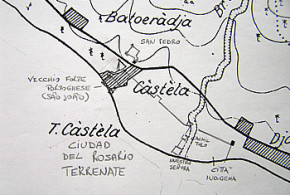
Shortly afterwards the conquest of Malacca, the Dutch, completed the Portuguese fort on the Ilha das Naus (called by them Red Island).

MUAR: a Portuguese fort in Malay Peninsula

The Portuguese had a second fort in Malay Peninsula, this fort was in Muar, and it now vanished.
Was built by Eredia in 1604 at the mouth of the Muar river. The fort was triangular with round ramparts.

An old map of the Portuguese fort in Muar.

An old map of the Portuguese fort in Muar.


PACEM-PASSUMAH: a Portuguese fort in Sumatra

The actual name should be Pueek ( 05.09N -97.13E ).
The fort was built in 1520/21, and its life was short, Gaspar Correia is positive (Lendas da India,Tomo II ,Parte II ,pp.795 : "...e puserão fogo á fortalesa,que tudo foy feito em cinza: o que foy em Maio de 1524."
The fort , was square with a wooden "tranqueira" (palisade) and was built near the seashore.

For information on Pacem my thanks to Nuno Rubim.

Books about Portuguese Malacca

A book on Portuguese Malacca community:  "Save our Portuguese Heritage Conference 95. Malacca."


Google
Web www.colonialvoyage.com